Crisis communication resources to help you protect your revenue, reputation, and brand.
Effective crisis communications when “it” hits the fan.

Our blog is filled with deep resources to help with your crisis communication needs. Whether you are writing a crisis communication plan, seeking the best media training tips, or digging for case studies on crisis situations, you’ll find it here. Our goal is to give you all of the public relations resources you need to protect your revenue, reputation, and brand.
For those of you who love DIY and taking on a challenge, we’ve worked really hard to give you a good road map to follow. However, sometimes the fastest option is to bring in a pro. If that’s the case, we’re fully vaccinated and we’re ready to meet your needs, anywhere and anytime.
If you need help with your crisis communications plan, we’re ready to help.
When you need media training for your spokespeople, give us a call.
Anytime your organization needs a great keynote for your conference, we’d value the opportunity to serve you.
We invite you to:
By Gerard Braud, CSP, Fellow IEC
Crisis communications surrounding Covid-19 has been difficult. Why is it that you can put a medical expert in front of the media and they have difficulty landing your crisis communications message?
Before reading this blog further, watch the INTRO to the video which describes the disclaimer, my personal bias, and my personal goal for putting out this message:
Now, imagine if a medical expert got on television and made the impassioned plea below: (Note, the entire plea is demonstrated in today’s video for training purposes.)
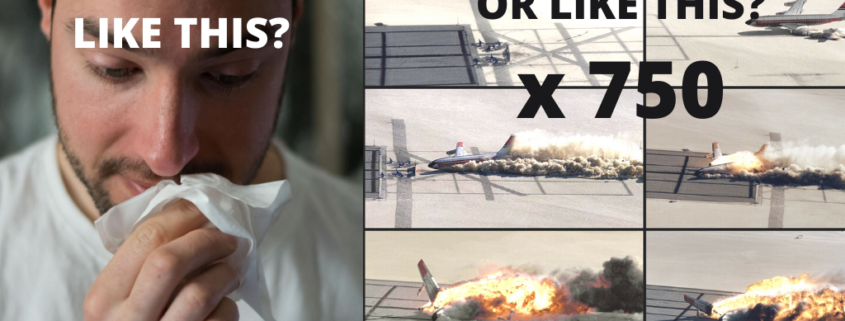
“The daily death toll from Covid-19 in the United States is like five Boeing 737 Max 8 jets crashing every day and killing everyone on board.
Think about this. Governments around the world were outraged that 346 people died in two crashes of 737 Max 8 jets. Governments and airlines banned the planes from flying because 346 people died.
Yet here we are, in the middle of a pandemic, and there is no outrage when the number of people who die each day in the United States is equal to five jets crashing each day.
The number of people who have died since the onset of the pandemic in the United States in March is equal to 750 jets crashing and killing everyone on board.
As a country, would we sit idly by if five jets crashed every day?
As a country, would we be outraged if 750 jets fell out of the sky and killed 150,000 U.S. Citizens?
We would not stand for it.
If terrorists shot down five jets every day in the United States and killed 1,000 people, would we not declare war?
If terrorists killed 150,000 U.S. Citizens over five months, would we not mobilize every bit of energy we have as a united nation to stop them from taking one more life?
So then why is it that we are okay with letting 1,000 U.S. Citizens die every day from a disease that we can fight and stop?
So then why is it that we are okay with letting 150,000 U.S. Citizens die in five months from a disease that we can fight and stop?”
©2020 Diversified Media, LLC
(…and scene.)
(Footnote: An Axios poll release while I am writing this says 30% of Americans believe the numbers I just used from the CDC are inflated.)
The opposing viewpoint has been effectively using the analogy that says:
“Covid-19 deaths are no different than the deaths we see every year from the common flu.”
The second analogy about the flu has stuck with about one-third of Americans, according to polls.
And I’ll add this point to number 3 — Those who have been selling their analogies better, have sold them as a dismissive message to an audience that is usually motivated by fear. In other words, people who are normally motivated and inspired by fear are being told, “You have nothing to fear.”

— Now before you start wondering if this blog is motivated by my politics, the answer is no. For more than 25 years I’ve worked to share crisis communications strategies with you and this is just one more lesson.
It should be noted, that in most crises, there are not two opposing arguments. For example, when a jet crashes and kills all 200 people on board, the President, members of Congress, Governors, and elected officials are not standing in front of the media saying,
“It’s just one jet. More people die every day from the flu than died in that airplane crash.”
So no, this is not a blog that takes sides on the issue because of politics. It is a blog about how to be effective in your crisis communications.
Where did my airplane crash analogy come from? Recently on a television news program, a doctor was trying to use the analogy, but he failed to land the analogy. The doctor failed because his delivery of the analogy lacked passion, fear, and outrage.
In conclusion:
We’ve watched the viral spread of the analogy that Covid-19 deaths are no different than the flu. Let’s watch to see if the analogy about the airline crash takes off.
Crisis communications and media training expert Gerard Braud, CSP, Fellow IEC is based in New Orleans. Organizations on five continents have relied on him to write their crisis communications plans and to train their spokespeople. He is the author of “Don’t Talk to the Media Until…”
More crisis communications articles:
Covid-19 Crisis Communications Webinar Recording
The Biggest Lie in Crisis Communications
4 Steps Every Company Needs to Take in Order to Avoid the Default Spokesperson

By Gerard Braud, CSP, Fellow IEC
Think of social media as a compass. A compass has 360 degrees or points on it. If you face one direction, the opposite direction is 180 degrees from you.
In social media, any time you take a position on a topic, you can be assured that someone else has an opinion 180 degrees away from you – or the exact opposite opinion. And for that much, if we keep with the compass analogy, if you were to put 360 social media participants in a virtual space, you can bet that no two feel exactly the same. Each has a different opinion, ranging from just one or two degrees off to being 180 degrees away – or feeling exactly the opposite of someone else. You can see some of the digital impact of #blacklivesmatter, #metoo, and other social justice hashtags on social media here.

The media loves to report what people think on social media. Rather than conducting a scientific poll to measure public opinion, television reporters and producers turn to Facebook and Twitter to report how people feel about any issue. This replaces a previous disturbing, sad trend of the “man on the street interview.” This is where a television reporter hopelessly stands on a street corner trying to get sound bites from random people, to fill a hole in a new story.
Years ago, stories would have run on the news and people would have voiced their opinions at the office water cooler, at the corner bar, or at the beauty parlor.
Social media is a virtual office water cooler, corner bar and beauty parlor all connected to the world’s largest amplifier.
Add to it that search engines and hashtags allow the amplification to be searched and then amplified through the television news media, which means the television media will tell you what people think.
Sadly, and with a degree of bias, the media tell you what they think the prevailing thoughts are, even though my compass analogy tells you that whatever one person thinks about one issue, someone else thinks something slightly or very different. For example, for each person who believes people must wear masks in public to prevent the spread of the Coronavirus, there is another person who believes they should not have to, or that the use of masks is not helpful to prevent the spread.
Social media is full of opinions. Many of us have heard a variety of quotes about opinions. They range from the mild, “Opinions are like Belly Buttons, everybody has one;” to the slightly more crude, “Opinions are like farts. Just because you have one doesn’t mean you have to let it out;” to the even more crude analogy I heard during my television news career, “Opinions are like assholes. Everybody has one and thinks that everyone else’s stinks.” (Google “Opinion Quotes” to see countless more.)
The sad reality is the media, for nearly 20 years, has laid inflammatory opinions out for the public to hear, just to fuel a degree of outrage, so that people keep talking about what they heard on the news and where they heard it. News Talk Radio pioneered it and I’d say Rush Limbaugh turned it into an ugly ratings bonanza, copied by local talk radio, which has then been copied by Fox News and CNN each time they assemble a group of pundits who scream at each other with opposing views.
First, you must be more aware than ever that you will be judged harshly by critics for any and everything done by your organization, its executives, and its employees. Your efforts at good news publicity will be condemned by naysayers. Your future crises will become the focal point for public hostility in social media. I predict that someday in the not too distant future, companies will go out of business simply because of public pressure on social media.
Long term, your company could see serious damage to both reputation and revenue because of social media pressure. You could be forced to apologize for harmless acts or actions that capture the ire of social media.
In conclusion, every corporation, non-profit organization and government agency, and the executives and employees of each, face tougher scrutiny than ever. The time is now to rethink your media relations, social media and crisis communications strategies. What got no attention in the past will be more amplified than ever in the most costly ways.
Rethinking your media relations, social media, and crisis communications strategies can be extremely difficult and time-consuming, so these videos can walk you through it. View 5 Steps to Effective Crisis Communications here.
Crisis communications and media training expert Gerard Braud, CSP, Fellow IEC is based in New Orleans. Organizations on five continents have relied on him to write their crisis communications plans and to train their spokespeople. He is the author of “Don’t Talk to the Media Until…”
More crisis communications articles:
Covid-19 Crisis Communications Webinar Recording
The Biggest Lie in Crisis Communications
4 Steps Every Company Needs to Take in Order to Avoid the Default Spokesperson
Photo by Thomas de LUZE on Unsplash

By Gerard Braud, CSP, Fellow IEC
In this year of crisis upon crisis, many brands have been stumped and confused as to how to address the Black Lives Matter #BLM movement and the associated social justice issues.
The Black Lives Matter movement has created some communications challenges that are in some ways unique, but in other ways, can be addressed using the 5 Steps to Effective Crisis Communications.
Consider these steps for addressing #BLM, and any other social or political issue in the future. Keep in mind, these suggestions are not based on how significant the issue may be, but rather on techniques for effective crisis communications.
1. Any activist movement or protest could affect your company if you are called upon to comment.
In the case of Black Lives Matter, your company or brand may have been called upon to make a statement of support.
But before you decide if you’ll say something and what that might be on this or any other social issues, we must consider Step 1 of the 5 Steps to Effective Communications, which is based on your Vulnerability Assessment. (I encourage you to watch this week’s video, where I go into more details than I will go into in this blog.)
Your Vulnerability Assessment is designed to assess situations that could affect your organization’s revenue, reputation, and brand.
Commenting on any social issue, political issue, or political figure, can have a positive or a negative effect on your organization’s revenue, reputation and brand.
Black Lives Matter is unique because a brand statement of support pleased some, while angered others. Sometimes the words of support even angered members of the #BLM moment, if not done to their standards.
For example, unique to this situation, some brands that voiced support were criticized because their support was not accompanied by tangible action. Watch the video for tangible examples.
2. Your Vulnerability Assessment has the ability to identify a situation that can actually lead to corporate policy, which will also shape your future response and behavior.
You should have a frank discussion and establish policy about whether your brand does or does not comment on social issues, political issues, or candidates. If your brand’s position is that you never comment on such issues, when asked to do so, you need to have a statement ready that explains your corporate policy.
If you do speak in favor of an issue, policy or candidate, be ready for how it affects your brand. Home Depot reportedly has a policy not to comment or support, but reportedly their co-founder donates heavily to a presidential candidate, causing shoppers to go to Lowes if they don’t like the supported candidate.
Goya Foods is facing a boycott after its CEO praised the President at a White House Event.
3. Also, consider whether action by your brand is part of your corporate policy.
At the height of the #BLM protests, many protesters criticized brands that offered verbal support, asking, “So what are you going to do about it?”
Some organizations have taken the pro-active step of establishing various funds for various causes, such as social justice, women’s issues, LGBTQ issues, and more. Additionally, they establish committees of employees who have a say in how, when, and to whom the funds are given.
In conclusion, let me make two points. First, I’m not telling you which approach is best for your brand. That needs to be decided based on your Vulnerability Assessment. Secondly, throughout your career, you will face many watershed moments and face many significant issues. As a brand, you should never be surprised and you should always be prepared.
To have a confidential conversation or to schedule a Virtual Vulnerability Assessment, please use this link.
Crisis communications and media training expert Gerard Braud, CSP, Fellow IEC is based in New Orleans. Organizations on five continents have relied on him to write their crisis communications plans and to train their spokespeople. He is the author of “Don’t Talk to the Media Until…”
More crisis communications articles:
Covid-19 Crisis Communications Webinar Recording
The Biggest Lie in Crisis Communications
4 Steps Every Company Needs to Take in Order to Avoid the Default Spokesperson

By Gerard Braud
What do you think about the riots, protests, political unrest, all during the pandemic?
Before you verbalize your answer, think not just about your answer to the question, but also the impact your answer could have on the reputation and revenue of your business. This is especially true for those of you who are in businesses that involve face to face contact with customers. While it is true that society needs to have discussions about the important issues of the day, what degree of caution should you consider in voicing a strong opinion to a customer who strikes up a conversation with you? And, what should be the guidelines for you or your employees when you consider whether it is appropriate to strike up a conversation with a customer?
Years ago, I proposed a similar question, “What do you think of the protests going on in Baltimore?” The same crisis communications principles, and this same video interview recorded with a colleague rings true years later.
Anastasia Turchetta is a Registered Dental Hygienist and host of Hump Day Happenings, a video blog for the dental industry. Here is our conversation regarding how to handle talking about such crises in the workplace:
Small business owners, such as her dental clients are faced with two situations when top news breaks. Situation one is that a customer may initiate a discussion about the controversial issues of the day. Situation two is that the business owner or their employees initiate a discussion.
1) Is this the right time and place to talk about these important issues?
2) Could the conversation result in the customer getting angry and taking their business somewhere else?
3) Is that a risk you are willing to take?
4) What advice should be given to business owners and their employees?
If an event affects your reputation and revenue, a crisis exists, in some degree. If customers elect to buy goods or services from someone else because they feel slighted by your business, then you have an emerging crisis.
In the video blog, Anastasia reminds us of what many of us were taught by our parents, which is to never talk about religion and politics.
In addition to the decision you make about having controversial conversations with your customers in person, you must also think about the personal opinions a business owner and their employees post to social media. Be especially aware of those employees who have accepted friend requests from customers.
Each employer, whenever there are hot button issues in the news, should consider what they should say to their employees face to face, as well as on social media.
If you are passionate about the issues of the day, seek out the proper venue or community group to enact change. But consider carefully how your personal opinions and those of your employees will affect your livelihood, revenue, and business.
I personally know of many case studies in which entertainers, celebrities and business owners have been put out of business and lost all they owned because of how and where they voiced their opinions. Consider what price you are willing to pay.
Crisis communications and media training expert Gerard Braud, CSP, Fellow IEC is based in New Orleans. Organizations on five continents have relied on him to write their crisis communications plans and to train their spokespeople. He is the author of “Don’t Talk to the Media Until…”
More crisis communications articles:
Covid-19 Crisis Communications Webinar Recording
The Biggest Lie in Crisis Communications
4 Steps Every Company Needs to Take in Order to Avoid the Default Spokesperson

Here we are entering the middle of summer, where we can reflect on and learn from the unprecedented crises that have taken place in the past few months. As the crises unfolded, I wrote about how you can communicate more effectively in these various situations. Let’s look back at where we’ve been this Spring, and examine what rings true for crisis communications, corporate communications, and protecting your revenue, reputation, and brand today.
At the first signs of the Coronavirus, in this blog, I warned companies to get professional media training and to assess the vulnerabilities of their particular organization. I explained that by preparing for the crisis, you could show your executive leadership team you are thinking ahead and thinking on their behalf. Watch the video here:
As the pandemic unfolded I advised in this blog that the answer is YES, you do NEED a crisis communications plan for COVID-19 and other vulnerabilities, and provided 5 steps to write a crisis plan:
I continued to provide update after update, even discussing how to do virtual media interviews, since they were suddenly a MUST, and we all needed to learn to adapt and communicate in a new way.
Finally, I addressed the truth that no one wanted to address. I predicted this pandemic would likely last through the summer, and it became clear that we would not only need to manage the Coronavirus, but we would also need to manage Coronavirus + Tornado (that later ripped through my hometown), or Coronavirus + Weather Events as we entered hurricane season (we were hit later by Cristobal), AND the crises that our organizations are always vulnerable to – such as explosions, fires, power outages, crime, social media firestorms, and more. You can read the blog here.
In this blog in May, I warned that the issue of wearing masks vs. not wearing masks could spur on political issues, protests, and outrage among our country.
As protests took over our country, I was quiet. Social media and the internet was too noisy, too complicated, and too hostile for a time. The point now is not to say “I told you so,” but to acknowledge that when one crisis hits, we have to be prepared, and that we have to prepare for all of the regular challenges and crises that can occur in addition to that initial crisis.
Hopefully, by reflecting on the last few months, you are more motivated now than ever to prepare. You have work to do. It’s challenging to write a crisis communications plan. It’s challenging to think about such tragic events that could happen to your company. But as we can see, they do happen, they can last for months, and they can pile on top of each other.
I’ve broken down
1. Start with analyzing the vulnerabilities of your company to certain crises.
2. Write a thorough crisis plan that addresses and outlines every last detail.
3. Write pre-written news releases that you can deliver to the media and the public in less than one hour.
4. Have your spokespeople and your leadership team professionally media trained.
5. Conduct realistic crisis drills.
This can all be done virtually, and I’m here to help.
This 5-part video series outlining the 5 Steps to a Crisis Communications Plan can make your path easier. Schedule a call with me so that I can walk you through it or answer any questions you might have.
Crisis communications and media training expert Gerard Braud, CSP, Fellow IEC is based in New Orleans. Organizations on five continents have relied on him to write their crisis communications plans and to train their spokespeople. He is the author of “Don’t Talk to the Media Until…”
More crisis communications articles:
Covid-19 Crisis Communications Webinar Recording
The Biggest Lie in Crisis Communications
4 Steps Every Company Needs to Take in Order to Avoid the Default Spokesperson
