Crisis communication resources to help you protect your revenue, reputation, and brand.
Effective crisis communications when “it” hits the fan.

Our blog is filled with deep resources to help with your crisis communication needs. Whether you are writing a crisis communication plan, seeking the best media training tips, or digging for case studies on crisis situations, you’ll find it here. Our goal is to give you all of the public relations resources you need to protect your revenue, reputation, and brand.
For those of you who love DIY and taking on a challenge, we’ve worked really hard to give you a good road map to follow. However, sometimes the fastest option is to bring in a pro. If that’s the case, we’re fully vaccinated and we’re ready to meet your needs, anywhere and anytime.
If you need help with your crisis communications plan, we’re ready to help.
When you need media training for your spokespeople, give us a call.
Anytime your organization needs a great keynote for your conference, we’d value the opportunity to serve you.
We invite you to:

By Gerard Braud, CSP, Fellow IEC
The COVID-19 coronavirus crisis has spawned new aspects of crisis communications and media interviews. Behold, the social distancing media interview done from your computer in your home.
What do you think about these interviews?
Share them via:
@gbraud on Twitter
Gerard Braud on LinkedIn
The BraudCast on YouTube
Braud Communications on Facebook
After you share your observations, I’ll share them back with our community so you’ll be better prepared if you or one of your team members is called upon to do a television interview via your computer from home.
Should you need in-depth training, we can provide you with remote media training for remote interviews as well as train-the-trainer remote training so you can coach your executives and subject matter experts. To learn more, schedule a call: https://calendly.com/braud/15min
Many of the techniques you have learned in traditional media training still apply. Yet, at the same time, there are some clear distinctions and additional burdens. Think of it this way: In a traditional television interview, the news crew is responsible for things you never need to think about, such as:
Whereas you traditionally needed to focus on:
Suddenly, you have to do both your job and their job.
It isn’t easy. I’ll work on a checklist for all of you, but by all means, if you need professional training we’re here to be your training partner.
Crisis communications and media training expert Gerard Braud, CSP, Fellow IEC is based in New Orleans. Organizations on five continents have relied on him to write their crisis communications plans and to train their spokespeople. He is the author of “Don’t Talk to the Media Until…”
More crisis communications articles:
How to Use Social Media for Crisis Communications
The Biggest Lie in Crisis Communications
4 Steps Every Company Needs to Take in Order to Avoid the Default Spokesperson
Photo by Sam McGhee on Unsplash

By Gerard Braud, CSP, Fellow IEC
In crisis communication, the burden is shared between your leadership team and your communications team, to give clear directives to your employees, your customers, your stakeholders, and the media.
Nothing undermines the credibility of a leader during a crisis more than when their actions don’t match their words.
Be congruent. Your actions must match your words.
For example, don’t call a news conference about the coronavirus to tell your audience that social distancing requires people to be six feet apart, when in fact, you are standing shoulder to shoulder with 10 people on the stage with you. That’s not being congruent. You are sending a mixed message and the cynics are going to call it out.
Don’t tell your audience not to shake hands, yet you shake hands. That’s not being congruent.
A perfect example of congruency can be seen in the media, where news anchors are distancing themselves within a news studio. That’s being congruent.
Leaders should be mindful of the proliferation of social media and cell phone cameras. As soon as you behave in a way that lacks congruency, someone will capture you in the act and publicize it. Don’t make your crisis worse by letting your bad actions overshadow your good message. Don’t create a secondary crisis because of your own bad behavior, poor judgment, or lack of congruency.
Leaders are often taught to catch their employees doing something right so praise can be given, rather than catching an employee doing something wrong so that criticism is given. As a leader, you need to lead in actions and in words. We want to catch you doing something right.
In times of crisis, people want to trust the leaders of their companies and their communities. A crisis, as we pointed out in yesterday’s blog, can really highlight who is a true leader and who is a fake leader.
Leadership is never based on one’s title; it’s based on one’s behavior.
Crisis communications and media training expert Gerard Braud, CSP, Fellow IEC is based in New Orleans. Organizations on five continents have relied on him to write their crisis communications plans and to train their spokespeople. He is the author of “Don’t Talk to the Media Until…”
More crisis communications articles:
How to Use Social Media for Crisis Communications
The Biggest Lie in Crisis Communications
4 Steps Every Company Needs to Take in Order to Avoid the Default Spokesperson
By Gerard Braud, CSP, Fellow IEC
We’ll be putting a date on all of our crisis communication updates as it relates to COVID-19 and coronavirus. Our goal is to provide expert crisis communication tips, and while some of it is evergreen, some of our advice is based on the crisis events of the day as we enter a world that changes by the minute.
Today’s advice is evergreen. Back in 2005, Hurricane Katrina devastated my hometown of New Orleans. The economy came to an immediate standstill. Everyone’s life was violently disrupted.
At the time, I was very angry, because I had predicted the effects of Katrina in 1989; I had warned of it. Some communities in the metro area, to my pleasure, headed the warning and prepared for the crisis. New Orleans, as a city, did not.
COVID-19 is exactly the same.
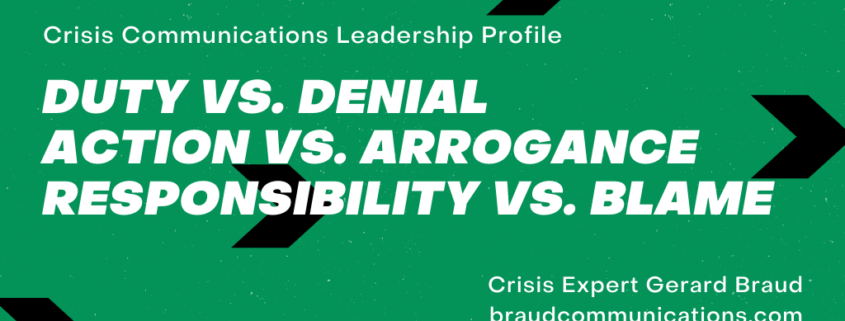
During those dark days after Hurricane Katrina, I developed a Crisis Communications Leadership Profile. It was true then and it is true today.
Look around you in the organization where you work. Gravitate and work with those who “get it.” Distance yourself from those who don’t get it.
Gravitate to those who believe in planning and executing their plans, which is their duty and which requires action. When done correctly, your employees and customers or constituents will hear your communications and therefore be equipped to be responsible.
This will not be over quickly. My prediction is that you are looking at 90 days of life discomforts on the low end, but more than likely 120 to 150 days of disruption on the practical side of things.
Your task is to communicate clearly, effectively, and frequently so everyone in your stakeholder group knows what they can expect day by day, week by week, and month by month.
As always, if I can be of further assistance, please reach out to me. Use this link to schedule a call https://calendly.com/braud/15min
Crisis communications and media training expert Gerard Braud, CSP, Fellow IEC is based in New Orleans. Organizations on five continents have relied on him to write their crisis communications plans and to train their spokespeople. He is the author of “Don’t Talk to the Media Until…”
More crisis communications articles:
How to Use Social Media for Crisis Communications
The Biggest Lie in Crisis Communications
4 Steps Every Company Needs to Take in Order to Avoid the Default Spokesperson

By Gerard Braud, CSP, Fellow IEC
While many companies and brands are responding and communicating about the coronavirus (Covid 19), other individuals are questioning whether coronavirus fears are being blown out of proportion.
The best crisis communications tip I can give you is as simple as A-B-C:
In the grand scheme, it doesn’t matter if you, personally think things are being blown out of proportion or not.
What matters is that you are managing the expectations of your employees, your customers, and your stakeholders.
And because things change on a daily basis, you must be prepared to communicate constantly. In other words – Always Be Communicating.
When you manage expectations, you manage, mitigate, or eliminate fear.
You and your organization will be affected in some way. How severe the effect is can depend upon how effectively and how frequently you communicate.
Take your audience away from worry and take them to a place of informed decision-making.
Crisis communications and media training expert Gerard Braud, CSP, Fellow IEC is based in New Orleans. Organizations on five continents have relied on him to write their crisis communications plans and to train their spokespeople. He is the author of “Don’t Talk to the Media Until…”
More crisis communications articles:
How to Use Social Media for Crisis Communications
The Biggest Lie in Crisis Communications
4 Steps Every Company Needs to Take in Order to Avoid the Default Spokesperson
Photo by Macau Photo Agency on Unsplash

By Gerard Braud, CSP, Fellow IEC
Coronavirus is spreading and if you are in public relations, emergency management, or business continuity, you need to be preparing and using your crisis communications tools.
Those are the two questions I have been asked the most in the past week.
In the 5 Steps to Effective Crisis Communications,
I’ve long defined a crisis as any event that affects an organization’s revenue, reputation and brand. As evidenced by the stock market, coronavirus checks all of the boxes.
Should you need to do this all quickly, I have some great turnkey options ready for you to use. Use this link to schedule a free, private call https://calendly.com/braud/15min
Crisis communications and media training expert Gerard Braud, CSP, Fellow IEC is based in New Orleans. Organizations on five continents have relied on him to write their crisis communications plans and to train their spokespeople. He is the author of “Don’t Talk to the Media Until…”
More crisis communications articles:
How to Use Social Media for Crisis Communications
The Biggest Lie in Crisis Communications
4 Steps Every Company Needs to Take in Order to Avoid the Default Spokesperson

By Gerard Braud, CSP, Fellow IEC

Cyber threats, cyber hacks, denial of service attacks, and cyber ransom events should be one of the top things you focus on when it comes to crisis communications and the Five Steps to Effective Crisis Communications system.
Each one of these has the ability to damage your organization’s revenue, reputation, and brand. Each of my crisis communication plans have up to six pre-written news releases designed to address the various types of cyber threats and attacks. I have sent out three new updates to my clients since January.
Cyber issues have generated the greatest number of calls I have received in the past 12 months from organizations that want to update their crisis communications plan and crisis communications strategies. Cyber issues are a perfect example of the types of issues you should discuss during Step 1 of Effective Crisis Communications, which is your quarterly Vulnerability Assessment. The nature of cyber threats changes daily as hackers adopt new methods to take your system down.
Daily, there are news stories about cities, counties, and states that cannot function because hackers have taken over their system. Daily there are stories of companies that get hacked and can’t serve their customers until their systems are back up. Massive class action lawsuits happen when an organization loses control of personal information.
What goes unreported is that many of these organizations have not spent the money needed to keep their systems safe, which means they are spending a small fortune to try to recover their systems.
Most hackers are happy to restore your system for you, if you simply pay a ransom. The hackers are wise enough to request an amount of money that is less than the cost of losing business or paying experts to restore your system and end your cyber crisis.
This requires organizations to have a discussion about both cyber insurance and whether or not you would pay a ransom. As a policy, most organizations will firmly say they don’t pay ransoms because they fear the hackers will attack a second time. But the reality is, many cyber insurance companies will pay the ransom because it costs less than to manually restore a system. Trust me – the hackers know this.
If you follow the Five Steps to Effective Crisis Communications,
If you need to schedule a free strategy call or if you need ask about any of the Five Steps to Effective Crisis Communications, please use this link to schedule a free 15 minute strategy call with me.
Crisis communications and media training expert Gerard Braud, CSP, Fellow IEC is based in New Orleans. Organizations on five continents have relied on him to write their crisis communications plans and to train their spokespeople. He is the author of “Don’t Talk to the Media Until…”
More crisis communications articles:
How to Use Social Media for Crisis Communications
The Biggest Lie in Crisis Communications
4 Steps Every Company Needs to Take in Order to Avoid the Default Spokesperson
Photo by Icons8 Team on Unsplash