Crisis communication resources to help you protect your revenue, reputation, and brand.
Effective crisis communications when “it” hits the fan.

Our blog is filled with deep resources to help with your crisis communication needs. Whether you are writing a crisis communication plan, seeking the best media training tips, or digging for case studies on crisis situations, you’ll find it here. Our goal is to give you all of the public relations resources you need to protect your revenue, reputation, and brand.
For those of you who love DIY and taking on a challenge, we’ve worked really hard to give you a good road map to follow. However, sometimes the fastest option is to bring in a pro. If that’s the case, we’re fully vaccinated and we’re ready to meet your needs, anywhere and anytime.
If you need help with your crisis communications plan, we’re ready to help.
When you need media training for your spokespeople, give us a call.
Anytime your organization needs a great keynote for your conference, we’d value the opportunity to serve you.
We invite you to:
By Gerard Braud, CSP, Fellow IEC
Reopening after Covid-19 requires expert crisis communications on your part. Not because you have a crisis, but because this situation could rise to the level of a crisis. So today we share four tips as America reopens in phases.
As I write this, various states and communities in the United States are implementing various forms of reopening, after closures for Covid-19. This could go well or this could go badly for you, so proceed with caution.
Things are not going back to normal. This is a transition. If you require face masks and gloves for either your employees or your customers, make sure the rules are clear and that you have procedures and policies in place to enforce those rules.
My expectation is that some of you may see fights or acts of violence between the rule-followers and the non-rule-followers.
In your communications with customers and employees, avoid making absolute statements, such as, “We guarantee the highest level of safety.” You can’t guarantee anything in a world where you cannot control all of the variables.
Instead, opt for statements that use the word “goal.” For example, “Our goal is to offer a clean and safe environment for all of our employees and customers.” The nuance of your wording matters.
Consider if things go wrong as you reopen and you become the hub of the next cluster of Covid-19. Is it worth it?
Businesses that are not on stable ground financially are desperate to re-open, which can cause business owners to do what they think is best in the short-term rather what is best in the long-term. Some business owners will say, “I am reopening for people. My employees need money.”
Yes, but when we say people, it must be best for your employees, your customers and your community. If you re-open and infect customers or contribute to an outbreak in your community, you have failed to make the correct choice. The negative attention you will receive in the media will damage your reputation, revenue, and brand.
Furthermore, if you have a new cluster, will you be forced to shut down again? How long will you be shut down? Will you end up worse off than if you had proceeded down a different path?
There is no one right answer that covers all types of businesses.
If I reopen, and my actions result in the death of an employee or customer, will I be able to live with my decision and myself?
The burden is heavy. The consequences may be heavier.
Crisis communications and media training expert Gerard Braud, CSP, Fellow IEC is based in New Orleans. Organizations on five continents have relied on him to write their crisis communications plans and to train their spokespeople. He is the author of “Don’t Talk to the Media Until…”
More crisis communications articles:
Covid-19 Crisis Communications Webinar Recording
The Biggest Lie in Crisis Communications
4 Steps Every Company Needs to Take in Order to Avoid the Default Spokesperson

By Gerard Braud, CSP, Fellow IEC
We raise a glass and present our first ever COVID-19 Crisis Communications Award to the team at Lysol. After the president asked doctors at a news conference if products like Lysol could be consumed orally or as an injection, the Lysol team was fast to respond with this statement:
“Due to recent speculation and social media activity, RB (the makers of Lysol and Dettol) has been asked whether internal administration of disinfectants may be appropriate for investigation or use as a treatment for coronavirus (SARS-CoV-2).
As a global leader in health and hygiene products, we must be clear that under no circumstance should our disinfectant products be administered into the human body (through injection, ingestion, or any other route). As with all products, our disinfectant and hygiene products should only be used as intended and in line with usage guidelines. Please read the label and safety information.
We have a responsibility in providing consumers with access to accurate, up-to-date information as advised by leading public health experts. For this and other myth-busting facts, please visit Covid-19facts.com.”
What is your takeaway on this? Three things…
In the 5-Steps to Effective Crisis Communications, you are encouraged to conduct frequent Vulnerability Assessments. Based on the kinds of things the president may say on any given day at his coronavirus briefings, you need to add “Rumors & Speculation” to your vulnerability list as your first take-away.
You also need to prepare a pre-written news release for Rumors & Speculation. Add this to your library of pre-written news releases.
You now need to designate a member of your team to watch the daily White House briefings because there is no telling when your brand or company might get mentioned in a positive or negative way.
As we discussed last week, you cannot focus all of your crisis efforts on just COVID-19. You must think COVID + X. For Lysol, it was COVID + Presidential Speculation.
What made the task of responding even harder is that in our politically divided country, people are either all Trump or never Trump. Lysol, had to walk on eggshells to avoid damage to their revenue, reputation, and brand by being forced to issue a crisis statement that attempted not to anger Trump supporters. (I’m having to walk on eggshells myself, just to write a blog about this.)
Lysol wins their award for dancing around the land mines while also being fast to respond.
Wouldn’t you love to be a fly on the wall at Lysol when this went down?
Be well and be prepared. We live in strange times.
Crisis communications and media training expert Gerard Braud, CSP, Fellow IEC is based in New Orleans. Organizations on five continents have relied on him to write their crisis communications plans and to train their spokespeople. He is the author of “Don’t Talk to the Media Until…”
More crisis communications articles:
Covid-19 Crisis Communications Webinar Recording
The Biggest Lie in Crisis Communications
4 Steps Every Company Needs to Take in Order to Avoid the Default Spokesperson

By Gerard Braud, CSP, Fellow IEC
We’re all more than a month deep into various forms of crisis communications for COVID-19. So, how much worse could it get? Let’s talk frankly about that.
You are exhausted.
Oh yea, and don’t forget the flood, the tornado, the hurricane, the chemical release, the fire, the explosion, and the power outage.
Wait, what?
“No!” you say. “I already have a crisis. I’m dealing with the COVID-19 crisis. That’s my crisis.”
Reality check. That’s one of your crises.
Amid the exhaustion around COVID-19, you must avoid the myopic belief that you have somehow been given permission to focus only on one crisis at a time. The hardcore truth is, you must be ready for more.
When you apply the 5-Steps to Effective Crisis Communications strategy, you see there is work that still must be done to prepare for a compound crisis.
You must multitask and keep your teams focused on the reality and the possibilities of “What else?”
As always, if you need help with any of your 5-Step process, reach out. You can use this link to schedule a free 15-minute call.
The reality is that COVID-19 may seem overwhelming. But don’t get caught in the trap of thinking that you can put everything else on the shelf until COVID-19 has passed.
Crisis communications and media training expert Gerard Braud, CSP, Fellow IEC is based in New Orleans. Organizations on five continents have relied on him to write their crisis communications plans and to train their spokespeople. He is the author of “Don’t Talk to the Media Until…”
More crisis communications articles:
Covid-19 Crisis Communications Webinar Recording
The Biggest Lie in Crisis Communications
4 Steps Every Company Needs to Take in Order to Avoid the Default Spokesperson
By Gerard Braud, CSP, Fellow IEC
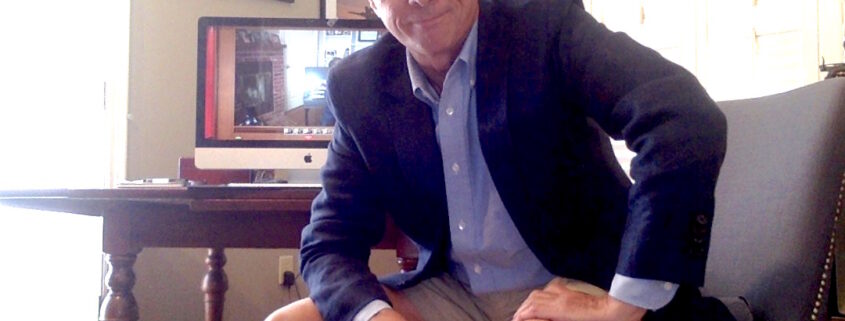
The number of remote media interviews, online interviews, Zoom interviews, and the like have skyrocketed in the past few weeks. In last week’s video, I asked you, who is doing them well? How is the quality of the videos?
Well, today I am providing you with expert media training strategies to help you look professional, organized, and credible as a source for your media interview.
If lighting, camera angles, technology, and wardrobe stress you out (and rightfully so), this video can help you be a video producer in your own home office or other remote location.
Crisis communications and media training expert Gerard Braud, CSP, Fellow IEC is based in New Orleans. Organizations on five continents have relied on him to write their crisis communications plans and to train their spokespeople. He is the author of “Don’t Talk to the Media Until…”
More crisis communications articles:
Covid-19 Crisis Communications Webinar Recording
The Biggest Lie in Crisis Communications
4 Steps Every Company Needs to Take in Order to Avoid the Default Spokesperson
By Gerard Braud, CSP, Fellow IEC
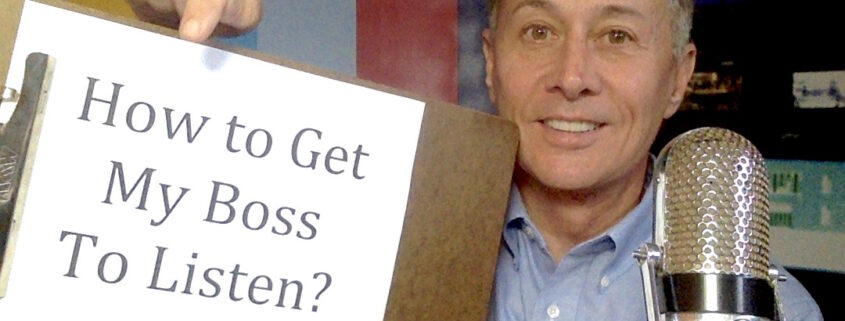
Many communicators and public relations practitioners share the same struggle right now, and it isn’t just the COVID-19 coronavirus pandemic itself. The problem they face is fighting an uphill battle against a boss who won’t communicate, despite professional advice to communicate more effectively than ever before.
As a communication expert, you know that employees and customers need updates to address the uncertainties.
And therein lies the problem.
Because facts are not always known in these uncertain times, many executives feel paralyzed. They fear making a proclamation that is incorrect or that they have to walk back. Good. You should have that fear. Others fear giving false hope. Good. Don’t give false hope.
Some are paralyzed because they fear having to deliver bad news, such as layoffs or closing a business.
There is an answer. You should issue communications that clearly says,
These are uncertain times. We know you are looking for answers. We want answers too. But there are so many events that are beyond our control that we simply are not able to give you those answers, because we don’t know what they are.
You see, sometimes the best option is to simply state the obvious. Express that you understand the pain, problem, and predicament. Express that you are looking for answers and when you get them you will share them.
A little communication that states the truth, is better than no communications because of uncertainty.
Those of us who practice crisis communications have long observed the problem of executives who fail to engage in crisis communications. Several frustrated communicators asked about it during a webinar I taught last week with my colleague Bill Coletti at Kith. (You can listen to the full replay here)
Let me go a little deeper on this issue.
This may come as a surprise to you, but a crisis doesn’t make an executive want to prepare or respond in the way you would expect. It’s really hard to explain. It goes against conventional wisdom. You would think that everyone would be jumping on board with best practices and seeking out a top crisis communication expert.
A few will. Most won’t.
Those who won’t communicate suffer from simply having a personality type that causes decision paralysis. Others simply don’t “get it.” They have never been taught that communications has a value.
Start with Step 1 of the 5-Steps to Effective Crisis Communications, which is to create a Vulnerability Assessment.
In the webinar, we also talked about the concept of making a list. On one side you list all the reasons not to communicate and on the other side, you list all of the reasons to communicate.
The struggle is real.
The problem of the boss who won’t communicate is nothing new and sadly COVID-19 won’t change it.
Crisis communications and media training expert Gerard Braud, CSP, Fellow IEC is based in New Orleans. Organizations on five continents have relied on him to write their crisis communications plans and to train their spokespeople. He is the author of “Don’t Talk to the Media Until…”
More crisis communications articles:
Covid-19 Crisis Communications Webinar Recording
The Biggest Lie in Crisis Communications
4 Steps Every Company Needs to Take in Order to Avoid the Default Spokesperson
By Gerard Braud, CSP, Fellow IEC
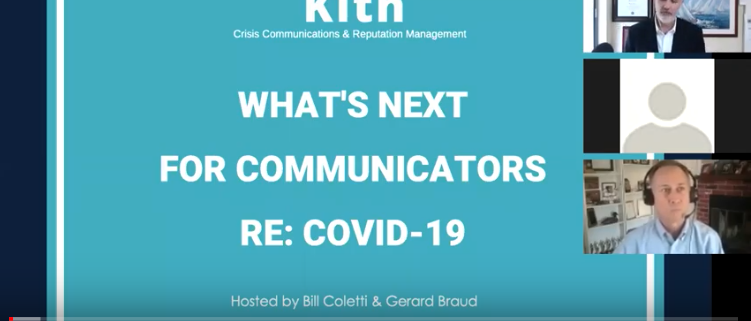
Crisis experts Bill Coletti and Gerard Braud share their insights and top recommendations on “what’s next” and what to do in this very uncertain phase between shutting down and re-opening for business.
In addition to the webinar recording, please feel free to share the Slide deck with your colleagues.
Hopefully, the insights and recommendations shared will be helpful to you and your teams in this difficult time.
Crisis communications and media training expert Gerard Braud, CSP, Fellow IEC is based in New Orleans. Organizations on five continents have relied on him to write their crisis communications plans and to train their spokespeople. He is the author of “Don’t Talk to the Media Until…”
More crisis communications articles:
How to Use Social Media for Crisis Communications
The Biggest Lie in Crisis Communications
4 Steps Every Company Needs to Take in Order to Avoid the Default Spokesperson