Crisis communication resources to help you protect your revenue, reputation, and brand.
Effective crisis communications when “it” hits the fan.

Our blog is filled with deep resources to help with your crisis communication needs. Whether you are writing a crisis communication plan, seeking the best media training tips, or digging for case studies on crisis situations, you’ll find it here. Our goal is to give you all of the public relations resources you need to protect your revenue, reputation, and brand.
For those of you who love DIY and taking on a challenge, we’ve worked really hard to give you a good road map to follow. However, sometimes the fastest option is to bring in a pro. If that’s the case, we’re fully vaccinated and we’re ready to meet your needs, anywhere and anytime.
If you need help with your crisis communications plan, we’re ready to help.
When you need media training for your spokespeople, give us a call.
Anytime your organization needs a great keynote for your conference, we’d value the opportunity to serve you.
We invite you to:
By Gerard Braud, CSP, Fellow IEC
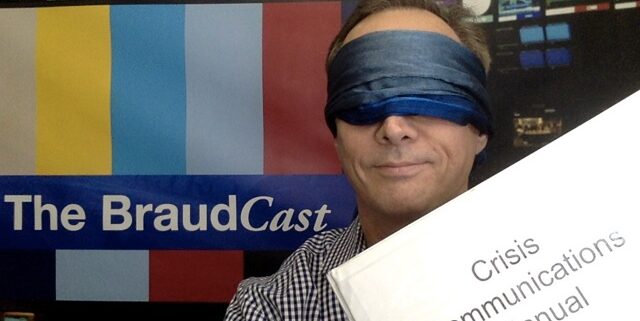
We decided to have some fun today and create our own version of the Bird Box Challenge.
If you’ve watched Bird Box, you’ll get it.
If you love Sandra Bullock’s opening monologue, you’ll get it.
If you’ve followed the Bird Box Challenge craze, you’ll get it.
If you haven’t, well then I’ll just look stupid to you.
I’ve managed to capture all of the basic tenants of my crisis communications plan philosophy in only 20 seconds, while also channeling Sandra Bullock’s rage as she talks to the characters “boy” and “girl.”
But on a serious note, if you want to learn more about the 5-Steps to Effective Crisis Communications, use this link to sign up for our free 5-part video series.
Oh, and you can look at the videos. No blindfolds needed. You won’t get hurt.
Crisis communications and media training expert Gerard Braud, CSP, Fellow IEC is based in New Orleans. Organizations on five continents have relied on him to write their crisis communications plans and to train their spokespeople. He is the author of “Don’t Talk to the Media Until…”
More crisis communications articles:
Please Pick Me to be Your Media Trainer
The Biggest Lie in Crisis Communications
4 Steps Every Company Needs to Take in Order to Avoid the Default Spokesperson
By Gerard Braud
The poem, Twas the Night Before Christmas, is only 56 lines long. As writing goes, it’s pretty perfect. But we all know there are people where you work, who feel compelled to make edits, no matter how perfect your writing is. Maybe it’s the CEO or CFO, or an engineer, IT guy, accountant, doctor, or even the lawyer. Sure, they just want it to be more accurate and legally correct. But are all of those edits really necessary?
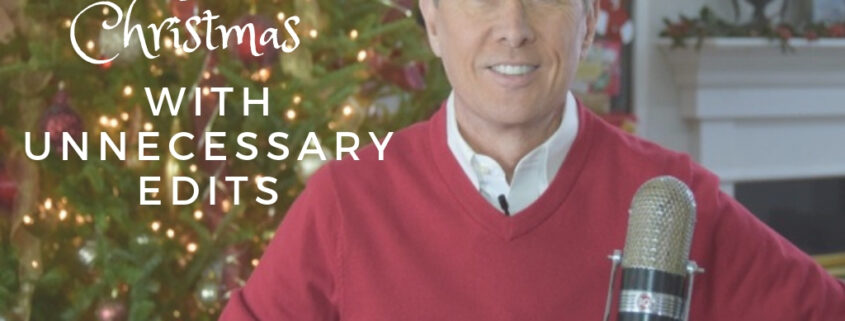
So for those of you who feel compelled to make edits, and to those of you who have been victimized by a red pen, I offer to you this special version of the poem, with edits. ©2018
Twas the Night Before Christmas With Edits
Twas the nocturnal period preceding the annual Christian festival, when throughout the domicile
No one of consequence was moving, including the rodents
Long socks receptacles were suspended near the thermal unit, with safety as a top priority
in expectation that a legendary Christian Bishop, born in the region of modern day Turkey, in or about 280 A.D., who was later Canonized by the Pope, would arrive post-haste
The humans below the legal age of majority, were reclined comfortably within their sleeping apparatuses
While apparitions of dehydrated fruit, filled their subconscious
And the maternal figure donning a headscarf, and I, in a consensual relationship, did likewise
Had just reached a state of extended hibernation
When in an external grassy zone, a ruckus occurred
I spontaneously ejected myself from my sleeping device, to evaluate the situation
Away to an opening in the wall I expedited myself
With vigor, I forcefully opened a set of protective panels
The satellite of the earth unified with the flakes of ice crystals
Gave the reflective quality of noon, to objects below
When, while visibly curious there appeared
A smaller than common vehicle of transport and eight proportional deer, common to subarctic regions
With a demure heavy equipment operator, so agile and prompt
I surmise instantly that it must be the aforementioned Saint
More rapid than birds of prey, the mammals came
And he exuded a high-pitched sound, then proclaimed their given names
You may Google the historic names if necessary, since corporate policy prohibits us from releasing names without consent… and because some of the names imply behavior that may be deemed as inappropriate or suggestive, and not in keeping with our policies regarding sexual harassment in the workplace
To the top of covered shelter protecting the entrance to our domicile
To the top of the vertical structure supporting the inner and outer cladding
Now run or travel somewhere in a great hurry, bolt, and/or gallop
As foliage void of moisture within a tropical cyclone, having winds exceeding 74 miles per hour
When they encountered structures that hindered forward progress, they accelerating upward
So up to the structure’s ridgeline the beast maneuvered
With the vehicle at capacity with objects of play; and the Bishop inside as well
And then like chimes, I heard on the ridgeline
The exaggerated movement, and clatter of horny feet
As I extracted my head from the framed opening, and was moving in a circular motion
Down the vertical channel for combustion gases, came the Saint, with great haste, void of OSHA required protective gear
His wardrobe consisted of natural mammal pets with hair still attached, covering his entirety, much to the protest of certain animal rights activist
The garments were discolored with combustion residue
A sum of replicas were suspended to the rear of his torso
And like a merchant of goods, he displayed all of his wares
His visual organs – how they reflected the light
His facial indentions exhibited great joy
His face just below his eye socket, was reminiscent of blooming thorn-filled plants; his nostril area like ripe, round fruit
His pursed lips, they provoked such dry amusement
And his unshaven facial hair was similar in color to the crystalized precipitation
The extension of a tobacco burning device was clinched within the enamel-coated structures of his jaw
And cancer causing carbon particles were visible in a circular shape
His facial structure was wider than it was tall
His spherical abdominal region
Vibrated upon guffaw, resembling a food basin at capacity with sweet, semisolid preserve
His weight-to-height ratio was disproportionate; while he correctly personified a character portrayed in a seasonal holiday movie classic starring Will Ferrell
And there was humor in his antics, despite my presence
A non-flirtatious closing one eye, and a rotation of his neck
Soon indicated he was friend and not foe and therefore there was no need to seek outside mutual aid
He remained silent and demonstrated a commendable work ethic
And he filled the long sock receptacles; then made a quick, sudden movement
And he placed his index digit beside his nostril trunk
And with acknowledgement, he ascended the combustion chamber vent
He extradited himself to his transport, then repeated the high-pitched sound
And away the individual and his mammals departed through a control ascent in the atmosphere, similar in nature to the seed disbursement mechanism of certain plants
But I was able to discern his verbal proclamation as he departed from vision
Happy Christmas to all, and to all a good night… despite the edits.
©2018 Diversified Media, LLC dba Gerard Braud Communications
Crisis communications and media training expert Gerard Braud, CSP, Fellow IEC is based in New Orleans. Organizations on five continents have relied on him to write their crisis communications plans and to train their spokespeople. He is the author of “Don’t Talk to the Media Until…”
More crisis communications articles:
Please Pick Me to be Your Media Trainer
The Biggest Lie in Crisis Communications
4 Steps Every Company Needs to Take in Order to Avoid the Default Spokesperson

By Gerard Braud, CSP, Fellow IEC
Today’s crisis communication question is, what would you do if there was a fire and explosion where you work?
How long would it take before someone in your company could gather the facts, write a crisis communications news release, get the news release approved by the crisis management team, then released to the media, your employees, your customers, and your community?
One hour? Two hours? Three hours, or more?
The crisis communication case studies I’ve reviewed indicates many companies still take in excess of three hours to issue a statement. That is far too long and frankly, unacceptable.
If your company can’t release at least a basic statement in less than one hour of the onset of the crisis, you are failing.
Let me add a layer of crisis communications reality. There is a chance that a member of the public is instantly posting pictures and videos to social media within minutes of the explosion.
Let me increase your crisis anxiety by pointing out that the eyewitness could be broadcasting the fire and disaster live with Twitter’s Periscope, Facebook Live, YouTube Live, Instagram Live, and LinkedIn Live, as well as other emerging apps.
With each passing minute that social media is telling your story, you are losing control of the narrative and increasing the potential damage to your company’s reputation and revenue.
The best way to communicate quickly is to
To learn more about the 5 Steps to Effective Crisis Communication, use this link to get access to a free 5-part video series that explores best practices in crisis communication. This series takes you into a deeper dive than we have time for here.
The assessment, done on a clear sunny day, identifies everything that could potentially damage your company’s reputation and revenue. This must include sudden crises such as fires and explosions, as well as smoldering crises such as sexual harassment or a social media post gone wrong.
This should not be just a checklist of standard operating procedures. It should be specific, sequential instructions for gathering information, confirming it with your crisis management team, then disseminating one message to all audiences. Those audiences must include the media, your employees, your customers, and your community. The plans I license to my clients have a provision that they must communicate to their audiences within one hour or less of the onset of the crisis. You can learn more details by signing up for the 5-part video series. You’ll also be given an option to download a PDF of a First Critical Statement that is perfect for every crisis.
Each of my clients receives a base set of 100 pre-written news releases with their crisis communications plan. Each news release is methodically written to have multiple choice and fill-in-the-blank options that allow the statement to be modified in about 10 minutes. The statements read less like a traditional news release and more like a well-written news story. This one statement goes to all audiences and stakeholders.
In crisis communication media training, all of your potential spokespeople learn to deliver their statements by using the pre-written news releases in Step 3. They also learn the secrets to answering tough follow-up questions. A primary purpose of media training is to allow your spokespeople to make mistakes in private so that they do not make mistakes in public. In media training, it is also critical that each participant gets videotaped and evaluated multiple times during the day.
Like media training, the drill is designed to allow participants to make mistakes in private so that they do not make mistakes during a real crisis. A good crisis communications drill must have misdirection, injections of social media and mainstream media activities, plus at least two full-blown mock news conferences. Generally, the drills I conduct last about three hours, followed by a 90-minute evaluation. Team members can know the day of the drill and the time, but the drill scenario should be a secret.
The bottom line is that the traditional speed of communications from companies is far too slow in the age of social media. Many executives seem oblivious to the speed of social media, in part, because so many executives are not personally on social media. That must change if you want to protect your organization’s reputation and revenue in a crisis.
If you need to know more, please contact us. For a deeper dive, make sure you sign up for the free 5-part video series on the 5 Steps to Effective Crisis Communications.
Crisis communications and media training expert Gerard Braud, CSP, Fellow IEC is based in New Orleans. Organizations on five continents have relied on him to write their crisis communications plans and to train their spokespeople. He is the author of “Don’t Talk to the Media Until…”
More crisis communications articles:
Please Pick Me to be Your Media Trainer
The Biggest Lie in Crisis Communications
4 Steps Every Company Needs to Take in Order to Avoid the Default Spokesperson

By Gerard Braud, CSP, Fellow IEC
Health, safety, and environmental (HSE) best practices are expanding beyond emergency management and disaster recovery. An increasing number of occupational safety experts are recognizing that their crisis management duties must now include best practices in crisis communications.
Many HSE experts work in smaller companies without a public relations professional, so CEO’s and managers are tasking their HSE experts with managing communications during a crisis event.
To learn more about the 5 Steps to Effective Crisis Communication, use this link to get access to a free 5-part video series that explores best practices in crisis communication. This series takes you into a deeper dive than we have time for here.
Among the things HSE professionals must be aware of is that your emergency response activities are often captured on social media by eyewitnesses. As of this writing, eyewitnesses can broadcast your emergency with Twitter’s Periscope, Facebook Live, YouTube Live, Instagram Live, and LinkedIn Live, as well as other emerging apps.
Not only are members of your community getting information from social media eyewitnesses, but so are the mainstream media who often republish and rebroadcast social media pictures and videos. We have some great crisis communication social media case studies in the 5-part video series.
Respectable companies are seeing their reputation and revenue destroyed because of negative publicity on both social media and mainstream media.
You must adopt new best practices for crisis communications so that you can be communicating with the media, your employees, your customers, and your community faster than ever before. Faster crisis communications helps you control the narrative of the story. Fast and accurate crisis communications also ends speculation found on both social media and mainstream media.
Step 2 of the 5 steps to effective crisis communications is to have a library of pre-written news releases that can be edited in record time and distributed to all audiences, including the media, your employees, your customers, and your community. Each of my clients receives a base set of 100 pre-written news releases with their crisis communications plan. Each news release is methodically written to have multiple choice and fill-in-the-blank options that allow the statement to be modified in about ten minutes.
Step 3 of the 5 steps to effective crisis communications is to have a crisis communications plan that sequentially guides the HSE professional through gathering facts about the incident, confirming it with the crisis management team, then using a pre-written news release to communicate with all of your stakeholders. A good crisis communication plan must take into account that the HSE team is not necessarily schooled in the best practices of public relations. Therefore, the best PR and crisis communication practices must be baked into the sequential instructions of the crisis communications plan.
HSE professionals are often becoming the spokesperson in a crisis. Hence, Step 4 in the 5 steps to effective crisis communications is to schedule crisis media training. A pre-written news release makes a perfect news conference script to read. Media training helps you learn to deliver the statement well. It also helps you respond to difficult questions.
To go deeper, register for the 5 Steps to Effective Crisis Communications. If you are ready to move forward, phone us at 985-624-9976.
Crisis communications and media training expert Gerard Braud, CSP, Fellow IEC is based in New Orleans. Organizations on five continents have relied on him to write their crisis communications plans and to train their spokespeople. He is the author of “Don’t Talk to the Media Until…”
More crisis communications articles:
Please Pick Me to be Your Media Trainer
The Biggest Lie in Crisis Communications
4 Steps Every Company Needs to Take in Order to Avoid the Default Spokesperson
By Gerard Braud, CSP, Fellow IEC
You are going to learn about Bubba in today’s BraudCast video. But first, put yourself in this situation and then answer the questions below:
Imagine there is an explosion where you work. The community is rattled by the blast. The community can see black smoke billowing. Police, firefighters, and EMS are responding. Now answer these three questions:
1) How long will it be before eyewitnesses begin posting pictures, video, or comments about the incident to social media?
2) How long will it take before the media either arrive to report on your event or how long before the media begin to tell the story with social media accounts from eyewitnesses?
3) How long will it take before you are able to draft a news release, get it approved, and get it released?
Please post your answer below or Tweet it to me @gbraud
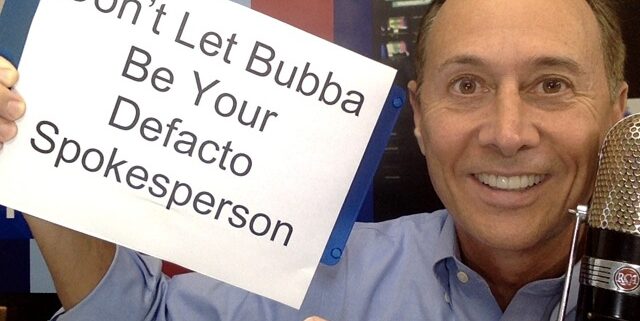
So who is Bubba and why should you care? Bubba was the guy who stood outside of his house trailer and told me, “It blow’d up real good,” when I was a TV reporter and asked him about an explosion at a nearby chemical plant. I then put Bubba on the news. You can get the fun, juicy version of the story by watching the video featured above.
By default, Bubba inadvertently became the company’s de facto spokesperson because the company was slow to issue a media statement to me as the television reporter covering this breaking news story.
Bubba was both a spokesperson’s worst nightmare, as well as one of my greatest inspirations for the 5 Steps to Effective Crisis Communications system that I have followed for more than 20 years. To get the juicy version of the Bubba story, and to meet Bubba’s modern day social media counterparts, please watch the video. I promise you’ll love it and you’ll want to share the lesson with co-workers and colleagues.
With every passing minute that there is no official statement from your organization, the narrative of the story is controlled by eyewitness accounts, as well as by speculation from the media. You and the company you work for are unintentionally making eyewitnesses your de facto spokespeople if you fail to issue at least a very basic statement within one hour of the onset of the crisis. (You can get a free copy of a basic statement by registering for my free 5-part video series on the 5 Steps to Effective Crisis Communications here.)
As you watch the video, you will learn that Bubba set the narrative for my news report about the explosion and fire. His soundbite controlled the narrative of the news story because the paid spokesperson for the company failed to respond to my request for an interview. The public relations spokesperson had a chance to be on live reports at 10 a.m., 11 a.m. and noon. Bubba would have never had a chance to say, “It blow’d up real good,” nearly two and a half hours into this crisis, if an official spokesperson agreed to do an interview. I only interviewed Bubba because I needed a soundbite to complete the aesthetics for my noon news report.
Bubba was made the de facto spokesperson not by me, but technically by the company and its paid spokesperson, when the spokesperson elected not to give me an interview.
According to Step 2 of the 5 Steps to Effective Crisis Communications, a company’s crisis communications plan should dictate that a spokesperson and statement should be available to the media, employees, the community, and other stakeholders, within one hour of the onset of the crisis.
According to Step 3 of the 5 Steps to Effective Crisis Communications, a company spokesperson should be able to meet that deadline by using a fill-in-the-blank pre-written news release.
According to Step 4 of the 5 Steps to Effective Crisis Communications, a company spokesperson should have undergone sufficient media training, such that they can effectively deliver the pre-written news release to reporters, without fearing that the interview will go badly.
The takeaway: Don’t let Bubba be your de facto spokesperson.
Learn more about the 5 Steps to Effective Crisis Communications by watching our free 5-Part video tutorial. Register here.
Crisis communications and media training expert Gerard Braud, CSP, Fellow IEC is based in New Orleans. Organizations on five continents have relied on him to write their crisis communications plans and to train their spokespeople. He is the author of “Don’t Talk to the Media Until…”
More crisis communications articles:
3 Lessons the Melania Trump Coat Can Teach All Public Relations People
The Biggest Lie in Crisis Communications
4 Steps Every Company Needs to Take in Order to Avoid the Default Spokesperson
By Gerard Braud, CSP, Fellow IEC
As a meetings industry professional, you dread when you get pulled aside at an event, by a colleague who whispers, “We have a situation.”
You feel a rush of panic; an air of dread; a feeling of confusion.
How you deal with a “situation” today is different than how you would have addressed the same situation five to ten years ago. Why? Because your attendees are changing.
Highly sensitive attendees can turn a small situation into a big crisis. Meeting professionals are finding that often it happens when an attendee is critical of a single word, story, or example shared by one of those speakers you worked so hard to vet. If you read evaluations, chances are you are noticing that they are far more snarky and mean-spirited than in years past. Many speakers will tell you that it is not uncommon for their best tried-and-true stories, case studies, and hilarious punch lines to become criticized on social media during your event and often while the speaker is still on stage.
Think of it like this – ten years ago we were told that a happy customer tells three people and an angry customer tells 10-12 people. Today, an angry, dissatisfied attendee simply tweets their displeasure with the hashtag of #YourEvent and everyone knows about it. This triggers a situation.
Left unchecked, the situation smolders and has a real potential to reach a flash point. An ugly flashpoint can damage the reputation of the event and the sponsoring organization. That reputational damage is then converted into a negative revenue impact in the months and years that follow, such as if people decide not to attend the event or to renew their association membership.
Your situation can easily ignite into a financial crisis and a membership crisis.
What should you do?
Below we outline a formal 5-step process you should follow.
This is where you identify all of the things that could damage your reputation and revenue. It ranges from the sudden things like a natural disaster or a mass casualty shooting, to those smoldering things such as sexual harassment, or an ugly social media post that goes viral.
In your assessment, you should examine the double-edged sword nature of social media. Every conference urges attendees to post comments to social media. But if you evaluated those posts, you would find an overwhelming number of participants posting or only a few who seek to be role models.
As most events transition to have their own event app, examine whether that app pays for itself or whether it expedites posts to social media that can do more harm than good.
This must be a thorough, step-by-step document that guides you through the process of gathering information about your situation, confirming it, then disseminating an appropriate statement to all who need to receive an explanation.
Built into those five steps would be a predetermined process. Strategically and relentlessly monitoring social media at an event needs to be a 24/7 job assigned to up to three people. Should your listening team detect a potential situation, a key component is to find the individuals at the heart of the situation. You have to privately and separately speak to the accused and the accuser. Time is of the essence. Your initial goal is to listen in-person so the “situation” doesn’t play out on social media. Engaging on social media can amplify and magnify the situation.
In some situations, a formal statement must be made from the main stage of the event, with a possible mass email going out to all attendees, and in the case of associations, an email to all members. These actions are covered in steps three, four, and five.
Prepare these statements now, that you would use if and when they are needed. Start with the most troublesome and likely issues identified in your Vulnerability Assessment. Your statements must use fill-in-the-blank and multiple-choice options in order to remain timely. Because the speed of social media controls the initial narrative, these pre-written statements are three to six hours faster than if you tried to craft a perfect statement in the midst of your crisis and while still trying to run a successful event.
Someone has to be prepared to read the pre-written statement to your audience and then respond to tough questions. Essentially, you need to go through the same type of Media Training that corporate spokespeople go through. Many associations provide Media Training to their board members before the event.
Test your team members, test your Crisis Communications Plan, test your Pre-Written Statements, and test your spokesperson.
Is all of this really necessary? Is it overkill? The answer lies in a simple mathematical formula in which you begin by calculating the financial damage one situation could cost your organization. Chances are the time and money you put into the five steps will be far less than the cost of letting a situation turn into a crisis.
Crisis communications and media training expert Gerard Braud, CSP, Fellow IEC is based in New Orleans. Organizations on five continents have relied on him to write their crisis communications plans and to train their spokespeople. He is the author of “Don’t Talk to the Media Until…”
More crisis communications articles:
Please Pick Me to be Your Media Trainer
The Biggest Lie in Crisis Communications
4 Steps Every Company Needs to Take in Order to Avoid the Default Spokesperson