Crisis communication resources to help you protect your revenue, reputation, and brand.
Effective crisis communications when “it” hits the fan.

Our blog is filled with deep resources to help with your crisis communication needs. Whether you are writing a crisis communication plan, seeking the best media training tips, or digging for case studies on crisis situations, you’ll find it here. Our goal is to give you all of the public relations resources you need to protect your revenue, reputation, and brand.
For those of you who love DIY and taking on a challenge, we’ve worked really hard to give you a good road map to follow. However, sometimes the fastest option is to bring in a pro. If that’s the case, we’re fully vaccinated and we’re ready to meet your needs, anywhere and anytime.
If you need help with your crisis communications plan, we’re ready to help.
When you need media training for your spokespeople, give us a call.
Anytime your organization needs a great keynote for your conference, we’d value the opportunity to serve you.
We invite you to:
Lorem ipsum dolor sit amet, consectetuer adipiscing elit. Aenean commodo ligula eget dolor. Aenean massa. Cum sociis natoque penatibus et magnis dis parturient montes, nascetur ridiculus mus. Donec quam felis, ultricies nec, pellentesque eu, pretium quis, sem. Nulla consequat massa quis enim. Donec pede justo, fringilla vel, aliquet nec, vulputate eget, arcu. In enim justo, rhoncus ut, imperdiet a, venenatis vitae, justo.
Nullam dictum felis eu pede mollis pretium. Integer tincidunt. Cras dapibus. Vivamus elementum semper nisi. Aenean vulputate eleifend tellus. Aenean leo ligula, porttitor eu, consequat vitae, eleifend ac, enim. Aliquam lorem ante, dapibus in, viverra quis, feugiat a, tellus.
By Gerard Braud Our focus on media training, crisis communications and public relations extends into the Duck Dynasty controversy and three lost opportunities. Put your politics, religion and personaBy Gerard Braud
 Our focus on media training, crisis communications and public relations extends into the Duck Dynasty controversy and three lost opportunities.
Put your politics, religion and personal views about gender, sexuality and race aside for a moment in order to put these observations into the context for which they are intended.
Today’s primary question: Did those reacting to Duck Dynasty’s Phil Robertson each miss a golden opportunity in their reactions to advance their respective causes?
A secondary question: Is the media, in many cases, misreporting this story because most who are reporting on it are not reacting to the original GQ story? Instead, are they reacting to headlines they have heard from from others in the media, and from others who are reacting, who have labeled Robertson as homophobic, anti-gay and a racist?
Remember… put your politics, religion and personal views aside to look at the questions from a public relations point of view…
Also, read the GQ article first.
Also, read the Bible passage that Phil makes reference to.
Once you’ve done your background research, you can read on…
Here are the missed media opportunities by A&E, gay activist groups, and groups representing blacks.
Lost Opportunity #1 – Gay Organizations are failing to advance their cause because they opted to be reactive rather than pro-active in their statements. This is especially true for what I’ve read from GLADD. From a media training, crisis communications and public relations perspective, their statements vented anger back at Robertson. This approach divides all audiences into pro-gay and anti-gay factions. If GLADD took a calmer approach and removed anger, hurt and outrage from their statement, they could – from a media and public relations standpoint – leverage the situation to their advantage.
If I were writing their statement for them, it would have said, “We recognize that many people in America share a similar Biblical belief as expressed by Phil Robertson, including the belief that it is sinful for a man to sleep with a woman he is not married to and for a woman to sleep with a man she is not married to. What we share with Robertson is the belief that monogamous relationships have value, and therefore underscores our support that marriage equality be extended to partners of the same gender. We also recognize that many people believe homosexuality is a choice and we continue to strive to educate people that a person’s gender, sexual orientation, and gender identity are defined in the womb. This is a belief shared my many Christians, who are both heterosexual and homosexual.”
Lost Opportunity #2 – The NAACP and the Human Rights Campaign issued a join statement that also chose to be reactive rather than proactive.
 The statement calls Robertson “racist” and “homophobic.” (A side note – this joint statement surprises me since many Christian blacks very much share Robertson’s Biblical views and believe in the same Bible passage which he referenced in GQ.)
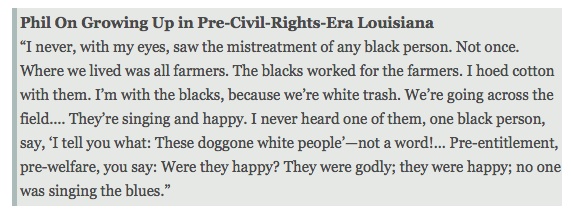
In GQ Robertson talked about his own perception of blacks he knew and worked with growing up. The statements referenced his perception from where he lived, and from my read of the article, spoke of no hate toward blacks, yet the joint letter and the media have labeled Robertson as racist.
Again, the NAACP and HRC are using angry and accusatory language that reflects the hurt they feel. They are effectively driving the story and the headlines in the first phase of the story. However, for the sake of gaining a headline, did they fail to seize on a greater public relations opportunity to advance their cause?
My advice would have been to issue a statement that would have said, “Some in the black community will interpret the remarks made by Phil Robertson as racist. We, however, see it as a personification of what blacks endured during the civil rights period. In many parts of America, our white brothers and sisters did not see the discrimination that many of our black brothers and sisters were experiencing. It is for that reason that we have spent the last 50 years fighting for equality and justice for all and the reason we will continue to our efforts to bring awareness to the need for equality.”
Lost Opportunity #3 – A&E could have addressed this matter without Phil’s suspension. A&E quickly bowed to pressure from the above mentioned groups, who are well organized, well funded, and have a public relations machine already in place. Television networks usually make their decisions based on their own revenue and the reaction of advertisers, who get pressured by activist organizations.
A simple statement without the suspension could have been the wisest way the network could have responded to the unfolding media crisis. They could have simply issued a statement that said, “We realize that many people will be offended by Phil’s remarks, while many people share his belief. However, even if we, as a network do not agree with all that Phil has said, we respect his First Amendment rights and his freedom of speech. We ask for understanding by all of our employees, viewers, and sponsors. We also apologize to anyone who may have been offended by Phil’s remarks.”
While Duck Dynasty viewers are not currently as well organized as the above mentioned groups, I think A&E will see that they too vote with their dollars and have the ability to organize and mobilize through social media to put pressure on the network and the sponsors of Duck Dynasty. This program draws one of the largest audiences on cable television and A&E.
Crisis Management for Duck Dynasty
Now consider this media relations, crisis communication and public relations truth – We’ve seen many people who are in the media spotlight for a controversy, make it worse when they either respond or attempt to issue an apology. Paula Deen was horrible in her live Today Show interview with Matt Lauer. Chip Wilson, founder of Lululemon was forced out of his job because his apology was poorly worded and poorly executed.
The next move for Phil Robertson and the Duck Dynasty family is the most critical. A poorly executed post-crisis interview, like the one by Paula Deen, could spell disaster. While saying nothing in the short term is an option, every time any of the Duck Dynasty stars are in public, you can bet someone from the media will be there shouting a question or asking for a comment about the controversy.
Every member of the Robertson family – if they want to manage this properly – must sit down with the best media expert and best media trainer they can find – and spend some serious time preparing for their verbal and non-verbal reactions. The clever one-liners used on the television show will not play well in media interviews. The media trainer must work with the family members to keep them authentic and to recognize that they can still speak their mind, but that each word they say is important and each word they do not say is important.
Careless phraseology by an authentic person is what started this controversy. Careless phraseology will make the controversy worse.
There are many moving parts to this media crisis and there are many opportunities that have been missed and are yet to be taken.
By Gerard Braud
 Yet one more group of public relations and marketing professionals has asked me to speak at their PR & Marketing conference about the wonderful ways social media will allow them to connect and sell to their customers. I love to speak at conferences, but I cannot tell a lie, especially about social media and the return on investment (ROI) for companies.
I cannot tell you to use social media for positive ROI without talking about the negative ROI.
Too many PR and marketing professionals still mistakenly think social media is their magic bullet. The truth is, one size does NOT fit all. One company may get great ROI through social media while other companies will generate zero buzz or attraction.
The reality is, one should never talk about the positive side of social media for sales and marketing without talking about the negative effects of social media. It can destroy an organization’s reputation, which then negatively affects the revenues. Social media is a dangerous double-edged sword that cuts both ways. I’ve spoken at many conferences which focus too heavily on social media marketing, without full consideration of the “the big picture.”
Some organizations and brands are a perfect fit for social media. I’ve had the pleasure of working with Chobani Yogurt, which benefited from a huge love fest on social media from people who first discovered the product when it first appeared on store shelves a few years ago. Their following developed organically and the company benefited from the loyalty of their customers.
This might not be as true for a bank, hospital, electric company, oil company, etc.
One needs to consider the demographics of the social media audience. Chobani is a darling for the social media active 18 – 32 age group, especially among females.
 Meanwhile, many of my clients in the rural electric cooperative sector are in communities consisting of primarily older residents who are less active on social media and who are not constantly using their iPhones for calls, texting, and social media. Many are farmers and ranchers who are working the fields all day and not sitting in front of a computer, laptop, tablet or phone. Also, the rural residents who are young and active on social media don’t want to talk about, or follow, or “Like” their rural electric company, their bank, their hospital, or any of the other industries that don’t understand the true nature of social media.
Despite the success of Chobani on social media, when Chobani had a product recall recently, their brand got beat up by their detractors. Meanwhile, my rural electric co-ops, which get little traffic in good times, get a significant increase in traffic during their crisis events, especially when there is bad weather and a power outage.
In the world of social media, too much focus is on Facebook and Twitter, with not enough emphasis on YouTube and videos, which then requires photographic skills and trained spokespeople. In the world of social media, younger folks are leaving Facebook for Instagram and Pinterest. These forms of social media are even more difficult to use for ROI and sales for service industries, while it might be the best marketing for chic consumer brands. In the word of Twitter, only 16% of the population uses it, which makes it hard to use to reach customers, yet it is widely used by the media during a crisis.
 In talking about social media one must be careful that young sales, PR & Marketing professionals who use social media daily, think the entire world is ready to embrace social media. The hypocrisy is that they want to market and sell their companies using social media, while the reality is that they have no personal desire to follow a bank, hospital or electric company on social media. A sales, marketing or PR person is doing a disservice to their organization to think they can significantly generate new customers and spread the world about new lines of business without recognizing that:
a) the demographics may not support their belief
b) the “sexiness” of the product may not support their beliefs
c) social media may have a greater negative impact on ROI than it has a positive impact on ROI.
The reality may be that they cannot justify the investment of their time in social media.
So… yes, I can customize a program for your conference if it is focused on all aspects of social media – the good, the bad and the ugly — but I cannot do a program that tells the audience social media is a rosy, wonderful world.
I cannot tell a lie.
 It is a bold move; perhaps unprecedented. Certainly in my career in crisis communications and my prior career as a reporter, I cannot recall a community that has suffered a crisis, asking the media to stay away. However, officials in Newtown, Connecticut are asking the media to stay away on December 14th, the one-year anniversary of the tragic shooting that killed 27 people.
From a media relations perspective, I support this bold move.
As for the lessons for communicators and public relations professionals, Newtown offers many crisis communications lessons. Free information and a free webinar from one year ago are still online. Sadly, a bold post-Newton prediction I made in a blog post on CommPro.biz has come true.
I predicted that, “The Sandy Hook shooting will likely not raise any discussions about effective crisis communications, although it should.” With CommPro.biz, I presented a free webinar outlining what all schools should do in order to be properly prepared for effective crisis communications should they experience a shooting or some other type of crisis.
An effective crisis communication plan can save lives and move people out of harms way. With all my heart I believe it and advocate for crisis communications preparedness each day.
 The blog and webinar are still online for your review.
Sadly, I can report my prediction has come true, at least among the schools that contacted me immediately after the webinar and during the year. Of those who had more questions about writing a crisis communications plan, to date, not a single person who has contacted me has been able to get their school officials to endorse or believe in the premise that if you plan on a sunny day, all will go much more smoothly on your darkest day. So many organizations see communications about a crisis as a reactive response to media after a crisis rather than a pro-active event of planning that should be done long before a crisis ever strikes. Not a single person who contacted me was able to get their schools to allocate even a modest amount of time or money to begin the effort.
It would be a great day for children, parents and educations if my prediction were wrong.
The lessons from one year ago are all still online, offered to you free of charge.
Friends,
I’m sorry about the spam that infiltrated the feed burner that delivers my blog to you. The system got hacked and the crisis guy had a crisis. Hopefully it has all been cleaned out.
I value the fact that you subscribe to my blogs and hope we’ve seen the last of the bad guys. However… if there is spam in this message sent via feed burner, then I’ve got more work to do.
With warm regards,
Gerard Braud
By Gerard Braud
 Every media training class I teach worldwide begins with this phrase:
“If you could attach a dollar to every word that comes out of your mouth, would you make money or lose money?”
Here is an image straight from my media training manual if you need proof.
Here is a video lesson for you to share with your CEO and spokespeople.
Recently we have published two articles here about Lululemon founder Chip Wilson. The first focused on his foolish ad-libs in a TV interview for which he was clearly not prepared. In the article we said his failure to prepare for the media interview would affect his profits. The second article focused on his poor attempt to apologize for his first blunder, creating a social media fire storm. Now comes the news that he is out as Chairman of the company he helped found, because of… wait for it… wait for it… because of things he said.

Click image to watch video
Chip Wilson’s ad-libs and bad media interview caused him, in large part, to be ousted from the company that he helped start.
It all began in a Bloomberg interview and now CNBC is covering the final chapter on their network.
Verbal blunders have cost an executive his position in his company.
This should be a wake-up call to all public relations people, executives and CEOs. It should be, but it won’t. Most CEOs and executives will remain too stubborn and arrogant to schedule time for training. Most public relations people will be too timid and afraid of losing their jobs to get in the CEO or executive’s face and demand that they dedicate ample time to prepare for EVERY media interview.
Many CEOs and executives treat media training as though it is a bucket list item – something they do once in life. This is as dumb as me taking one class at putt-putt and thinking I can play golf against Tiger Woods in the PGA.
EVERY interview requires practice.
Media interviews are not something you should ever take lightly.
Media interviews affect your bottom line.
Media interviews are connected to money.
Media interviews affect profits.

Click to watch interview
I’m befuddled to see how corporations spend millions on branding, millions on product development, and millions on all the contracts lawyers write, all to protect profits. Why would any corporation or executive spend so much on all of that stuff… why would they place such a high financial value on all of that stuff… yet completely under estimate the financial value of a media interview?
Wake-up executives.
Wake-up public relations people.
Wake-up corporations.
Wake-up CEOs.
Wake-up Chairmen and boards.
If you invest time and effort in media training it will pay huge dividends.
I’ve witnessed corporations lose millions in moments in a bad interview.
I’ve witnessed corporations make millions in a moment in a well planned and practiced interview.