Crisis communication resources to help you protect your revenue, reputation, and brand.
Effective crisis communications when “it” hits the fan.

Our blog is filled with deep resources to help with your crisis communication needs. Whether you are writing a crisis communication plan, seeking the best media training tips, or digging for case studies on crisis situations, you’ll find it here. Our goal is to give you all of the public relations resources you need to protect your revenue, reputation, and brand.
For those of you who love DIY and taking on a challenge, we’ve worked really hard to give you a good road map to follow. However, sometimes the fastest option is to bring in a pro. If that’s the case, we’re fully vaccinated and we’re ready to meet your needs, anywhere and anytime.
If you need help with your crisis communications plan, we’re ready to help.
When you need media training for your spokespeople, give us a call.
Anytime your organization needs a great keynote for your conference, we’d value the opportunity to serve you.
We invite you to:
By Gerard Braud
 Watch the news coverage as winter storms move across the United States, leaving many people without power in the cold for up to two weeks. Much of this story is being told through the eyes of the so-called, “citizen journalists.”
Citizen journalism is one of the reasons breaking news got broken. While corporate communicators, corporate executives and corporate lawyers haggle over every word and comma in a news release, eye witnesses to news events are posting their pictures and videos online with astounding speed.
Corporations around the world need to wake up. They need to rethink their approach to media relations and crisis communications. They need to think and act like citizen journalists. They need to post fast to the web.
Learn more at this Free Webinar on Thursday, December 12, 2013
When I hear a corporate communicator tell me, “Our people will never let us do that,” my first instinct is to channel my inner Ron Burgundy because, “I’d like to punch you in the spleen.” Trust me, in 1994 I heard these same people telling us that we couldn’t use e-mail and websites. They were wrong then and they are wrong now.
But seriously – stop saying you can’t. Here are 5 things to consider.
 #1 The Miracle on the Hudson
When U.S. Airways had a jet full of people land in the Hudson River in the media capitol of the world, all of the world’s media used the same image taken by a guy with a smart phone who posted the image to Twitter. I’d wager that U.S. Airways might have not even known they had lost a plane when those first images hit Twitter. You must be that fast to post images of your own news events.
#2 The Virginia Tech Massacre
On that sad day when 32 people died at Virginia Tech, University officials were slow to meet, slow to make decisions, and slow to issue both news releases and emergency communications to their student body. Instead, an engineering student used his smart phone to capture video of police officers on campus as 26 gunshots from the gunman are heard on the video. There was no national  news media on the campus at that moment, yet when the students uploaded his video to CNN iReports, the media had all they needed to tell the story from a location where no media would have been allowed. You must be that fast to post video of your own news events.
#3 Stop Analyzing Words and Commas
After more than 30 years in communications, I still don’t understand why corporations spend so much time scrutinizing a written news release, only to have the spokesperson say dumb, un-vetted comments in an interview. If the interview isn’t going to match the written news release then stop spending so much time on the news release and spend that time in media training with the spokesperson.
#4 Stop Writing News Releases from Scratch
Every crisis communications plan should have a huge library of pre-written and pre-approved news releases that can be easily modified through strategically placed fill-in-the-blanks and multiple-choice options. If 100 things could go wrong in your organization, you should have 100 pre-written news releases. The pre-approval process will allow them to be posted to the web and read to the media in less than one hour of the onset of your news event or crisis.
#5 Practice
To be as good as a citizen journalist you must have the necessary Facebook, YouTube and Twitter accounts set up. You must set up accounts with CNN iReports and other media uploading profiles. You need the right phone or tablet device and it must be configured to interface with your social media accounts. You need Skype for live reports. Here is the big one – you must practice your performance on camera as well as your ability to share and publish online from your smart device. This isn’t easy to do, yet you must do it and make it look easy.
The bottom line is someone will be telling your story. It can be an uninformed, yet technologically advanced eye-witness, or it can be an official source who understands the technology, as well as good media relations and crisis communications.
Who will tell your next story?
Want to learn more? Register for this free CommPro.Biz webinar on December 16, 2013 at 1 p.m. EDT
By Gerard Braud
 Crisis Communications, a working Crisis Communication Plan as well as good media training skills will be critical in the next few days as bad weather moves across the United States.
Before the weather gets to you, now is the time to begin managing the expectations of your customers and employees. Many of you will experience power outages that may last up to two weeks. Let your customers and employees know this through effective communications today.
In your communications to them, be very clear about the pain, problems and predicaments they will face.
#1 Do Not Sugar Coat the News
Tell people exactly how bad things may get. Make sure your messaging is direct and simple. Deliver the headline, give a good synopsis, and then give the details. Write your communications the same way a reporter would write a news story. Don’t overload your communications with corporate jargon, acronyms and politically correct phrases that may confuse your audience.
#2 Do Not Hedge Your Bets With Optimism
You are better off to tell audiences what the worst will be and then be happy if the worst does not come to pass. It is easier to celebrate good news than to apologize for a situation that drags on and gets worse.
Click here to watch Gerard’s video on winter storms

Click image to watch video
#3 Be Ready to Use Every Means of Communications Available to You
Traditional media will be overwhelmed with many stories. If you want to get their attention and get coverage as a way to reach your audiences, do these things now:
#4 Media Training for Spokespeople
Anyone who records a video or does an interview with the media should have gone through extensive media training prior to this crisis. Additionally, do role-playing and practice with them before each interview in the coming days.
 #5 Be Skype Ready
In a winter storm type crisis, media may ask you to do live interviews via Skype. Download Skype to your mobile devices now and practice using Skype. Additionally, all spokespeople on a Skype interview must be properly media trained in a Skype interview setting. Use my online tutorials to help you prepare spokespersons.
#6 Expect a Spike in Social Media Communications
Keep in mind that organizations that often have very little following on social media will see a spike in social media during power outages. As audiences have no computer access they will turn to their mobile devices. Your team needs to be prepared to monitor social media and reply to posts only when it is absolutely necessary. Too many replies to negative comments only lead to more negative comments and those comments keep re-posting more frequently in everyone’s news feed.
#7 Direct Tweets to Reporters
Increasingly, reporters respond quickly to Tweets. I find that in a weather crisis you can get a reporter’s attention faster with a Tweet than with an e-mail, phone call or text message.
#8 Be a Resource
Don’t confine your social media posts to only information about your organization. Post resource information that your audience needs, such as locations to shelters, information about emergency supplies, and any other creature comforts they need.
#9 Don’t Be Left in the Dark
Now is the time to review your list of emergency supplies and gather all of the devices you need to power your mobile devices. Devices like Mophies can charge your phones and tablets. Make sure you have batteries and flashlights. If you can, get a generator and ample supplies of gasoline. Gather extra food, water and blankets. Make sure you can heat your work environment.
#10 Rest When You Can
Rest and sleep well before the crisis. Work strategically in shifts during the crisis. Everyone doesn’t have to be awake all of the time. Naps are allowed in the middle of the day.
#11 Victory from Preparedness
Don’t judge your public relations skills by how well you were able to wing it during and after the crisis. Victory is measured by how much you did on a clear sunny day to prepare for your darkest day.
#12 Update Your Crisis Communication Plan
When this crisis is over, evaluate whether your crisis communication plan worked. It should be so thorough that nothing slips through the cracks, yet easy enough to read and follow during your crisis so that it tells you everything to do with a precise timetable for achieving each task. If it doesn’t meet these criteria, evaluate it during and after your crisis, then prepare for a substantial re-write or re-design as soon as this crisis is over.
By Gerard Braud

Click to watch video
Toronto Mayor Rob Ford has done it. So has Lululemon founder Chip Wilson. So have presidential candidates like Herman Cain and Sarah Palin. Each is guilty of saying dumb things in media interviews.
Why do powerful people say dumb things in media interviews?
Here are 3 reasons…
First, powerful people fail to dedicate the appropriate amount of time to preparing for and training for their interviews. Most people who run for office or lead corporations are usually sent to a media training coach so they can learn to effectively communicate with the media. The media trainer should never be a spin doctor who teaches people to avoid answering questions, but rather a thoughtful coach who teaches the spokesperson to craft thoughtful, well worded answers that provide the appropriate amount of context, quotes, and supporting facts. The essence of the best answers requires having a good writer who can write articulate, quotable phrases in the voice of the spokesperson. The spokesperson is then responsible for internalizing these phrases for use in the interview.
One media training class is never enough. Media interviews require practice before each interview, just as an athlete would practice before each game.
Training, practicing and internalizing key phrases requires dedicated time, and many powerful people fail to allocate time, thinking they can do fine without additional practice.
That leads us to reason number two, which is arrogance and overconfidence by the powerful person.
Powerful people have often had some success in the past with spontaneously saying the right thing in the right moment. Politicians have often been told early in their careers that they were good public speakers. However, the stakes get higher each day as a person’s public profile rises. Often, reporters begin to dig a little deeper and question the congruency between what a person has said in the past and their actions in the present.
The increased scrutiny generates harder questions, which requires even more practice and more time spent internalizing powerful, quotable phrases. Yet the arrogant and over confident spokesperson fails to recognize that what got them to this level will not get them to the next level. In other words, a good public speaker needs to become a great professional speaker. Many are never motivated to become as great as they should be.
This brings us to reason number three, which is the spokesperson’s failure to correlate the monetary and reputational impact of what they say and the massive damage that happens when they say dumb things. One of the worst examples I’ve ever seen is a spokesperson who said the wrong thing and derailed a $700-million industrial project.
 Just look at the spokespeople we sited above. Rob Ford’s dumb statements have lead his city council to begin stripping him of his power. It is unknown whether his reputational damage will cause him to lose his job come election time. Chip Wilson has seen an outcry on social media as former customers abandon Lululemon yoga wear, all because of a careless adlib on Bloomberg TV. Herman Cain tried to run for president, knowing sexual harassment allegations were part of his past, yet failed to be prepared with a well-written response. Instead, when he was asked if he had ever been accused of sexual harassment, he responded, “Have you ever been accused of sexual harassment?” His campaign contributions dried up and his bid for President ended. Sarah Palin may be able to bring a crowd to their feet in a public rally of supporters, but in media interviews my opinion is she is consistently one of the worst spokespeople I have ever seen. Her failed interview with Katie Couric during her bid for Vice President derailed the presidential campaign of Senator John McCain. Many would say her verbal blunders have kept her from advancing her political career. Her statements may be acceptable to a certain loyal audience, but constant blunders erode her loyal support and empower her detractors.
 Powerful people become powerful because they have certain skills or characteristics that propel them forward. The most powerful people are those who can recognize their own weaknesses and either hire people to do those jobs for them, or they hire coaches who will honestly critique their weakness and develop a process to improve in those areas.
Talking to the media is hard. It requires you to think like a reporter and organize your thoughts like a journalist is taught to write a news report. It requires you to know how to punch home a headline, how to begin and end with a great synopsis sentence, how to pepper the interview with well planned quotes, and how to give a few supporting facts without over loading the interview with irrelevant details. A journalist spends four years in college learning this system and practices it daily with each report they write.
No spokesperson should be foolish, arrogant or over confident enough to try to match their amateur status with that of a professional, anymore than they should think that one trip to the putt-putt course makes them ready to play golf in the PGA.
By Gerard Braud
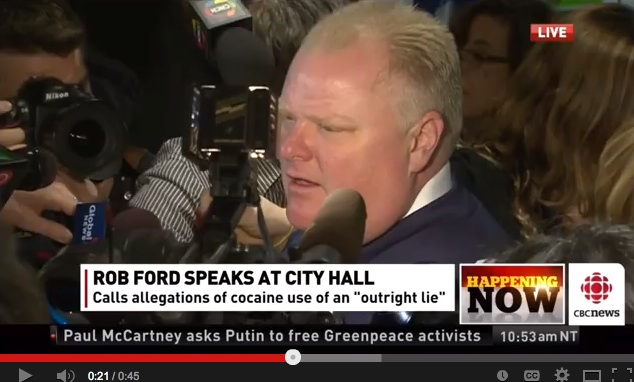 When media training a candidate, politician, or elected official, one of the hardest things to teach them is when to shut up.
In every media training class I impart this expert advice to the trainee: “When you are digging a hole for yourself, put down the shovel.”
 Toronto May Rob Ford has likely never heard this from his media trainer. One must ask, has Rob Ford ever had media training? Instead of putting down the shovel he has brought in a backhoe.
As repulsive as you may find Rob Ford’s latest quote, I’m going to give it to you here just to show what an amazing failure this guy is every time he is questioned by reporters. You can watch the video for yourself.
“Oliver Gondek says that I want to eat her pussy and Oliver Gondek, I’ve never said that in my life to her. I would never do that. I’m happily married. I’ve got more than enough to eat at home,” said Toronto Mayor Rob Ford.
From Vancouver to Toronto, Canadians have dominated the news for the past two weeks for saying things to the media that they should not say. Each time, they make the situation worse with a poorly executed apology. We saw that last week with Lululemon Founder Chip Wilson and now with Toronto Mayor Rob Ford.
Each case, the spokesman created their own crisis by what they said. Dare I say the United States media has not covered this much news from Canada in my lifetime?
Admittedly it is difficult to media train certain people with certain personality types. Certain rich or powerful people are arrogant enough, or over confident enough, that their inflated egos preclude them from seeking expert advice and expert coaching in order to improve their skills in many areas, including talking to the media.
Oh! Canada!
 If after this you need to have a good laugh, watch John Stewart’s coverage of this story on The Daily Show.
By Gerard Braud Navigating the waters of a crisis requires a good crisis communication plan before the waters ever begin to rise. Clear sunny day planning, long before your darkest day, is the secretBy Gerard Braud
 Navigating the waters of a crisis requires a good crisis communication plan before the waters ever begin to rise. Clear sunny day planning, long before your darkest day, is the secret. In today’s social media filled world, this has never been more true.
Sadly, in our social media world some public relations people expect to Tweet their way out of a crisis or repair damage using Facebook. Neither is true. While “shiny and new” social media can be part of an effect communications strategy, you must first have the foundation of tried and true media relations, crisis communications, employee communications and stakeholder communications.
Here is a sure fire 5 step approach that must be your foundation.
Step 1: Vulnerability assessment
Before “it” hits the fan, you have to identify everything that could go wrong, including potential sudden crises and smoldering crises. Hire a facilitator to take your organization through the process of a deep examination of the things that could go wrong that would damage the reputation and revenues of the company.
Step 2: Write your pre-written news releases, web posts, and e-mails
Perhaps you’ve heard the expression, “when you are up to your ass in alligators it is hard to think about draining the swamp.” This applies to crisis communications. One of the biggest mistakes public relations people make is that as the crisis is unfolding, they open a blank document on their computer and start writing a news release, which then goes through hours of unnecessary re-writes before it is release. Consider this: on a clear sunny day you should write as many of these potential news releases as possible, leaving blanks that you’ll fill in when you know the details of the actual event. These documents can be pre-approved by leaders, speeding up your ability to release them to the public. I’ve facilitated many crisis communication writing retreats that produced more than 150 pre-written news releases in one day. That kind of productivity rocks!
Step 3: Write your crisis communications plan
Very few documents that public relations people refer to as a crisis communication plan would pass my test for what a plan should be. Most are worthless 6 to 12 page documents that state standard operating procedure and serve absolutely no purpose on the day of your crisis. Yet to be fair, this is what most PR people were taught in school or at some PR seminar. Frustrated by what I kept finding, I invented something new.
My approach is to write a document that is intended to be read and followed during the crisis. It dictates specific, sequential tasks in a very fast moving time frame. It captures all of the perfect behaviors of the most senior communicator, yet is so easy to follow than any one who can read can execute the plan flawlessly. I’ve invested about 2,500 hours of development in my base plan, which is about 50 pages long, which I am now able to customize for my clients during a single afternoon workshop.
Step 4: Annual media training for a crisis
Despite all of the buzz about social media, holding a live news conference within both the first and second hour of a crisis is vital if the media are standing at your door. Many organizations damage their revenues and reputations when untrained spokespeople say dumb things during a crisis.
It is important for every potential spokesperson to recognize that media training is not a bucket list item that you do once in life. Talking to the media is a skill that requires regular practice. I recommend media training for all spokespeople at least once a year, with an expert coach. Then, before every media interview, in-house staff should do a fast refresher course.
Think of it this way – the best athletes achieve great success because they practice often and partner with a great coach. Great spokespeople practice often and partner with a great coach, protecting their reputation and revenues through what they say, and just importantly, what they don’t say.
Step 5: An annual crisis communications drill
Realistic crisis communications drills are the best way to test your communications team and the decision making process of your leaders. A drill once a year allows colleagues to establish trust and good working relationships. A crisis drill allows ample time for leaders to pause and discuss decisions they must make during a real crisis. This helps them avoid decision paralysis during a crisis.
Your crisis communications drill should include at least two mock news conferences during the drill. Hire mock media and never use real media. Your facilitator must write a complicated, yet realistic scenario. It must include a likely crisis, plus all of the social media, employee and media buzz that would surround a real crisis. The facilitator should also hire a team of people to flood your phone lines with constant calls, replicating the calls you would receive from media, customers, and concerned citizens in a real crisis.
Conclusion
All of this takes time. None of it is easy or fast. But, it is much easier to prepare on a clear sunny day than to struggle and fail on your darkest day. Your reputation and revenues depend upon it.
About the author: Gerard Braud (Jared Bro) has helped leaders and organizations on 5 continents write their crisis communications plans, using his one-of-a-kind writing retreat that completes one years worth of work in 2 days. He is regarded as an expert in media training and crisis communications plans and is the author of Don’t Talk to the Media Until… 29 Secrets You Need to Know Before You Open Your Mouth to a Reporter. Contact him at www.braudcommunications.com or gerard@braudcommunications.com
By Gerard Braud
 Five public relations veterans, pontificating and dropping F-bombs over cocktails recently at the PRSA conference, concluded the biggest problem in PR today is the lack of perseverance by those in the media relations, public relations and the communication professions.
Is this true or not true for you? Read on…
I’ll describe the group as “old salty dogs” who speak their mind and say hello to the truth and to hell with political correctness. Sitting there are a combined 150 plus years of PR experiences, including myself, three gals and another guy. The waiter has just brought the first round of drinks, so these comments have not been impaired by alcohol.
One gal said she was successful because every November, she went back to her boss and asked for budget money she had been denied earlier in the year, knowing there is always extra money in the pot. She says often she got what she asked for and sometimes more because she was “Smart enough to ask, when the rest of the dumb a**es sat with their fingers up their a**es and never asked. It was like robbing a fu*#ing bank and I walked out with all the money.”
“And if they didn’t have the money, I didn’t walk out of the office until I got a definitive answer that I’d get the money after the first of the fu*#ing year. I always finished the year strong and I hit the ground running hard on January 2nd,” she said.
“Most people today are afraid they’ll get fired if they push too hard,” I responded.
“They should be fu*#ing fired for not asking,” the other guy said. “That’s the fu*#ing problem with PR people; they’re afraid to get fu*#ing fired or quit their fu*#ing jobs. Your fu*#ing career never starts until you’re willing to quit or get fired.”
Do you ask for extra money in November? Read on…
Another veteran complained that PR people go into hibernation mode and near paralysis from Halloween to the first of March. “It’s like they surrender to the holidays until after New Years and then have difficulty regaining momentum after the first of the year. This isn’t a job that you start and stop,” she barked. “I call bull sh*t on this ‘seat at the table’ crap. You don’t deserve a fu*#ing seat if you don’t do your job 12 months out of the year.”
That lit up the discussion like throwing a match on gasoline. One gal blamed it on moms in PR not being able to comprehend that work is work and home is home. The guy said he thinks it is “the damn Gen X-Gen Ys” who aren’t as committed to their jobs and “go into lala land from Halloween to New Years.” One gal ranted about how hard she worked to establish herself in a male dominated workplace 34 years ago and how “PR people today are pissing on the trails that were blazed to make PR a credible part of corporate culture. You can’t just fu*#ing mentally shut down every winter.”
In his book Good to Great, author Jim Collins made a great point that we each have to “keep the fly-wheel turning” if we want to succeed in our careers. In other words, we have to persevere to succeed.
What do you think? Is perseverance dead in PR? Do you persevere or hibernate in the winter?