As mentioned in all my tutorials this month, my goal for you, if you are a spokesperson, public relations expert, or Public Information Officer (PIO) for a government agency, is to make iReports part of your crisis communication and media relations plan. Now I’m asking you to think in terms of telling compare and contrast stories, especially during hurricane season or your natural disaster. Here is why:
Think about when you watch television news. If there is a natural disaster, in order for you to appreciate the magnitude of the disaster, don’t you really need to know what things looked like before the disaster?
The best stories are told when the audience can see before, during and after an event.
I want this to always be your goal when you file your CNN iReports. This means not just filing one report, but filing several.
During Hurricane Isaac in 2012, as it impacted my home in Mandeville, Louisiana, 30 miles north of New Orleans, I filed CNN iReports for five days.
My first report was on a clear sunny afternoon, as I told the audience how Lake Pontchartrain would flood portions of the community. You can watch that original video here.
The next day, I filed several more iReports as the storm moved in, and specifically, as Lake Pontchartrain caused flooding, just as I had predicted in the previous video.
This link will take you to the index for all of the articles and videos.
If you, like many others, think this information would be valuable as a workshop at a conference or corporate meeting, please call me at 985-624-9976. You can also download a PDF that outlines the program, Social Media iReports.pdf so you can share it with your meeting planner or training manager.
https://braudcommunications.com/wp-content/uploads/2020/12/Logo-white-01-300x138.png00gbraudhttps://braudcommunications.com/wp-content/uploads/2020/12/Logo-white-01-300x138.pnggbraud2015-06-16 03:00:202021-05-20 01:43:17Tutorial #8: Telling Compare and Contrast Stories to the Media During Hurricane Season
Tutorial #6 by CNN iReporter Evangelist Gerard Braud —
Click image to watch video
In order to shoot your own videos to tell the story of your crisis, it is crucial that you have the right technology. Having the right crisis communications tools will help you communicate quickly and effectively to your audiences on your darkest day, whether your organization faces a hurricane, tornado, or a smoldering crisis.
You are welcome to use any brand of phone or tablet you like, as long as you can
1) Take video of yourself with it
2) Upload that video to the Internet.
Getting to the internet means you either need a reliable Wi-Fi signal or a good G3 or G4 signal on your device.
Raw video, also known in the news business as B-roll, is one type of image you can send to iReports. They also accept still photos. However, my favorite approach is to do a traditional television news style reporter standup. Standup is the TV term for the reporter walking and talking on camera.
Some early generations of smart phones only allow you to use your phone screen as a video view-finder while you take a picture or video of something in front of you. Ideally, you want a smart phone or tablet that has a two-way camera — the one that allows you to hold your tablet or phone at arms length while you see yourself on the screen.
Your goal in the standup should be to make it short – usually 38 seconds. The short length makes it easy and fast to upload. Sometimes longer videos will not upload because of a lack of bandwidth, especially during a crisis or during bad weather. When doing a standup, your goal should also be to walk, talk and provide information in a quotable nugget, just as you will learn if you have ever been through a media training class. Because of this technology and demand, I’ve changed the way I teach media training classes to teach spokespeople how to walk and talk and deliver great information in a quick nugget. As you deliver your standup, you must also speak in a conversational tone and not in a stiff, rehearsed sounding voice.
Because my goal is to convert my iReports into Live interviews, I also have the right software. Skype on my iPhone and iPad, connected to the web, becomes my source for broadcasting Live. This means that you need to set up a Skype account on a clear sunny day, before you ever actually need it. Just like any other technology, you have to practice using it in order to get it right when you need it quickly in a crisis.
When I report Live for CNN, I’m asked to call one of their many Skype numbers. When I report Live for The Weather Channel, they phone my Skype number.
The iPad is my favorite out of my 2 devices, because I love the size of the screen and the quality of the camera. However, it is heavier and harder to hold. Some iPad cases make it easier. Several companies also make iPad tripod devices. While a tripod provides a steady image, the downside is that you are unable to walk and talk to tell your story. In rainy conditions, the iPhone is easier to keep dry. You can use a baggie with a hole cut in it for the camera.
In our next article, you will learn what types of stories get the best attention.
If you have questions, tweet me @gbraud or send an e-mail to gerard@braudcommunications.com
https://braudcommunications.com/wp-content/uploads/2020/12/Logo-white-01-300x138.png00gbraudhttps://braudcommunications.com/wp-content/uploads/2020/12/Logo-white-01-300x138.pnggbraud2015-06-12 03:00:322021-05-20 01:44:00Tutorial #6: Crisis Communications Technology for Hurricane Season
Tutorial #5 By CNN iReporter Evangelist Gerard Braud —
So far this month, we have reviewed why you should be a CNN iReporter, or at the very least why you should learn to effectively shoot your own smartphone videos. We have learned how to set up your CNN iReporter account and how to determine what is newsworthy and what isn’t. Now it is time to learn exactly how to effectively communicate through video on your darkest, stormiest day. Here are a few lessons for telling the story of your organization’s crisis, ranging from natural disasters to tragic events like workplace shootings. As with our previous lessons, this one is also based on my video documentation of Hurricane Isaac in 2012. Enjoy!
Click here to watch video
It is important to evacuate when an approaching hurricane is going to be a bad one. Staying in your home in destructive winds and killer flooding is dumb. Hurricane Isaac was not a strong storm and mandatory evacuations were not called. So, I decided to stay in my home on the shore of Lake Pontchartrain in Mandeville, LA, which is 30 minutes north of New Orleans. The storm winds at the eye of the hurricane were just over 75 miles per hour, making it barely a Category 1 hurricane. The eye was forecast to pass 50 miles to the west of me, which meant the winds would not be destructive where I was. The path would push water from the Gulf of Mexico into Lake Pontchartrain, resulting in localized flooding from storm surge.
As an experienced storm chaser, my goal was to document the hurricane, from the preparation stage, through the flooding, then through the aftermath and cleanup.
My home is a small cottage, raised on steel 10-foot pilings, with steel beams. Below my house is a carport and storage area that is 5 feet above sea level. That places the floor of my living quarters 15 feet above sea level and makes for a great perch to view mother nature. The storage area is constructed with mandatory breakaway walls, which will wash away in a storm, and they did.
Two days before the hurricane I began to document the flurry of activities and preparations in the community. There were long lines at the gas stations until every pump ran dry. I documented empty grocery store shelves, as water and canned goods were snatched up. At the hardware store I documented long lines as people purchased electrical generators and filled propane tanks.
On Tuesday, August 28, 2012, the evening before the storm made landfall, I filed an iReport that showed a calm lake, a green parkway and the green grass in my yard. I explained to viewers that the next day the entire area would be underwater, which all came to pass and made for a great follow up report. That was the iReport that lead CNN Headline News (HLN) producers to ask me to do a live report on Evening Express as the hurricane made landfall on August 29. By then, electrical power had gone out and I was broadcasting live using my iPhone 4, a G3 phone signal, and Skype
The big surprise with Hurricane Isaac was that the storm stalled and stayed in the same place for nearly 2 days, all the while causing the floodwaters to get higher. A fast moving storm would have come and gone in 12 hours. This one would cause flooding from Tuesday until Sunday.
By the time we hit the air live on Evening Express on the evening of August 29, there were whitecaps rolling down my driveway. After dark I did a live report for the Dr. Drew Show. Shortly after I signed off with Dr. Drew around 9 p.m., I began to hear strange creaking noises in the house. Occasionally there were unnerving vibrations. When I turned on the faucet there was no water. This wasn’t good. #understatement. I grabbed a flashlight and walked downstairs, where I could see that the breakaway walls in the storage areas on my carport began to wash out. As they did, debris in the waves broke the water supply, leaving me without running water. Then I realized that near the water pipes were natural gas lines. #causeforconcern
I phoned a neighbor and asked if I could sleep at his house just in case mine had a gas leak. I shut off all of my pilot lights, blew out all of my hurricane lanterns and candles, grabbed my life vest and paddled my canoe to his house. By this time, the water was so deep I simply paddled over my fence.
Overnight, the eye of the storm began to move again. The morning of August 30th I paddled home to find there was no gas leak, so I filed more iReports showing the damage as the water level dropped some.
I was surprised at how much debris had washed into my yard. Then nature revealed unwanted guests. First, there were 10 alligators swimming in my yard. As it got warm, dead nutria, a large swamp rat the size of a large muskrat, began popping up out of the water. I counted 50 carcasses. As the water drained off further, it revealed a blanket of swamp grass 12-24 inches deep, filled with thousands of snakes. I felt like I was in an Indiana Jones movie. Such anomalies mean just one thing: file more iReports and do more live reports for Evening Express and Dr. Drew.
For me, the beauty of iReports is the ability of ordinary people to take their stories right to the world’s leading news network. News happens fast and there isn’t always a professional news crew present to capture it. A citizen with an iPhone can capture and report the news even when no news crews are around.
What people who work in public relations need to be aware of is that you too, have the ability to be an iReporter. If you fail to do so, your story will be told by a citizen on the street, who may have great pictures, but not always the correct information. This is true for all spokespeople. This is true for Public Information Officers (PIO).
https://braudcommunications.com/wp-content/uploads/2020/12/Logo-white-01-300x138.png00gbraudhttps://braudcommunications.com/wp-content/uploads/2020/12/Logo-white-01-300x138.pnggbraud2015-06-11 03:00:592021-05-20 01:46:10Tutorial #5: Hurricane Season Crisis Communications Lessons from Hurricane Isaac
As social media and smart phones expand their reach, we are seeing a seismic shift that is sending tremors through the mainstream media landscape. This is creating both new challenges, as well as new opportunities for media spokespeople. Capitalizing on the opportunities requires you to adopt new approaches, learn new skills and be open to new realities.
If you are bold enough and brave enough to try something drastically new, then I’d love to meet you at the upcoming World Conference for the International Association of Business Communications in San Francisco. I’ve prepared an all-new special presentation for Monday, June 15 from 10:30 a.m. – 12:30 p.m. in the Club Room. It only seats 100 people, so make plans to get their early.
This is not a lecture or a class but a do-and-learn workshop. You should come ready to write in the first hour, as well as to discuss the challenges you and/or your spokespeople have faced in previous media training classes or in previous interviews. If there is a problem, the first hour is dedicated to solving those problems so they never happen again. In fact, I’m ready for you to contact me outlining problems you’ve faced that you’d like to solve. Send an e-mail to me at gerard@braudcommunications.com with the subject line IABC Question.
Our focus in the first hour will include:
Discovering why the media landscape is changing
Learning the 4 things you must be ready to say in every interview
Rethinking your approach to media training
In the second hour you will be up on your feet unlocking the futuristic power of your smartphone, learning how to do remote interviews. Please make sure to bring either your smartphone or your iPad.
While many spokespeople complain about how the media operate, the reality is that you can learn to be an expert every time either you or an executive within your business speaks to the media.
Social media is one of the biggest trends changing the media. Free content is competing with professional content. The reality is news stories are being told by eyewitnesses with a smartphone faster than the story can be told by the mainstream media and faster than a corporation might be willing to tell the story of their own crisis.
As social media grabs more of the media’s audience, the media are watching their profits disappear. That means there are fewer reporters and photographers employed to tell your corporate story in good times and in times of crisis.
Where problems exist in the media we hope you see opportunities.
The greatest opportunity for someone who is a professional business communicator or public relations expert is, on one hand, to improve your own interview skills, and at the same time, learn new skills for doing interviews and creating videos that are as good as or better than the ones being supplied by eyewitnesses.
If you crave a chance to walk away with new skills that you can immediately use as soon as you are back at work, I look forward to meeting you at this workshop.
https://braudcommunications.com/wp-content/uploads/2020/12/Logo-white-01-300x138.png00gbraudhttps://braudcommunications.com/wp-content/uploads/2020/12/Logo-white-01-300x138.pnggbraud2015-06-10 14:03:072021-05-20 01:47:23Social Media Collides With Mainstream Media: The Changing Landscape of Media Interviews in Good Times & Bad
Tutorial #4 By Gerard Braud, CNN iReporter Evangelist —
Creating and filming your own CNN iReports or smartphone videos is a useful tool for communicating with the media, your employees, your customers, and key stakeholders in your crisis. Not only is it a useful tool during hurricane season, but it is useful during any crisis or natural disaster. However, if you plan to do these videos, it is important to understand what the media consider newsworthy. Often, what you consider newsworthy and what the media consider newsworthy are two different things.
Click here to watch video
For the 15 years that I worked as a reporter in print, radio and mostly television, people questioned me daily about why certain things got in the newspaper or on the air, and why other things did not.
News is traditionally defined as what is new, unique or different. Also, acts that tend to be violent, explosive and bloody often dominate the news, hence the old expression, “If it bleeds it leads,” as in, it leads off the newscast.
News and the decisions about what gets into a newspaper or broadcast on the news, is further based on “who cares?” If it is something people will talk about, i.e., they care, it is more likely to be considered news worthy.
What is considered news worthy and what gets on television today is far different than what was considered news worthy 10-15 years ago. News programs and news networks have shifted more toward what I would consider as “info-tainment.” Information and entertainment is blended together and sometimes it is difficult to separate them, or determine where one ends and the other begins.
A loud mouth television or radio commentator often shouts out an opinion in an entertaining way to a significant segment of the audience and produces a large amount of advertising revenue. This, in my opinion not only represents bias in the media, but is also the blurry line that bleeds from news into info-tainment.
Social media has also impacted news coverage and what gets reported. News was once defined as information designed to inform the electorate, so we could understand public issues and elect good leaders. However, today, more people care about — and the media is more likely to report on — the popularity of a viral video on the internet.
For your purpose, as a public relations professional, spokesperson or Public Information Officer (PIO), if a news worthy event happens where you work, your gut and experience tells you that a certain event is news worthy. What you must decide is whether you will be an active participant in providing official information to the media, or whether you will remain silent and allow the narrative to be told by the citizen on the street, armed with a cell phone.
My hope is that these tutorials encourage you to not only participate, but to also become an iReporter for CNN.
This link will take you to the index for all of the articles and videos.
If you, like many others, think this information would be valuable as a workshop at a conference or corporate meeting, please call me at 985-624-9976. You can also download a PDF that outlines the program, Social Media iReports.pdf, so you can share it with your meeting planner or training manager.
https://braudcommunications.com/wp-content/uploads/2020/12/Logo-white-01-300x138.png00gbraudhttps://braudcommunications.com/wp-content/uploads/2020/12/Logo-white-01-300x138.pnggbraud2015-06-10 03:00:532021-05-20 01:48:37Hurricane Season Tutorial #4: When Shooting Smart Phone Videos Consider “What is News?”
Everyday in June I will be sharing tutorials for effective crisis communications during hurricane season. The lessons apply to tornadoes, floods, blizzards, and other natural disasters. The future of crisis communications is in video, particularly CNN iReports, which allow organizations to tell the story of their crisis to their customers, audiences and key stakeholders, rather than speculating eyewitnesses. When speculating eyewitnesses videotape your crisis on their smartphones and it gets shared across local or even national media, your organizations reputation and revenue suffer.
Click image to watch video
CNN iReports should be added to the crisis communications, media relations and social media tool kit of every corporation, government agency, and non-profit organization in the world. Should your organization experience a significant crisis that gets significant media coverage, iReports are your direct path to adding perspective and official information about your breaking news story.
Just as most of you have established an account at Facebook, YouTube and Twitter, you should have an account pre-established at www.cnn.com/ireport so it is ready to use if you need it. Unlike other social media sites, you will use this one less often.
The set up process is fast and simple. If you have created any online profile in the past you can figure it out and complete the task in 5-10 minutes.
Some leaders and executives may question whether the company needs an iReport account. My philosophy is that if you experience a newsworthy crisis, you have two options. You can either have your story told by an unofficial eyewitness on the street that has an iReport account or you can provide better video, more factual details, and dispel rumors.
Shortly after your video is filed, a team of CNN iReport producers will watch your video. if they like it, they label it as vetted by CNN. The link is then shared with producers for the various CNN news programs. If those producers like it, they may place all or part of the video on the air in their news program. If your video proves that you have great visuals, a compelling perspective and compelling information, expect to get a phone call from CNN producers, asking you to do a live report via Skype, using your computer, smart phone or tablet.
This link will take you to the index for all of the articles and videos.
If you, like many others, think this information would be valuable as a workshop at a conference or corporate meeting, please call me at 985-624-9976. You can also download a PDF that outlines the program, Social Media iReports.pdf, so you can share it with your meeting planner or training manager.
https://braudcommunications.com/wp-content/uploads/2020/12/Logo-white-01-300x138.png00gbraudhttps://braudcommunications.com/wp-content/uploads/2020/12/Logo-white-01-300x138.pnggbraud2015-06-05 03:00:272021-05-20 01:49:10Tutorial #3: How to Plan for Your Next Hurricane on a Clear Sunny Day
The future of crisis and emergency communications in hurricanes, natural disasters and other weather related events, is in creating CNN iReports. It is a brilliant way to add to your crisis communications and media relations strategy. This strategy is perfect for public information officers (PIOs), emergency managers, and any corporate communications experts. Best of all, what you do for your iReport can be re-purposed and posted to YouTube, shared with The Weather Channel, and in many cases, uploaded through links with your local media outlets.
I started pioneering these reports as an experiment during Tropical Storm Lee in 2011 and then took it up a notch during Hurricane Isaac in 2012. You can do what I have done, provided you are willing to train and practice before the event is upon you. Since many of you will never have the chance to attend one of the live training sessions I teach at emergency management and public relations conferences, I thought you might benefit from this online tutorial.
I’ve created 23 online videos with associated articles on how and why you should be a CNN iReporter. When your organization faces a major crisis or news event that gets significant attention from your local news media, and has the ability be get national news attention, these will be useful.
Most iReports are eyewitness accounts of events. They are filed by the average person on the street who sends photos, video and narration directly to CNN, in the very same way that they can send videos to YouTube. What you will learn in these 23 lessons also applies to placing videos on YouTube, FaceBook, Twitter and your official website.
Who would you rather have posting photos, videos and narration? Should it be someone speculating about what they see? Would it be better if it came from an official source, with real knowledge of the event? Shouldn’t the media have official information from someone like you?
A CNN iReport is a direct path to one of the world’s premier news networks.
If you, like many others, think this information would be valuable as a workshop at a conference or corporate meeting, please call me at 985-624-9976. You can also download a PDF with a description of the program: Social Media iReports.pdf, so you can share it with your meeting planner or training manager.
https://braudcommunications.com/wp-content/uploads/2020/12/Logo-white-01-300x138.png00gbraudhttps://braudcommunications.com/wp-content/uploads/2020/12/Logo-white-01-300x138.pnggbraud2015-06-03 03:00:412021-05-20 01:51:19Hurricane Season Crisis & Emergency Communications: Why You Should be a CNN iReporter
In your public relations and communications role, which are you? Are you a rug or a flying carpet?
My dream is for you to soar as a PR expert, being both a thought leader and a brilliant, innovative, practitioner of your craft. My fear is that you let the so-called leaders in your company walk all over you, dictating what you can and can’t do.
Here are 6 questions to help you determine the answer, if you don’t know it already:
#1 Do your corporate leaders comprehend the monetary benefit of what you do OR do they see you as a financial burden?
#2 Do you hear “no” so often that you are feeling defeated and underappreciated? OR do you get summoned on a regular basis to serve as strategic council?
#3 Is it hard to focus on your tasks and know what your goals are because your leaders spontaneously throw new tasks at you? OR Do your leaders give you room to develop a communications plan with strategic goals and editorial calendars?
#4 Are you in constant reactive mode to emerging issues and crisis communications? OR do your leaders encourage preparation by having a crisis communications plan tested with crisis communications drills?
#5 When it is time to do a media interview, do you hold your breath fearing what your leaders may blurt out to a reporter? OR do your leaders willingly participate in media training and actively prepare for an interview?
#6 Do your leaders lump together tasks such as marketing, graphic design, internal communications, public relations and social media? OR do they recognize that unique talents and skills are needed to properly master each task?
If you are agreeing with the negative premises above, then you are a rug. You allow your employer to walk all over you. You are in a low place. You probably hate your job. Chances are you need to hire a headhunter and find a new job.
If you are agreeing with the positive premises above, then you are a flying carpet who can soar in your career. The sky is the limit. Life is good and rewards will follow.
Life is too short to be unhappy. The decision to control your happiness should be in your hands and not the hands of someone else.
https://braudcommunications.com/wp-content/uploads/2020/12/Logo-white-01-300x138.png00gbraudhttps://braudcommunications.com/wp-content/uploads/2020/12/Logo-white-01-300x138.pnggbraud2015-05-20 10:26:562021-05-20 01:51:596 PR Questions: Are You a Rug or a Flying Carpet?
You’ve heard HR leaders and executives say it many times, “Our employees are our number one asset.” If this is true, should those same employees also become your most important audience when a crisis strikes?
An increasing number of HR departments are taking the lead in crisis communications planning to make sure employee engagement is maintained in crisis communications plans.
Public relations teams traditionally wrote and executed a corporate crisis communication plan. In most plans, communications were targeted toward the media.
But the time has come for human resource professionals to forge a stronger partnership with each public relations team. Corporate crisis communications plans must ensure proper and equal communications to the media, employees and social media audiences.
Here are three considerations:
Consideration #1: Employees use social media apps on their personal smart phones. This means they can quickly disseminate facts or rumors about your company’s crisis.
Consideration #2: Haters love to spread rumors on social media, which if read by your employees, can cause employees to doubt whether the corporation is communicating the truth to them.
Consideration #3: With each minute that you fail to communicate to your employees and the outside world, your corporate reputation and revenue are being damaged.
Years ago the media were the most important audience in a crisis communications plan. They were the pathway to get your message to the masses, including your employees. But that has changed, beginning with the advent of e-mail, the web and Intranet sites. Each created a direct pathway for effective employee communications. HR and PR were able to share the responsibility for daily employee engagement.
These same tools should be your primary crisis communications tool.
HR and PR should want employees to get their news, especially about a crisis, from the company, rather than the mainstream media or social media.
Sadly, the norm seems to be that corporate executives make the mistake of thinking that when a crisis strikes they can gather critical executives in a room and hash out a strategy and write a statement. This doesn’t work and it is a recipe for disaster. When time is of the essence there is no time for impending disagreements, personality conflicts, and fights over commas and semantics in news releases. But that is exactly what happens when executives are arrogant enough to think they can “wing it” on the day of their crisis.
It is far wiser to spend a few dollars to prepare, than to watch large sums of money disappear because of falling stock prices and dropping sales, precipitated by a void in timely communications during a crisis.
While your company likely cannot communicate at the speed of Twitter, a reasonable goal is to issue your first statement to the media, employees and other stakeholders within one hour of any crisis going public.
What should you do if you are in HR?
1) Meet with your public relations team and make sure the company has written a crisis communications plan.
2) If there is no plan, partner with PR to write a plan that provides specific steps to communicate with the media, employees and key stakeholders.
3) Ensure that your plan is built for speed, by writing a library of pre-written news releases, constructed with a fill-in-the-blank and multiple choice format, in order to speed up your communications.
4) Establish a policy that states your employees and the media will get identical information at the same time. Never give employees information that is not provided to the media. Also, never give employees any information before giving it to the media.
Posting your official statement on your corporate website lets you provide links by e-mail to all employees and media with the click of a button. The same link can be posted to social media.
5) To perform flawlessly during your crisis you must practice when there is no crisis. Test your crisis communications plan at least once a year with a crisis communications drill.
Surprisingly, many companies do not see a need for a crisis communications plan until it is too late. Of the companies wise enough to have plans, many have failed to update their plans to emphasize the speed, urgency, and importance of communicating with employees.
If your employees are your greatest priority, you should provide them timely and honest information when a crisis strikes.
https://braudcommunications.com/wp-content/uploads/2020/12/Logo-white-01-300x138.png00gbraudhttps://braudcommunications.com/wp-content/uploads/2020/12/Logo-white-01-300x138.pnggbraud2015-05-15 08:06:052021-05-20 01:53:313 Key Human Resources Considerations & 5 Strategies for Employee Communications in a Crisis
In yesterday’s blog we talked about the impact a bad media interview can have on a spokesperson, whether it is a candidate running for office or a corporate executive. In the article, we examined presidential candidate Jeb Bush and his interview with Fox News.
What we see in this example is that a bad answer that makes headlines one day extends into more news cycles the next day. Rather than being able to focus on current issues and moving the conversation forward, Bush has to repeatedly focus on his past statement. This is a problem that many political candidates fall into. Bush is not the first and he will not be the last.
When your goal is to drive forward as a CEO, an executive, or a businessman or woman, it is difficult to see the road ahead when you have to deal with what is in your rear view mirror. Don’t let one misplaced statement harm your reputation or revenue.
https://braudcommunications.com/wp-content/uploads/2020/12/Logo-white-01-300x138.png00gbraudhttps://braudcommunications.com/wp-content/uploads/2020/12/Logo-white-01-300x138.pnggbraud2015-05-14 10:18:182021-05-20 01:55:37Media Interview Mistakes of Jeb Bush: The Sequel

 Think about when you watch television news. If there is a natural disaster, in order for you to appreciate the magnitude of the disaster, don’t you really need to know what things looked like before the disaster?


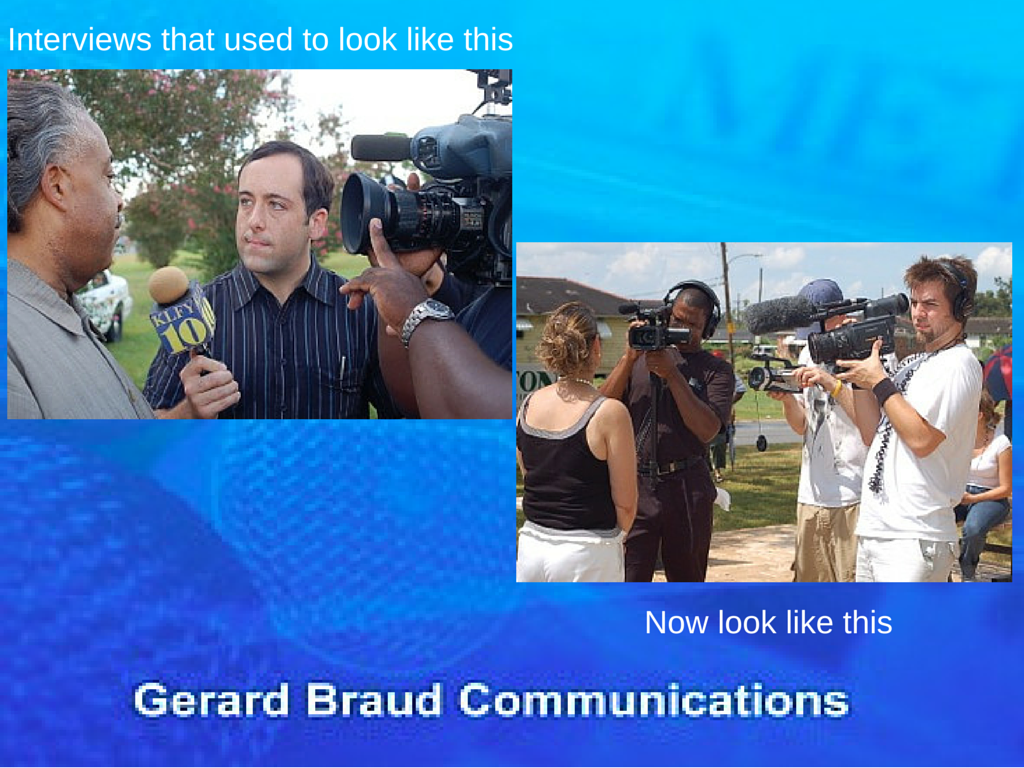 As social media and smart phones expand their reach, we are seeing a seismic shift that is sending tremors through the mainstream media landscape. This is creating both new challenges, as well as new opportunities for media


 By
By  By
By 