Crisis communication resources to help you protect your revenue, reputation, and brand.
Effective crisis communications when “it” hits the fan.

Our blog is filled with deep resources to help with your crisis communication needs. Whether you are writing a crisis communication plan, seeking the best media training tips, or digging for case studies on crisis situations, you’ll find it here. Our goal is to give you all of the public relations resources you need to protect your revenue, reputation, and brand.
For those of you who love DIY and taking on a challenge, we’ve worked really hard to give you a good road map to follow. However, sometimes the fastest option is to bring in a pro. If that’s the case, we’re fully vaccinated and we’re ready to meet your needs, anywhere and anytime.
If you need help with your crisis communications plan, we’re ready to help.
When you need media training for your spokespeople, give us a call.
Anytime your organization needs a great keynote for your conference, we’d value the opportunity to serve you.
We invite you to:
By Gerard Braud, CSP, Fellow IEC
 There is so much to hate about social media. Yet there are so many new avenues of communications available to you during a crisis, that it becomes hard to hate social media. On the other hand, during a crisis social media can blow up with excessive criticism and hate. Add to that, the fact that your older executives may freak out when they read all of the negative hate speech, and then you have a real problem on your PR hands. However, it is impossible to overlook the power of circumventing the media in certain crises when you can’t get news coverage, by taking your message straight to your audience on social media. Also, it is gratifying to get positive feedback from people who were hungry for information and found solace knowing you provided them vital information right there on social media.
…whew!!
Are you as tired of this merry-go round as I am? Sorting it all out is nothing short of exhausting.
So what do you think? Does shiny and new beat tried and true? In other words, does shiny new social media serve you better than the traditional approach to crisis communications? The traditional approach I’m talking about mixes good media relations, with good employee relations and a perfect crisis communications plan.
What happens if you combine all of the new social media, the latest technology, great media relations and great crisis communications all at the same time? I have done it while in seven feet of floodwaters with no electricity for five days. I ended up on live television with CNN and the Weather Channel, broadcasting my story from the heart of a hurricane where even their own news crews couldn’t go. Would you like to learn the secrets of doing that?
 Some of those secrets are in this article in Tactics
To help you sort it all out, you are invited to join me in Washington, D.C. on September 24th where we will explore the good, the bad and the ugly when it comes to social media for crisis communications. Here is how to register with PRSA.
Do not come if you are expecting suggestions for one magic solution that works for every organization. There is no such thing.
Here is a sample of what you will hear.
Come prepared for a tailored solution. Come prepared to discover the right fit for your organization and not the force fit that legions of social media consultants have tried to cram down your throat.
You will explore not only the good and bad side of social media, but you will also discern which elements of a good crisis communications plan, good media relations, and good employee communications are vital.
You will see case studies of companies that have used social media brilliantly in a crisis as well as companies that have spent millions on social media only to find that no one really wanted to participate in their social media conversation.
Also on our agenda is a healthy list of actions you should take on a clear sunny day, in order to be prepared for your darkest day. You will discover that the core elements of a strong crisis communications plan can lay the foundation for every action you take during a crisis. You will be relieved to learn that most of the decisions you will make during your crisis and most of the statements you need to write and issue during a crisis can all be prepared months and years in advance.
Don’t forget speed. Fast communications is the secret spice of all effective crisis communications.
One final thought if you sign up to join us: Clear your calendar for when you get back to the office because you will leave with a significant list of action items that you will want to work on as soon as you get home.
By Gerard Braud
 A clear sunny day is the best time to deal with your crisis. Your darkest day is the worst time to deal with a crisis. Let me explain…
A Crisis Communications Drill can simulate realistic emotions and pressures in a controlled environment, where you can mess up in private, rather than messing up during a real crisis.
Your goal in every Crisis Communications Drill should be to test multiple aspects of the organization. These are the seven most important things I test in the drills for my clients:
1) Is there a properly written Crisis Communications Plan that is so thorough that it can be read during the drill, word-for-word, in real time? Does it ultimately result in flawless performance by the Crisis Communications Team?
2) Did that Crisis Communications Plan allow the organization to begin issuing news releases, postings to the web and e-mails to employees within one hour or less of the onset of the crisis?
3) Did executives within the organization slow down the communications process by excessively word-smithing news releases?
4) Did the Crisis Communications Plan have pre-written news releases that were pre-approved on a clear sunny day by the executive team, so they could be released quickly without re-writes?
5) Are their multiple spokespeople who are qualified to stand before my mock media and survive their questioning?
6) Did misguided egotists step out of their assigned rolls and try to take over other people’s jobs? Did they withhold information that kept others from properly doing their jobs, thereby compromising the organization and in its crisis response?
7) Did the drill create enough realistic drama and anxiety, to add a level of fear into all participating teams? Did it help them realize drills and media training must be treated like an athlete treats their sport? Did it help them understand that regular practice on a clear sunny day makes you your best on your worst day.
This Friday the 13th (September 13, 2013) you will get an inside peak to the secret techniques I use with my clients as I take them through the rigors of a crisis communications drill.
 You will learn:
• How to weave social media into your drill
• Details about who should be involved
• Secrets to a realistic scenario
• Benefits to testing your spokespeople
• Ways to test your team and your Crisis Communications Plan
• Best options for getting future drills in your budget
Here are the sign up details and here is a companion article as a preview:
The Perfect Crisis Communications Drill
Friday, September 13, 2013
EDT Noon
CDT 11 a.m.
MDT 10 a.m.
PDT 9 a.m.
Free to those who use my Crisis Communications Plan with the Living License.
 By Gerard Braud
The pretty stuff always gets more attention than the ugly stuff. Preparing for media interviews and crisis communications is not as sexy as a newsletter or brochure. But when “it” hits the fan, will your customers, employees, and the media be remembering your great graphics? Or will they form their opinion of your company based on dumb things said by a spokesperson or horrific images of your crisis?
Media training, a properly written crisis communications plan, and a well-planned and executed crisis communications drill should be on your list of tasks to be completed before the end of this year.
Excuses are easy to come by for why these three things won’t get done before the end of the year. “It’s not in our budget” is the most common. Here’s a secret: Never take a “No” earlier in the year as a “No” at the end of the year. As sales, revenues, and the economy get better, most companies are seeing training budgets improve. Ask again. You may get a firm yes for this year. Remember: your company will spend far more on a holiday party than they will on any or all of these three tasks.
The second most popular excuse is, “We can’t get on everyone’s calendar.” Here’s a secret: Ask everyone involved if they have time on their calendar to play in a charity golf game. You will be amazed at how many people suddenly have an open day.
Now for the nitty-gritty and why you should do media training, a crisis communications plan, and a crisis communications drill before the end of the year.
In no particular order I’ll say this about each:
A crisis communications drill is the absolute best way to test everyone in your organization to see exactly how well (or how poorly) they will perform in a crisis. You get to test your crisis communications plan (if you have one), and your spokespeople. You will discover who on your leadership team has true leadership skills when “it” hits the fan and who will create constant roadblocks and impediments to success in both the drill and a real event.
Media training should be treated like a sport, with the understanding that regular practice is the key to being good. Every potential spokesperson should go through a rigorous initial media training class, then each year after that go through a refresher course. Too many executives think of media training as a bucket list item, which they only have to do once in their lives. Anyone who believes that may actually die at the podium when you need them the most. By the way, a crisis communications drill is a great time to realistically test your spokespeople. During and following a drill, many potential spokespeople realize that they are perhaps not as prepared as they should be. A little humility in a drill goes a long way toward instilling in people the concept of an annual media training refresher course.
Crisis communications plans have never been more of a necessity than they are now, in large part because of how a crisis now plays out in social media. Any crisis communications plan must equip you to communicate quickly through multiple means, including news conferences, web postings, emails to employees, and updates on social media. Yet many crisis communications plans really cannot help you achieve these goals because they were written with flaws from the beginning and because they haven’t been updated.
The biggest flaw with most plans is that they state only standard operating procedures. If your plan is only 6-20 pages long, chances are you need a major overhaul. I’m standing by to get the right plan in your hands through an intense two-day writing workshop that delivers to you a plan that is so thorough that nothing is forgotten, yet so simple to execute that anyone who can read execute it flawlessly. The plan is also ultra fast to use, because it contains a huge library of pre-written news releases that can be approved by your leadership on a clear sunny day, preventing time consuming delays on your darkest day.
If you are wondering if your plan is up to the task, you can always call me for a free review of your plan.
Ultimately, all three of these end-of-the-year tasks allow you to test your people and your plans on a clear sunny day, so you can perform your best on your darkest day.
Today marks two years since Hurricane Isaac and ten years since Hurricane Katrina.
 In that short time between these two hurricanes, media relations and crisis communications has been affected by social media and technology.
Are you ready to effectively communicate in your next big natural disaster, be it a tornado, snow storm, forest fire or hurricane?
Today we share tips on how to weather your storm with effective crisis communications, based on my coverage of Hurricane Isaac last year.
With seven feet of water in my yard, white caps rolling down my driveway, thousands of snakes, four 10-foot alligators and no electricity, I was able to broadcast live to CNN and The Weather Channel.
This series of 23 tutorials tells you how I did it and how you can do it too. Enjoy!
To view more videos on my hurricane coverage click here.

Click image to watch video
Click here to read Lesson #1 Why Be An iReporter

Click Image to Watch Video
Click here to read Lesson #2 Game Changers in Crisis Communication and iReporting

Click image to watch video
Click here to read Lesson #3 Set Up Your IReporter Account

Click image to watch video
Click here to read Lesson #4 What is News?

Click image to watch video
Click here to watch Lesson #5 Hurricane Isaac: iReports Before, During and After. Is This Guy Crazy?

Click image to watch video
Click here to read Lesson #6 Get the Right Tools to be a CNN iReporter

Click image to watch video
Click here to read Lesson #7 How a Guy in Mandeville, Louisiana Became a Source of Breaking News

Click image to watch video
Click here to read Lesson #8 How and Why to tell a Compare and Contrast Story

Click image to watch video
Click Here to Read Lesson #9 What to Say in Your iReport

Click here to read Lesson #10 Manage the Expectations of Your Audience

Click here to read Lesson #11 Where You Should Look When Using an iPad or Iphone for an iReport

Click image to watch video
Click here to read Lesson #12 Good Lighting for Your iReport

Click image to watch video
Click here to read Lesson #13 How to Manage Your Audio

Click image to watch video
Click here to read Lesson #14 How to Properly Frame Your Video

Click image to watch video
Click here to read Lesson #15 When to use earbuds and headsets

Click image to watch video
Click here to read Lesson #16 How and Why to Plan Movement in Your iReport

Click image to watch video
Click here to read Lesson #17 The Secrets to Using Skype for a Live CNN Interview

Click image to watch video

Click image to watch video
Click here to read Lesson #19 How to Shoot Great B-Roll

Click image to watch video
Click here to read Lesson #20 Learn Why Crap is King When it Comes to TV

Click image to watch video
Click here to read Lesson #21 Get Great New iReporter Gadgets

Click image to watch video
Click here to read Lesson #22 Keep it Short

Click image to watch video
Click here to read Lesson #23 Final Thoughts on How You Can be an Award Winning iReporter
We interrupt this blog with Breaking News. A school shooting at McNair Elementary School in DeKalb County, Georgia is sadly duplicating the same crisis communication failures that we began to outline in this morning’s article and the serious written and awaiting posts in the coming days.
Our goal is not to belittle this school or the DeKalb County schools. Our goal is to have all schools and school districts wake up and adopt crisis communications plans and modern communications techniques. News about a school shooting must come from the school with great effort. Schools must not relegate information to the media, who will speculate about what they don’t know. Schools must not let social media go wild with panic and speculation.
Here is a breakdown of how information is and is not flowing about this shooting, just as it has in many other school shootings:
News helicopters hover with overhead images:

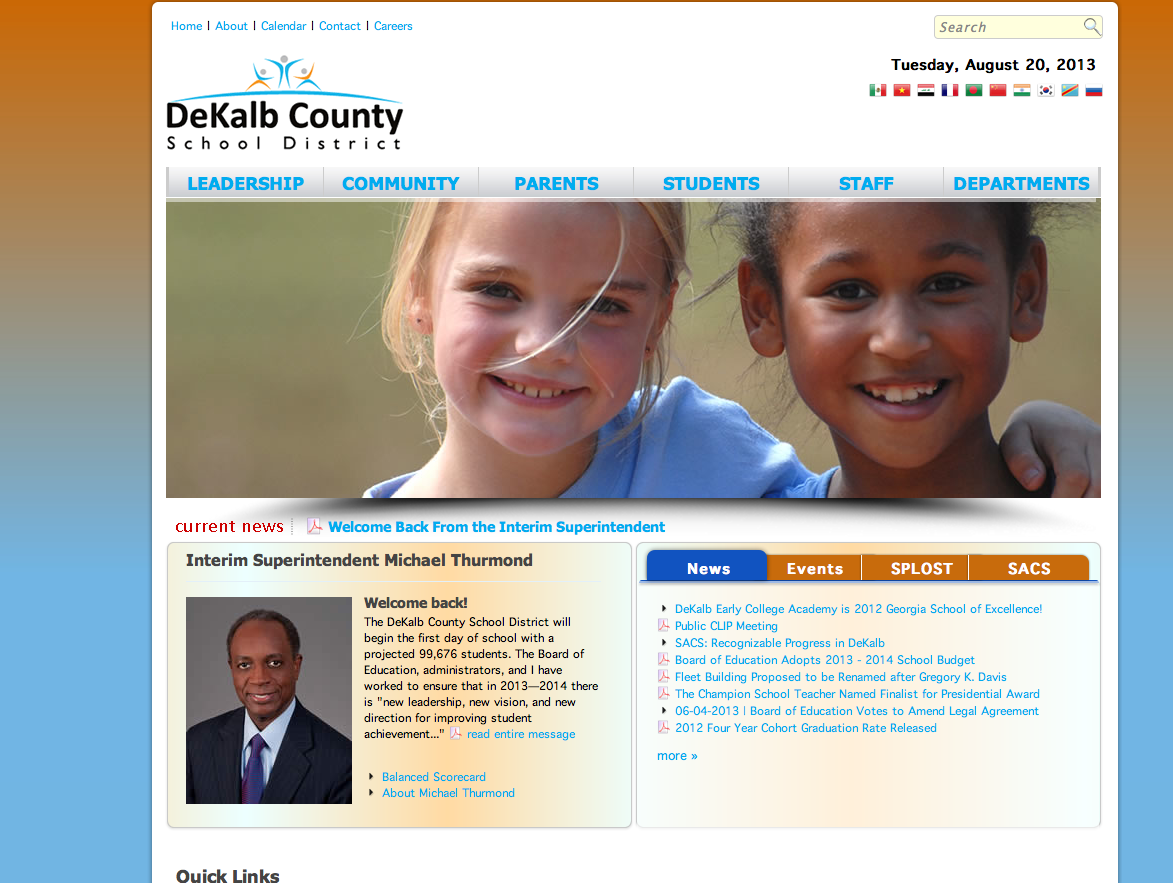
The DeKalb County School website has NO information about the shooting. Within one hour or less of the onset of the crisis, the county should be posting truthful, honest information about this crisis.
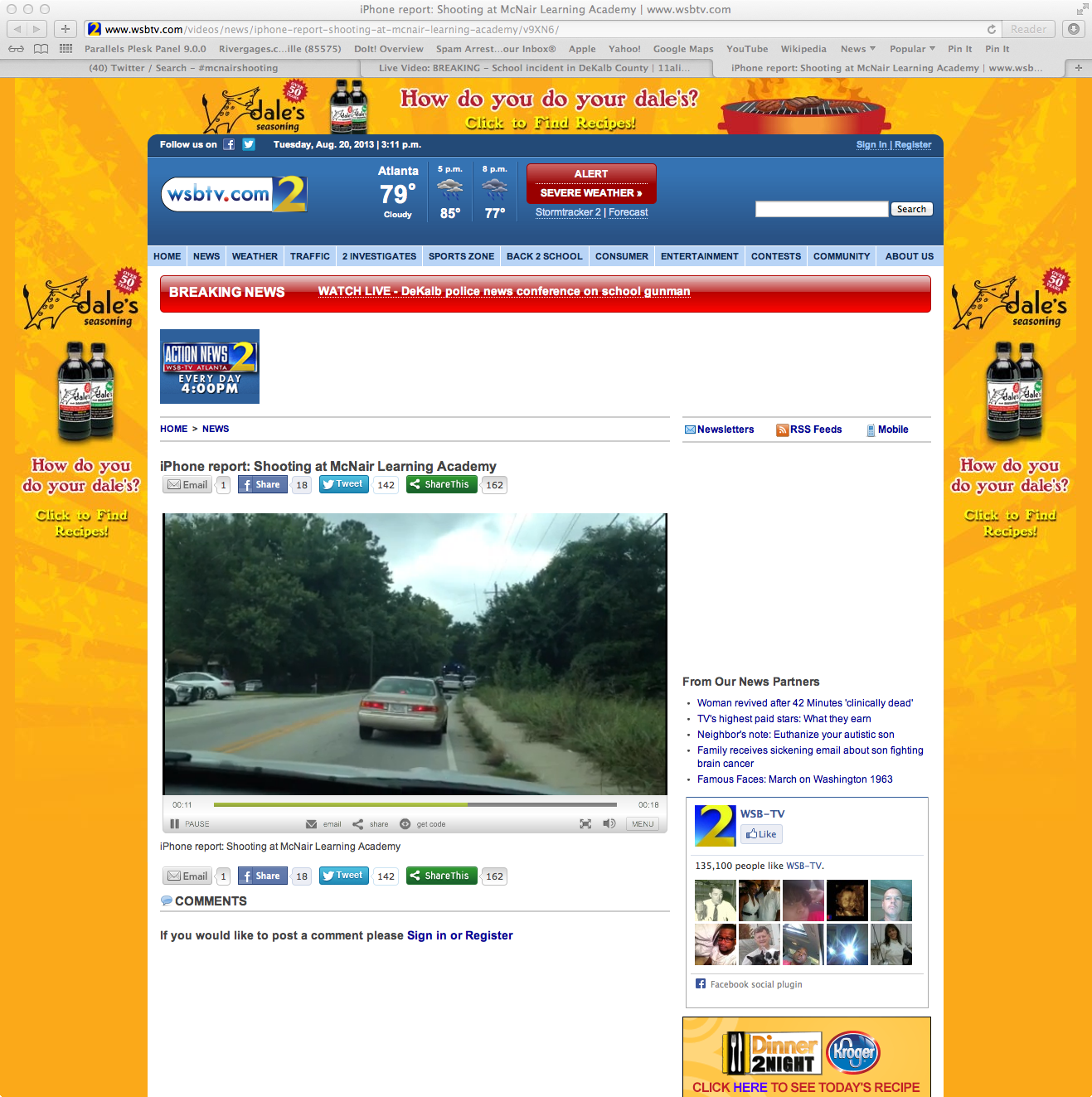
Eyewitnesses post iPhone video.
Online news organizations repost the iPhone video.
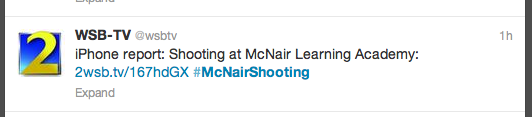
Twitter information about the school comes from observers and the media.

There are no Twitter updates from DeKalb County Schools. In fact, DeKalb hasn’t posted to their Twitter page since July 3. Today is August 20, 2013. Ideally, they should have a short Tweet with a link back to their official website.

The DeKalb Facebook page only gloats about happy news, ignoring this as a viable way to send timely and accurate information to the public. Ideally, they should have a short post with a link back to their official website.

Parents are being interviewed by the media, expressing their fears and frustrations. Police are trying to manage frustrated parents at a time when school officials should be managing this task.
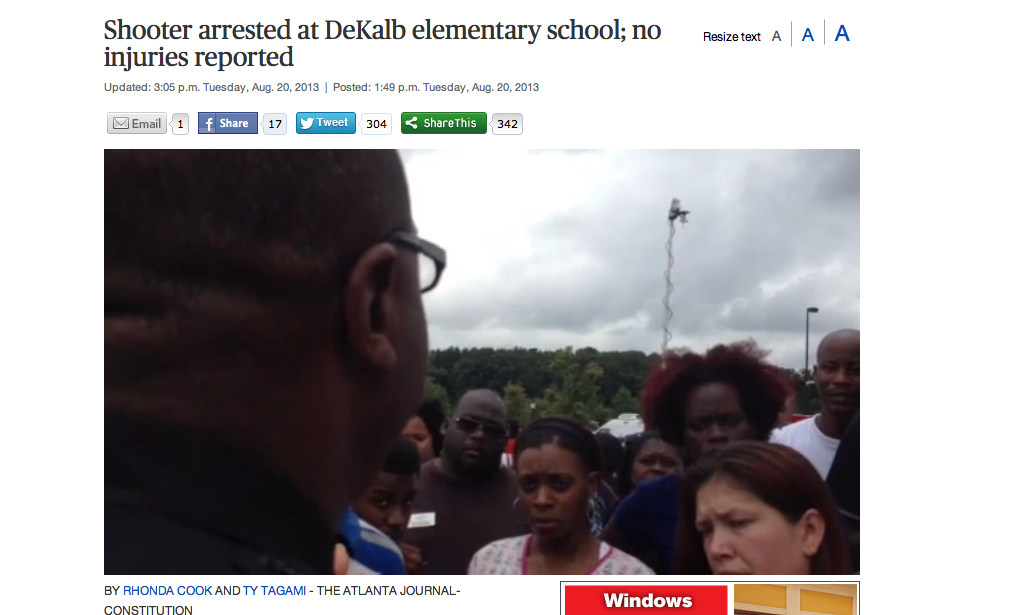
Read these Tweets to hear the frustration of parents amid the lack of official information from school officials.


So far… now in our third hour, we’ve seen no sign of a news conference from the DeKalb County School system. We do know the superintendent has spoken to parents at an area where children are being taken.
The bottom line is, it is time for educators and the education establishment to get educated about crisis communications. If you were being graded on this today, you would receive and F in communication, like so many other schools before you.
By Gerard Braud
Information drives the world. It drives opinion, it causes misconceptions, and it causes confusion. Information — good and bad — is at our fingertips 24/7 though mobile devices and the Internet. Yet in crisis after crisis, official communications is slow. Slow communications often leads to additional deaths and injuries.
 In any sudden crisis, a crisis communications team, with authorization from the crisis management team, should be able to do three things:
1) Hold a news conference
2) Post information to the internet.
3) Use a variety of communications channels to issue detailed information within one hour or less of the onset of the crisis.
As soon as a school shooting takes place, several things happen. First, there is the onslaught of media who will begin interviewing misinformed, hysterical parents and students. At the same time there is a clear absence of an official spokesperson from the school, who could be providing reliable information. Secondly, social media is buzzing with rumors, innuendos, and filled with constant inappropriate and insensitive opinions and comments.
A crisis communications plan solves this problem.
The consistent problem is that in a crisis, actionable information from reliable, knowledgeable, and official sources is lacking. The functions commonly known as public relations, media relations, employee communications and customer (parent/student) communications are often an after thought, relegated to those who have many other responsibilities for other aspects of the crisis. This must change and change quickly.
The future requires that rapid communications of relevant, accurate and actionable information must be made a priority by way of the development and implementation of crisis communications plans in all schools. It requires that key individuals in each school be assigned new communication responsibilities and that they receive training on crisis communications. While certain key individuals manage the crisis, others must manage the communications.
Many documents that purport to be a “Crisis Communications Plan” are not worth the paper they are written on. Most are superficial duplicates of a misguided attempt by schools to list a set of standard operating policies and public relations basics. These fall far short of equipping school leadership and their staff with the necessary tools to communicate rapidly and effectively in a crisis. A properly written crisis communications plan goes far beyond standard operating policy. It gives specific directives, assigned to specific individuals, on an assigned timetable. This ensures that truthful information reaches the media and the masses before misguided rumors spread by word of mouth and social media.
Historically, most organizations “wing it” on the day of their crisis, treating communications as an afterthought amid frustrations of the onslaught of media coverage. Done correctly, on a clear sunny day, an organization must strategize about their vulnerabilities and potential crises, then begin to write a crisis communications plan with clear directives on how and when to respond when any crisis reaches a flash point. This process is often tedious and time consuming because there are very few true expects in this body of knowledge. Implemented correctly on a clear sunny day and used correctly during a crisis, the crisis communications plan will ensure that any school can communicate detailed information to the media and the masses within one hour or less of the onset of a crisis. Achieving this level of speed requires effort beyond just writing the crisis communications plan. It requires that on a clear sunny day, an entire library of pre-written news releases with fill-in-the-blank and multiple choice options is also written, so there is a full library of one hundred or more templates that address most, if not all, of the potential crises identified during the vulnerability assessment.
Your assignment for this article is to plan a day to begin discussing all the things that might go wrong at your school. List them as part of a vulnerability assessment. If the list looks frightening, then good. Will it frighten you enough to take the next step and begin writing a crisis communications plan and your pre-written templates? For most schools the answer is something like, “we would love to have that, but we don’t have time,” or “that’s not in the budget.” If you miss the opportunity to do the right thing on a clear sunny day, you will pay the price on your darkest day.
In our next article we will examine why so many schools (and corporations) are doomed from the beginning because of a major design flaw.