Social media has changed the way that corporate communicators must react to effectively manage a crisis. This week public relations and media relations professionals from all over the world shared their advice on whether or not social media should be part of their crisis communication strategy. Their expert opinion is featured today and every week on the BraudCast. Listen to the video to hear what your colleague’s had to say.
Click image to watch and subscribe to The BraudCast
This question is one of a series of discussions about media relations, crisis communications, public relations, and social media. Yes, YOU are invited to share your bite size bits of best practices each week. Here is how:
Step 2: You will see a short video that poses a new question every Monday. You then post your best practices and observations on The BraudCast YouTube channel.
3: Once your opinion is shared, you can follow the discussion online so you can compare your best practices to those of your professional colleagues.
Step 4: Watch the Follow up Friday Video where you will see a short YouTube video outlining some of the most interesting observations. Yes…your comments may actually show up on our BraudCast video, bringing you world-wide fame, fortune, a big raise, glory, street parades, and more.
https://braudcommunications.com/wp-content/uploads/2020/12/Logo-white-01-300x138.png00gbraudhttps://braudcommunications.com/wp-content/uploads/2020/12/Logo-white-01-300x138.pnggbraud2016-01-22 03:00:002021-05-20 00:24:01You answered: Should social media be a part of your crisis communications strategy?
It is time for you to voice your opinion on crisis communications plans and strategy. Each week we seek your best PR practices on the BraudCast. Your discussion question is, “Should social media be a part of your crisis communications strategy?” Social media has changed the way that media relations and public relations professionals must communicate to effectively manage a crisis. That is why I am asking you to contribute by sharing your best advice with your colleagues.
Click image to watch and subscribe to The BraudCast
This question is one of a series of discussions about media relations, crisis communications, public relations, and social media. Yes, YOU are invited to share your bite size bits of best practices each week. Here is how:
Step 2: You will see a short video that poses a new question every Monday. You then post your best practices and observations on The BraudCast YouTube channel.
3: Once your opinion is shared, you can follow the discussion online so you can compare your best practices to those of your professional colleagues.
Step 4: Watch the Follow up Friday Video where you will see a short YouTube video outlining some of the most interesting observations. Yes…your comments may actually show up on our BraudCast video, bringing you world-wide fame, fortune, a big raise, glory, street parades, and more.
https://braudcommunications.com/wp-content/uploads/2016/01/Thumbnail-BraudCast.png7041268gbraudhttps://braudcommunications.com/wp-content/uploads/2020/12/Logo-white-01-300x138.pnggbraud2016-01-18 10:54:292021-05-20 00:24:33Should social media be a part of your crisis communications plan and strategy?
Some communicators are still trying to make a case to their executives to use social media for their organization. They may be trying to persuade their senior level executives or their board members that social media is not just a form of outbound marketing, but it can be used strategically for crisis communications and media relations. This week the BraudCast question was, “How do you get your executives to buy into the concept of using social media if your organization is not yet using it?” Watch the video to hear how your colleagues answered.
Click image to watch
This question is one of a series of debates in the media relations, crisis communications, public relations, and social media industries where you and your colleagues can share observations with each other. Yes, YOU are invited to share your bite size bits of best practices. Here is how:
Step 2: You will see a short video that poses a new question every Monday. You then post your best practices and observations on The BraudCast YouTube channel.
3: Once your opinion is shared, you can follow the discussion online so you can compare your best practices to those of your professional colleagues.
Step 4: Watch the Follow up Friday Video where you will see a short YouTube video outlining some of the most interesting observations. Yes…your comments may actually show up on our BraudCast video, bringing you world-wide fame, fortune, a big raise, glory, street parades, and more.
https://braudcommunications.com/wp-content/uploads/2020/12/Logo-white-01-300x138.png00gbraudhttps://braudcommunications.com/wp-content/uploads/2020/12/Logo-white-01-300x138.pnggbraud2015-10-15 11:43:102021-05-20 01:13:50BraudCast Answer: How do you get your executives to buy into the concept of using social media if your organization is not yet using it?
This week the BraudCast question is, “How do you get your executives to buy into the concept of using social media if your organization is not yet using it?” Your executives may be more traditional in their communication skills. They may be hesitant about opening their organization up to harsh criticism online, or they may not quite understand the purpose of social media. How do you persuade them about the communications and media relations opportunities that social media can provide for them?
Click image to watch
This question is one of a series of debates in the media relations, crisis communications, public relations, and social media industries where you and your colleagues can share observations with each other. Yes, YOU are invited to share your bite size bits of best practices. Here is how:
Step 2: You will see a short video that poses a new question every Monday. You then post your best practices and observations on The BraudCast YouTube channel.
3: Once your opinion is shared, you can follow the discussion online so you can compare your best practices to those of your professional colleagues.
Step 4: Watch the Follow up Friday Video where you will see a short YouTube video outlining some of the most interesting observations. Yes…your comments may actually show up on our BraudCast video, bringing you world-wide fame, fortune, a big raise, glory, street parades, and more.
https://braudcommunications.com/wp-content/uploads/2020/12/Logo-white-01-300x138.png00gbraudhttps://braudcommunications.com/wp-content/uploads/2020/12/Logo-white-01-300x138.pnggbraud2015-10-13 10:05:092021-05-20 01:14:31BraudCast Question: How do you get your executives to buy into the concept of using social media if your organization is not yet using it?
Some experts say a media trained public relations professional should take the lead as the spokesperson in a crisis, while others suggest a sympathetic statement from a senior executive or CEO. From a crisis management standpoint, this topic is crucial considering a bad media interview can only worsen your crisis, damage your reputation and harm your revenue. Watch the video to hear what communications professionals had to say this week about the topic.
Click image to play
Today’s video is just one of a series of answers to pressing questions in the media relations, crisis communications, public relations, and social media industries where you and your colleagues can share observations with each other. Yes, YOU are invited to share your bite size bits of best practices. Here is how:
Step 2: You will see a short video that poses a new question every Monday. You then post your best practices and observations on The BraudCast YouTube channel.
3: Once your opinion is shared, you can follow the discussion online so you can compare your best practices to those of your professional colleagues.
Step 4: Watch the Follow up Friday Video where you will see a short YouTube video outlining some of the most interesting observations. Yes…your comments may actually show up on our BraudCast video, bringing you world-wide fame, fortune, a big raise, glory, street parades, and more.
https://braudcommunications.com/wp-content/uploads/2020/12/Logo-white-01-300x138.png00gbraudhttps://braudcommunications.com/wp-content/uploads/2020/12/Logo-white-01-300x138.pnggbraud2015-09-17 23:30:062021-05-20 01:25:42BraudCast Answer: Who should be your spokesperson in a crisis?
Because you are so darn smart, it is time to share YOUR smarts. Your bite size bits of best practices are valuable to others just like you. So — ta-dah, drum roll – behold, The BraudCast 2.0 where you are invited to share your best practices in public relations, media relations, social media, crisis communications and employee communications.
Step 3: After you post your opinion, follow the discussion online to compare your approach to those of your professional colleagues.
Step 4: Watch the Friday follow-up video. We’ll share a short video with some of the most interesting observations. Yes…your comments may actually show up on our Friday BraudCast video. And of course, for you, that means fame, fortune, a big raise, glory, street parades, etc.
Thanks in advance for sharing your knowledge. Please take 2 seconds now to subscribe to The BraudCast. The first question begins Monday.
https://braudcommunications.com/wp-content/uploads/2020/12/Logo-white-01-300x138.png00gbraudhttps://braudcommunications.com/wp-content/uploads/2020/12/Logo-white-01-300x138.pnggbraud2015-09-08 11:40:582021-05-20 01:28:19Please Share Your Public Relations Smarts: Here is How
Crisis communications videos are rarely created by corporate spokespeople, government officials, emergency managers, or public information officers (PIO). However, they are an extremely effective way to communicate with your audiences in a crisis. You can be the official spokesperson and speak directly to the media about your crisis, rather than an eyewitness on the street who could be speculating or blowing your issue out of proportion. To create a quality video there are many variables, including how you frame yourself on camera.
Click image to watch video
Think about your vacation photos and videos. When you are in the image, do you see just a little of you and a lot of other stuff around you? Is your head in the middle of the picture, with your body at the bottom, and a bunch of sky above your head?
If so, you are likely not framing your images properly.
Photographers and videographers generally practice what is known as the rule of thirds. Photographers, especially when framing an individual in a photo or video, leave no space for sky above your head. Your hair or forehead fills the top of the frame. Your nose generally fills the center third. Your chin and neck would then fill the bottom third.
While this addresses the horizontal elements of your image, you must also consider the vertical portions of what you have framed. Often, you fill the left or right third of the frame, leaving the other two-thirds as positive space to your left or right.
Much of the poor framing we see today is the result of an entire generation of people using digital cameras. Because the yellow focus square in the viewfinder is in the middle of the viewfinder, most people stand far away from the person in the photo, then frame their head in the focus square. This is horrible. Stop doing it.
Step forward and get closer to the person whose photo you wish to take, then frame it as I have described above.
As with all of these video skills, you must practice in order to get it right. So after viewing the tutorial, take out your smart phone or tablet and record a video. You can also go home to your computer and look at some of your old photos. You’ll likely see that you’ve been framing pictures incorrectly for a long time… but soon you’ll be doing it right every time.
If you, like many others, think this information would be valuable as a workshop at a conference or corporate meeting, please call me at 985-624-9976. You can also download a PDF that outlines the program, Social Media iReports.pdf so you can share it with your meeting planner or training manager.
https://braudcommunications.com/wp-content/uploads/2020/12/Logo-white-01-300x138.png00gbraudhttps://braudcommunications.com/wp-content/uploads/2020/12/Logo-white-01-300x138.pnggbraud2015-06-24 10:39:312021-05-20 01:40:13Tutorial #14 How to Frame Your Crisis Communications Videos Properly
For those of you who attended the workshop, this blog will be part of the continuing education program you were promised. For those who missed the workshop, this will help you learn what the group learned. For those of you who would like a similar workshop for your chapter or professional association, please contact me at gerard@braudcommunications.com.
Before the teach-back segment, here are links to the two additional free training modules I offered to everyone:
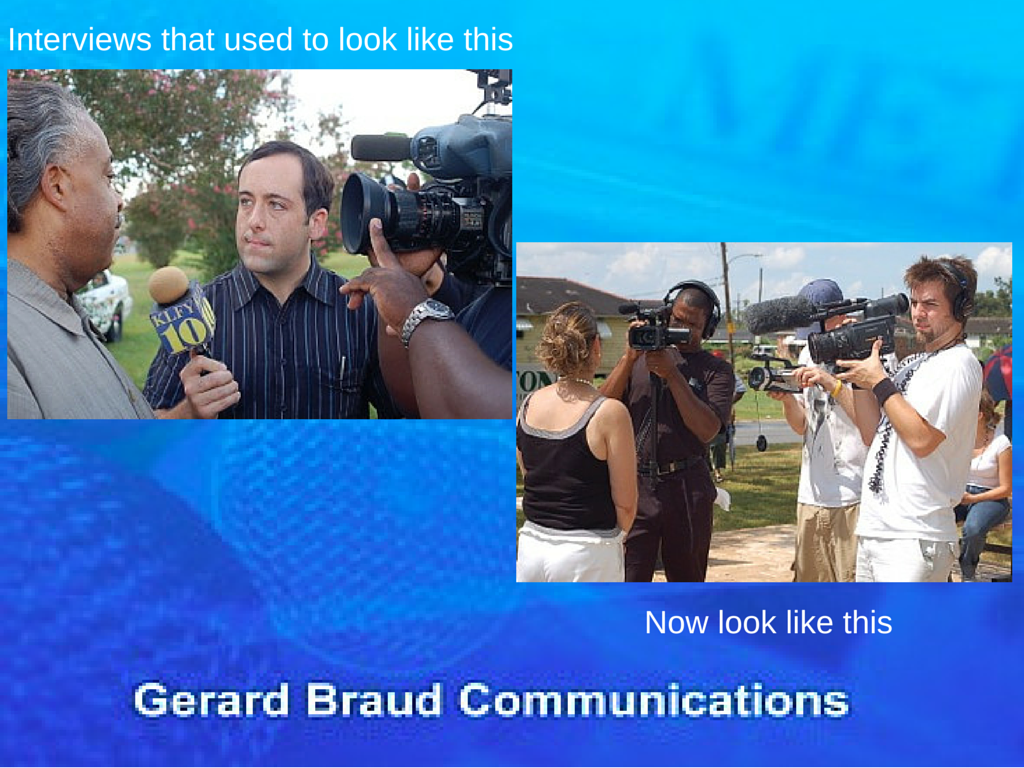
1) Reduced staffs, i.e. fewer reporters, photographers and journalists to tell your story.
Not too long ago a typical network news crew had five people. A typical local television or print crew had a reporter and photographer. Today, newspapers and television stations alike expect a single person to be both the reporter and photographer.
2) The “Caught on Video” craze.
With fewer employees to gather the news, the media depend upon videos submitted by eyewitnesses. The media save a lot of money by not having to chase the news and by letting the news come to them. However, verifying authenticity and facts is a problem. The old rule of, “consider the source,” seems to have gone out the window.
Statistics provided by IQ Media show that in the past three years, there has been a monumental jump in the number of times the phrase “caught on video” is said on television broadcasts.
3) Substituting Trending for News
Virtually every television news cast and every media website feature a segment about what is trending. This means that television airtime and web space are being filled with fluff provided by social media, rather than news gathered by professionals.
Statistics provided by IQ Media show that in the past three years, there has been a monumental jump in the number of times the phrase “trending” is said on television broadcasts.
4) Judgment Day is Everyday
The media have also substituted real news with social media comments from people who judge other people. A perfect example is the condemnation after the U.S. Navy rescued a family from their sinking sailboat on April 6, 2014. The parents had a small child on board and social media lit up with mean comments, which made up a huge part of the news coverage.
5) Pretend In-Depth Coverage
CNN looked foolish with their all-in attempt to cover the Malaysia 370 plane disappearance. Non-stop coverage of a single issue means fewer employees are needed than if your network covered a variety of issues affecting the lives of viewers.
6) Fake Breaking News
Combined with the pretend in-depth coverage is fake breaking news. The television media have a need to put up a banner across the screen each time they learn one new detail, regardless of how silly it is.
Among the many crazy things that CNN called “breaking news” in the Malaysia 370 story, is first breaking the news that the final words from the crew were, “Alright, good night.” The next day it was “breaking news” that the final words were, “Good night Malaysia three seven zero.”
Really CNN? In my time as a journalist we would have called that an error and a correction.
Statistics provided by IQ Media show that in the past three years, there has been a monumental jump in the number of times the phrase “breaking news” is said on television broadcasts.
Solutions to Media Changes
Among the many solutions we discussed, is the need to recognize that in the future, the media will expect you to provide video from any crisis experienced by your company, as well as a narrative. They will expect you to do a selfie style video directly from the scene.
Such videos are hard to do and require training and practice. While the interactive portion of our workshop taught some of the basic skills, the online 23-part tutorial will teach you even more.
https://braudcommunications.com/wp-content/uploads/2020/12/Logo-white-01-300x138.png00gbraudhttps://braudcommunications.com/wp-content/uploads/2020/12/Logo-white-01-300x138.pnggbraud2015-06-17 15:25:462021-05-20 01:42:347 Frightening Media Realities for Public Relations
Everyday in June I will be sharing tutorials for effective crisis communications during hurricane season. The lessons apply to tornadoes, floods, blizzards, and other natural disasters. The future of crisis communications is in video, particularly CNN iReports, which allow organizations to tell the story of their crisis to their customers, audiences and key stakeholders, rather than speculating eyewitnesses. When speculating eyewitnesses videotape your crisis on their smartphones and it gets shared across local or even national media, your organizations reputation and revenue suffer.
Click image to watch video
CNN iReports should be added to the crisis communications, media relations and social media tool kit of every corporation, government agency, and non-profit organization in the world. Should your organization experience a significant crisis that gets significant media coverage, iReports are your direct path to adding perspective and official information about your breaking news story.
Just as most of you have established an account at Facebook, YouTube and Twitter, you should have an account pre-established at www.cnn.com/ireport so it is ready to use if you need it. Unlike other social media sites, you will use this one less often.
The set up process is fast and simple. If you have created any online profile in the past you can figure it out and complete the task in 5-10 minutes.
Some leaders and executives may question whether the company needs an iReport account. My philosophy is that if you experience a newsworthy crisis, you have two options. You can either have your story told by an unofficial eyewitness on the street that has an iReport account or you can provide better video, more factual details, and dispel rumors.
Shortly after your video is filed, a team of CNN iReport producers will watch your video. if they like it, they label it as vetted by CNN. The link is then shared with producers for the various CNN news programs. If those producers like it, they may place all or part of the video on the air in their news program. If your video proves that you have great visuals, a compelling perspective and compelling information, expect to get a phone call from CNN producers, asking you to do a live report via Skype, using your computer, smart phone or tablet.
This link will take you to the index for all of the articles and videos.
If you, like many others, think this information would be valuable as a workshop at a conference or corporate meeting, please call me at 985-624-9976. You can also download a PDF that outlines the program, Social Media iReports.pdf, so you can share it with your meeting planner or training manager.
https://braudcommunications.com/wp-content/uploads/2020/12/Logo-white-01-300x138.png00gbraudhttps://braudcommunications.com/wp-content/uploads/2020/12/Logo-white-01-300x138.pnggbraud2015-06-05 03:00:272021-05-20 01:49:10Tutorial #3: How to Plan for Your Next Hurricane on a Clear Sunny Day
You’ve heard HR leaders and executives say it many times, “Our employees are our number one asset.” If this is true, should those same employees also become your most important audience when a crisis strikes?
An increasing number of HR departments are taking the lead in crisis communications planning to make sure employee engagement is maintained in crisis communications plans.
Public relations teams traditionally wrote and executed a corporate crisis communication plan. In most plans, communications were targeted toward the media.
But the time has come for human resource professionals to forge a stronger partnership with each public relations team. Corporate crisis communications plans must ensure proper and equal communications to the media, employees and social media audiences.
Here are three considerations:
Consideration #1: Employees use social media apps on their personal smart phones. This means they can quickly disseminate facts or rumors about your company’s crisis.
Consideration #2: Haters love to spread rumors on social media, which if read by your employees, can cause employees to doubt whether the corporation is communicating the truth to them.
Consideration #3: With each minute that you fail to communicate to your employees and the outside world, your corporate reputation and revenue are being damaged.
Years ago the media were the most important audience in a crisis communications plan. They were the pathway to get your message to the masses, including your employees. But that has changed, beginning with the advent of e-mail, the web and Intranet sites. Each created a direct pathway for effective employee communications. HR and PR were able to share the responsibility for daily employee engagement.
These same tools should be your primary crisis communications tool.
HR and PR should want employees to get their news, especially about a crisis, from the company, rather than the mainstream media or social media.
Sadly, the norm seems to be that corporate executives make the mistake of thinking that when a crisis strikes they can gather critical executives in a room and hash out a strategy and write a statement. This doesn’t work and it is a recipe for disaster. When time is of the essence there is no time for impending disagreements, personality conflicts, and fights over commas and semantics in news releases. But that is exactly what happens when executives are arrogant enough to think they can “wing it” on the day of their crisis.
It is far wiser to spend a few dollars to prepare, than to watch large sums of money disappear because of falling stock prices and dropping sales, precipitated by a void in timely communications during a crisis.
While your company likely cannot communicate at the speed of Twitter, a reasonable goal is to issue your first statement to the media, employees and other stakeholders within one hour of any crisis going public.
What should you do if you are in HR?
1) Meet with your public relations team and make sure the company has written a crisis communications plan.
2) If there is no plan, partner with PR to write a plan that provides specific steps to communicate with the media, employees and key stakeholders.
3) Ensure that your plan is built for speed, by writing a library of pre-written news releases, constructed with a fill-in-the-blank and multiple choice format, in order to speed up your communications.
4) Establish a policy that states your employees and the media will get identical information at the same time. Never give employees information that is not provided to the media. Also, never give employees any information before giving it to the media.
Posting your official statement on your corporate website lets you provide links by e-mail to all employees and media with the click of a button. The same link can be posted to social media.
5) To perform flawlessly during your crisis you must practice when there is no crisis. Test your crisis communications plan at least once a year with a crisis communications drill.
Surprisingly, many companies do not see a need for a crisis communications plan until it is too late. Of the companies wise enough to have plans, many have failed to update their plans to emphasize the speed, urgency, and importance of communicating with employees.
If your employees are your greatest priority, you should provide them timely and honest information when a crisis strikes.
https://braudcommunications.com/wp-content/uploads/2020/12/Logo-white-01-300x138.png00gbraudhttps://braudcommunications.com/wp-content/uploads/2020/12/Logo-white-01-300x138.pnggbraud2015-05-15 08:06:052021-05-20 01:53:313 Key Human Resources Considerations & 5 Strategies for Employee Communications in a Crisis


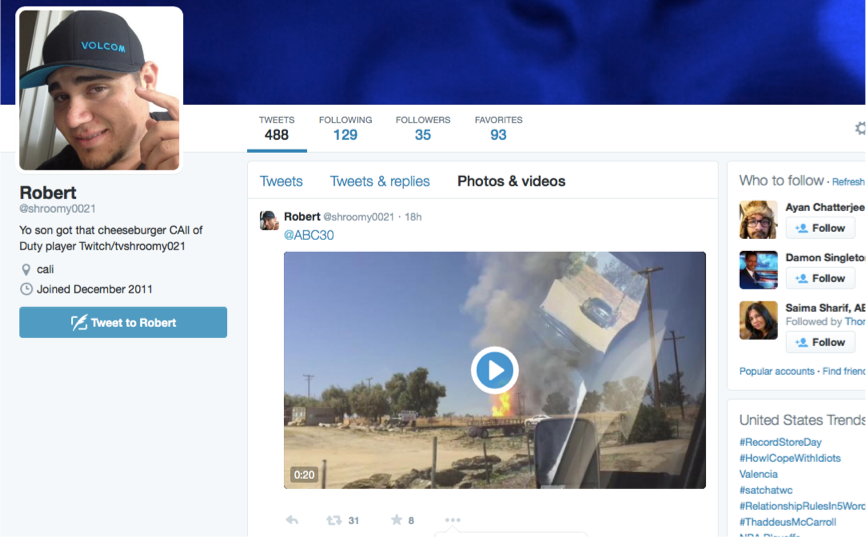 With fewer employees to gather the news, the media depend upon videos submitted by eyewitnesses. The media save a lot of money by not having to chase the news and by letting the news come to them. However, verifying authenticity and facts is a problem. The old rule of, “consider the source,” seems to have gone out the window.
![9866FC2E-26CB-4F4A-9366-0079E19FDD8E[1]](https://braudcommunications.com/wp-content/uploads/2015/06/9866FC2E-26CB-4F4A-9366-0079E19FDD8E1.png)
 Statistics provided by




 By
By