Crisis communication resources to help you protect your revenue, reputation, and brand.
Effective crisis communications when “it” hits the fan.

Our blog is filled with deep resources to help with your crisis communication needs. Whether you are writing a crisis communication plan, seeking the best media training tips, or digging for case studies on crisis situations, you’ll find it here. Our goal is to give you all of the public relations resources you need to protect your revenue, reputation, and brand.
For those of you who love DIY and taking on a challenge, we’ve worked really hard to give you a good road map to follow. However, sometimes the fastest option is to bring in a pro. If that’s the case, we’re fully vaccinated and we’re ready to meet your needs, anywhere and anytime.
If you need help with your crisis communications plan, we’re ready to help.
When you need media training for your spokespeople, give us a call.
Anytime your organization needs a great keynote for your conference, we’d value the opportunity to serve you.
We invite you to:

By Gerard Braud, CSP, Fellow IEC

There is an old expression that says, “Never put off until tomorrow what you can do today.”
In the world of crisis communications and crisis communications plans, that saying should sum up the concept of planning and preparing.
Why would you wait to decide what to do in a crisis, on the day of your crisis, when you can predetermine your actions through a crisis communications plan, as we discussed in yesterday’s blog.
Writing pre-written news releases falls into this same category.
Why would you waste time writing a news release in the midst of a breaking crisis, when 95% of your crisis news release can be written on a clear, sunny day?
– Gerard Braud
If you want to be a crisis expert, examine what goes right in most crises and what goes wrong in most crises.
In the age of social media, one of the things that perpetually goes wrong is that eyewitnesses tell your story long before your official, well-informed account is ever told.
A perpetual pain, problem and predicament for public relations people is that since so many people fail to plan ahead, they wait until they are in the midst of a crisis before they write the first word of their crisis news release.
Imagine you have a fire and explosion. Imagine that people may be dead or injured. Imagine that there is a fire and evacuations are necessary. And imagine that in the midst of all of this chaos and anxiety, you have to open a new Word document and start writing a news release. Yes, imagine that you are staring at a blank computer screen and writing from scratch. That, my friends, is insane.
Furthermore, you’ll spend 30 minutes to an hour drafting your release. Then your crisis management team will spend 30 minutes to an hour marking up and making edits to your first draft… so that pisses away two hours. By the time you finish your second draft and the approval of your second draft, it will likely be 3 to 4 hours before your company releases their very first statement. Keep in mind that within the first 60 seconds of that explosion, eyewitnesses started posting pictures and video on social media. Some eyewitnesses may be broadcasting your crisis live on social media. You are insane if you are going to let 3 to 4 hours pass without an official news release.
At a minimum, your organization should have a First Critical Statement issued in one hour or less of your explosion. A First Critical Statement is a basic pre-written news release that can be edited and released in 5 to 10 minutes. If you don’t have one, download one free from my website. Use the coupon code CRISIS
Today, on a clear, sunny day, you can likely write 30 smart, well-worded sentences that could be used as your crisis news release for that explosion.
What might that look like?
It would include:
Your goal should be to have one pre-written news release for EVERY item that you list in your Vulnerability Assessment that we talked about in Monday’s blog. My goal is to always have a minimum of 100 pre-written news releases in every crisis communications plan.
If you know the pain of a lengthy news release review by executives and lawyers, you should take comfort that a pre-written news release can be pre-approved. That means the language and sentence structure has been cleared and given the green light. The only thing that needs to happen before you release your statement is that you need to double-check the facts on the day of your crisis.
A pre-written news release is your best friend during a crisis.
Crisis communications and media training expert Gerard Braud, CSP, Fellow IEC is based in New Orleans. Organizations on five continents have relied on him to write their crisis communications plans and to train their spokespeople. He is the author of “Don’t Talk to the Media Until…”
More crisis communications articles:
Please Pick Me to be Your Media Trainer
The Biggest Lie in Crisis Communications
4 Steps Every Company Needs to Take in Order to Avoid the Default Spokesperson
By Gerard Braud, CSP, Fellow IEC
You are being challenged to complete 5 steps toward effective crisis communications before the end of 2019. Today the focus is on how to be a crisis expert in every crisis, because you have the right kind of crisis communication plan.
The first question to ask yourself is do you have a crisis communications plan where you work?
If you have a crisis communications plan where you work, excellent. We will next challenge you to review your crisis communication plan to make sure it works.
If you don’t have a crisis communication plan where you work, turn to the Vulnerability Assessment that you read about in yesterday’s blog. Review your Vulnerability Assessment and review the potential economic impact that various crisis events could cause to your employer. THAT should be your justification for making crisis communications planning a priority.
By definition, a crisis communications plan is a tool. It should be as vital to a public relations person as a hammer is to a carpenter or a calculator is to an accountant.
-Gerard Braud
The sad reality is that many companies and the executives in charge of these organizations simply think PR people will magically make everything go away if and when a crisis happens. That is never true. It isn’t magic. Crisis communications takes planning, preparation, practice, and successful implementation as a crisis is unfolding.
Likewise, many public relations people take pride in trying to wing-it in a crisis. Then, after they fail they want to do a conference breakout session on the lessons they leaned by not being prepared. Really? Most crisis communication experts would say that you should be fired because you have the means to learn and prepare, yet you failed to prepare.
In too many situations, communicators copy someone else’s bad idea of a crisis communications plan. By that, I mean most plans that I’ve been asked to review over the past 20 years are 6 to 12 pages long. Most contain checklists of things that should be done.
The flaw with these plans is:
If you have this kind of a document and you think it is a plan, you are mistaken. It is only a checklist.
My dream for you is that your crisis communications plan:
Yes, it is a tall order. But yes, it is doable.
Yes, it is a lot of work. Yes, it will cost you time and/or money. But in fairness, go back to any one item on your Vulnerability Assessment and re-examine the financial impact of each potential crisis. That should help you justify the amount of time and/or effort and/or money that you and your employer should be willing to devote to the process of writing or refining your crisis communications plan.
Always remember what has been said a million times: “If you fail to plan; plan to fail.”
Crisis communications and media training expert Gerard Braud, CSP, Fellow IEC is based in New Orleans. Organizations on five continents have relied on him to write their crisis communications plans and to train their spokespeople. He is the author of “Don’t Talk to the Media Until…”
More crisis communications articles:
The Biggest Lie in Crisis Communications
4 Steps Every Company Needs to Take in Order to Avoid the Default Spokesperson

By Gerard Braud, CSP, Fellow IEC
This is a 5-day crisis communications challenge. With only four months left in 2019, you are being challenged to focus on your crisis communications plan with crisis preparation, crisis practice, and ultimately, a focus on how you can be the expert who achieves crisis perfection.
In January 2019, you were issued a dare to participate in the five steps to effective crisis communications video course. Some of you have taken the challenge and you’ve become expert communicators. Some of you kicked the can down the road. No worries can-kickers. You can become a crisis communications expert in the four remaining months of 2019.
The dare to complete the 5-step video course still stands. I challenge you to take 10 minutes a day for five days to watch, learn, then implement the five steps. Register with this link.
Your mind has been pre-occupied in June & July with vacation. In August your distraction is getting the kids back in school. Use September to refocus and start with either conducting a baseline Vulnerability Assessment or updating your existing Vulnerability Assessment.
In order to write a crisis communications plan and a library of pre-written news releases for when “it” hits the fan, you have to know what your “it” is.
If you’ve never done this before, open an Excel spreadsheet and start writing down every sort of situation that could become a crisis that would cause you to generate a possible crisis response.
Keep in mind that this must go beyond a list of emergency situations. While emergencies are usually something that can trigger a crisis communications plan, non-emergencies are often more likely to trigger your crisis communication plan. This includes executive misbehavior, such as sexual harassment and embezzlement.
Once you’ve written down everything you can think of, separate them by classes, such as, natural disasters, crime, environmental, labor, activists, violence, workplace injury/fatality and so on.
Now start making visits to executives, middle managers, and members of your labor force. Simply ask them what situations they see daily that could arise to the level of a crisis. Define for them that a crisis is anything that can damage the reputation and revenue of the organization.
Add their observations to your list. Sort their observation by categories.
Next, attempt to identify what the economic impact would be to the organization if each one of these things happened. Use real dollars to calculate real impact for each one of the scenarios you identify.
By the way, once a quarter you should revisit this list and this process because new events will come up that did not exist three months before.
Once your list is completed, call a meeting with executives and let them know what you have learned and share the potential financial consequences of each item on the list.
Often, this list of vulnerabilities can be reduced because leaders will speak up and offer ideas that can eliminate a potential situation or crisis. Great. Hold them accountable to eliminate or mitigate the issue. For example, if malware and fake links in emails is one of your vulnerabilities, your IT team can likely put systems in place to prevent employees from clicking on bad email links. Hence, crisis eliminated or mitigated.
For all that remain, you now need to be prepared to communicate about them in the event any of these particular issues ignites into a crisis.
Tomorrow we’ll talk about how to begin managing your communications with a crisis communications plan.
Crisis communications and media training expert Gerard Braud, CSP, Fellow IEC is based in New Orleans. Organizations on five continents have relied on him to write their crisis communications plans and to train their spokespeople. He is the author of “Don’t Talk to the Media Until…”
More crisis communications articles:
Please Pick Me to be Your Media Trainer
The Biggest Lie in Crisis Communications
4 Steps Every Company Needs to Take in Order to Avoid the Default Spokesperson
By Gerard Braud, CSP, Fellow IEC
Amid three mass shootings in two weeks, it was surprising to get a call from the public information officer (PIO) of a city, asking what it would cost them to implement my crisis communications plan system for their town.
“We have lots of festivals and I think we are vulnerable to a mass shooting like they had at the Garlic Festival in California,” she said. In that shooting, four people died, including the gunman, and 13 others were injured.
Why is it surprising that a city wants a crisis communications plan? The reality is, every community and business should have a crisis communications plan with pre-written news releases for mass shootings and workplace shootings. But history tells us that a crisis seldom generates a discussion along the lines of, “What would we do if that happened here?” as it relates to communications and specifically crisis communications.
Hats off to this PIO for wanting to open a discussion with her city leaders. She admits that she’s been rebuffed before when she has tried to generate interest for having a robust crisis communications plan. The city’s elected officials seem to think it is a waste of time and money. They expect the PIO can just magically respond.
This flawed thinking is common among elected officials and corporate leaders. Many are in denial or ignorant about how fast news travels on Twitter, Facebook, and other social media channels. This is due in part to the fact that many of these decision makers don’t like or use social media, so they know of it… but they don’t understand the nuance of how fast bad news travels.
Time was when each shooting used to generate an article from me, urging people to evaluate how each school, community or business responded. We would examine whether news conferences were done correctly, whether the first news release was issued in less than one hour, and we would examine how media filled the void of news with mindless speculation. Those articles usually led to rebuffs alleging that it was “too soon to talk about it” or that it was “too opportunistic to talk about it.”
Experts in crisis communications would advise you that each crisis, whether it is a mass shooting, workplace violence, natural disaster, or sexual misconduct allegation, creates an opportunity to have a conversation and ask, “What would we do?” and “Are we prepared for something like this?”
If you want to be the crisis expert in your school, community, or company, here are 5 Steps that you can take immediately:
1) Conduct a Vulnerability Assessment to determine all of the potential crises that could befall your community or your company. This becomes your road map for your crisis communications plan and the number of pre-written statements you will want to have in your crisis communications plan.
2) Write a Crisis Communications Plan that precisely guides the organization through the process of gathering information quickly, confirming that information with leaders, then quickly issuing a series of statements to the public, the media, employees, and other key stakeholders.
3) Write a Library of Pre-written Statements that can be edited and customized quickly for distribution. That same statement should go to all employees, the public, to your website, and to your social media channels.
4) Conduct Media Training for all potential spokespeople and teach them how to conduct a news conference using the pre-written statements. The statements must be written for the spoken word and they must proactively answer every question that reporters will ask in a news conference. Never send a spokesperson out to ad-lib a news conference. It gets ugly fast.
5) Once you have completed the above four tasks, conduct a Crisis Communications Drill so that you can test your plan, your pre-written statements, and your spokespeople. Pepper your drill with misdirection, mock social media posts, and add at least two mock news conferences to your drill.
Be bold. Start a conversation that others may not be willing to have.
Be bold. Take action.
If you’d like to dig deeper into these five steps, request your free access to the 5-part video series on the 5 Steps to Effective Crisis Communications. Use this link to register.
Crisis communications and media training expert Gerard Braud, CSP, Fellow IEC is based in New Orleans. Organizations on five continents have relied on him to write their crisis communications plans and to train their spokespeople. He is the author of “Don’t Talk to the Media Until…”
More crisis communications articles:
Please Pick Me to be Your Media Trainer
The Biggest Lie in Crisis Communications
4 Steps Every Company Needs to Take in Order to Avoid the Default Spokesperson
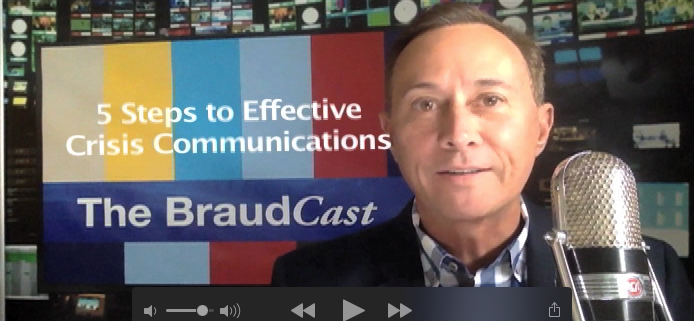
If you would like to master the 5 Steps to Effective Crisis Communications, now is the time to register for the Louisiana Hospital Association’s full-day workshop on November 7, 2019 in Baton Rouge. Learn how you can be a crisis communications expert.
For full details, use this link to download the brochure.
To register, click here.
The cost is only $195 for LHA members and only $250 for corporate guests.
To hear more about what you will learn in this workshop, watch this video:
| When: | Thursday, November 7, 2019 10:00 a.m. – 4:00 p.m. |
| Where: | Map this event » LHA Conference Center 2334 Weymouth Drive Baton Rouge, Louisiana 70809 United States |
Presenter: Gerard Braud, CSP, Fellow IEC – Gerard Braud Communications
Contact: Melissa Arthur
marthur@lhaonline.org
225-928-0026
Crisis communications and media training expert Gerard Braud, CSP, Fellow IEC is based in New Orleans. Organizations on five continents have relied on him to write their crisis communications plans and to train their spokespeople. He is the author of “Don’t Talk to the Media Until…”
More crisis communications articles:
Please Pick Me to be Your Media Trainer
The Biggest Lie in Crisis Communications
4 Steps Every Company Needs to Take in Order to Avoid the Default Spokesperson
By Gerard Braud, CSP, Fellow IEC
Tropical Storm and Hurricane Barry created a great opportunity this weekend for you to review your crisis communications strategies. Among them, strategically, are you using Facebook Live, YouTube Live, and other live social media channels to their full advantage when a natural disaster affects your organization and your customers? The power is right there in your hand with your cell phone.
I posted videos all weekend long as an example of how you can use this great live feature on social media platforms. Since 2011 I’ve been teaching public relations and customer service teams how to do what I do, such as in my training program called Weathering the Storm.

What participants quickly learn is that shooting good, short videos… and especially live videos on your cell phone, is hard. It comes rather easily for me, because I was a television reporter for 15 years – I have lots of practice.
1) Practice – Do a test recording before you go live. Mess up in private so you don’t mess up live.
2) Be a brand journalist – manage the expectations of your employees and customers. Tell people your best case scenario and your worst case scenario when bad weather is approaching. Also, like a journalist, cover the Who, What, When, Where, Why and How.
3) Be brief and don’t overwhelm your audience with unnecessary details. I posted 10 videos to my BraudCast YouTube channel in the past few days. They range in length from one minute to three minutes. On my private Facebook page, I initially posted serious “news” style videos because friends and friends of friends wanted to know how bad the flooding was in our town of Mandeville, Louisiana.
Late Saturday and into the day Sunday, my videos transitioned to being more humorous and silly – mainly for my own amusement and the amusement of close friends. Humor has to be used sparingly in a corporate setting. When done properly, it is effective; when done poorly you can easily create a secondary crisis on social media. Be careful.
Once your videos are posted, you can then share them with reporters on Twitter. I also uploaded b-roll to my Google Drive to share with the media (to learn what b-roll is, read more here). Media coverage in our town increased as reporters from around the world saw my videos on YouTube and Twitter.
Would you like to become an on-camera live video expert? Call me at 985-624-9976 to book your training class.
Crisis communications and media training expert Gerard Braud, CSP, Fellow IEC is based in New Orleans. Organizations on five continents have relied on him to write their crisis communications plans and to train their spokespeople. He is the author of “Don’t Talk to the Media Until…”
More crisis communications articles:
Please Pick Me to be Your Media Trainer
The Biggest Lie in Crisis Communications
4 Steps Every Company Needs to Take in Order to Avoid the Default Spokesperson