Crisis communication resources to help you protect your revenue, reputation, and brand.
Effective crisis communications when “it” hits the fan.

Our blog is filled with deep resources to help with your crisis communication needs. Whether you are writing a crisis communication plan, seeking the best media training tips, or digging for case studies on crisis situations, you’ll find it here. Our goal is to give you all of the public relations resources you need to protect your revenue, reputation, and brand.
For those of you who love DIY and taking on a challenge, we’ve worked really hard to give you a good road map to follow. However, sometimes the fastest option is to bring in a pro. If that’s the case, we’re fully vaccinated and we’re ready to meet your needs, anywhere and anytime.
If you need help with your crisis communications plan, we’re ready to help.
When you need media training for your spokespeople, give us a call.
Anytime your organization needs a great keynote for your conference, we’d value the opportunity to serve you.
We invite you to:
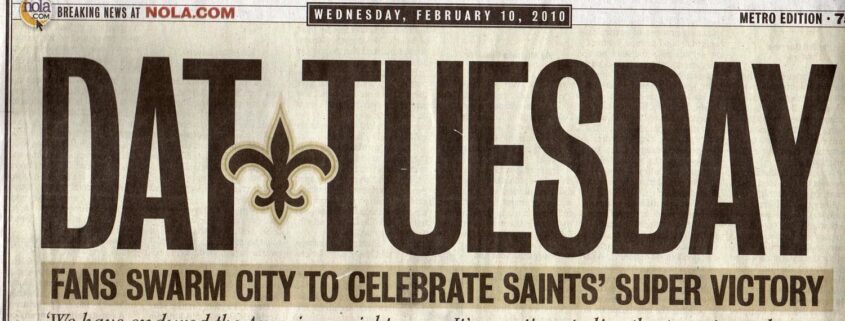

In the Executive Media Training classes I teach, I always emphasize the power of a verbatim quote as a key message, rather than relying on talking points and the ad lib problems associated with talking points. So to prove the power of a pre-planned, verbatim quote, I recently set out to literally be the one-in-a-million quote.
My beloved New Orleans Saints won the Super Bowl. Hence, a Super Bowl parade was planned and one million people turned out to watch. As my daughter and I drove into the city that day, we saw the media gathering to cover the euphoria. So I told her, “I think dad needs to be on the front page in the morning.”
She gave that uneasy laugh, knowing I’m a man of my word and knowing I’m always willing to do something extreme to make a point. Finally she asked, “So what’s your quote going to be.”
I replied, “We’ve suffered the American nightmare… no… we’ve endured the American nightmare… it’s our turn to… no… it’s our time to share in the American dream.”
She laughed. Several hours later while waiting for the parade to begin I saw a reporter I know. I called him over and asked if he needed a quote for his story. He rolled his eyes, then asked, “What is it?” as though he expected something lame.
“We’ve endured the American nightmare. It’s our time to share in the American dream.” Read more
Media Training in New Orleans Lesson coming this Monday. Don’t miss the one-in-a-million quote.
By Gerard Braud
It’s hard to believe that in 2010, people can still screw up public relations, crisis communications, crisis management and media relations, as much as Tiger Woods and his handlers.
Friday’s statement by Woods was old school. It was bad. It was too little. It was too late.
The Gerard Braud school of crisis communications says you should issue a public comment within one hour or less of the onset of a crisis going public. That means a statement should have been issued the day of the accident.
It’s 2010 and we have YouTube.com. I would have had Woods post a short YouTube video the morning after the accident. Nothing fancy; a simple point and shoot video camera with Tiger on camera saying, “Hi, this is Tiger Woods. Last night I did something really stupid and embarrassing. While backing out my driveway I hit a fire hydrant. I over reacted, pulled forward and hit a tree. You can imagine how embarrassing this must be for me. I’m okay. I’m not injured. I appreciate the concern of my fans. At this time I simply need to repair my car and my ego.”
When you say nothing, you open the door to speculation. When Tiger said nothing, he opened the door to all of his affairs. Had he issued a statement, there is a good chance none of this would have ever gone public and he could have dealt with his infidelity in private.
Waiting three months to make an appearance is unacceptable in 2010. Also unacceptable is the idea that Woods had to do the statement live, reading from a script, and taking no questions from reporters.
Here are my observations: Read more
This is our 5th and final day of looking back at the sins of 2009 and ways to redeem ourselves for 2010.
Today we’ll look at what leaders don’t know.
In 2009 I launched a new keynote called, Leadership When “It” Hits the Fan. It has placed me on the stage in front of a growing list of associations and audiences of CEOs, VPs and managers.
And as much as I bashed Social Media yesterday for being a shiny new object, the fact is, that shiny new object can have serious negative consequences for a company, especially when things go wrong.
It always disturbs me during my keynote, as I enter a dialogue with the leaders, to learn exactly what they know, what they don’t know, and what they don’t know they don’t know.
During a crisis I live by a cardinal rule to communicate quickly with the media, your employees and other key stakeholders. My goal is to make sure a company issues a public statement within the first hour that a crisis has gone public.
Leaders, meanwhile, often fall into decision paralysis. As a result, they make no decision because they fear they will make the wrong decision. They wait to have all the facts before they say anything at all.
The biggest thing leaders don’t know, going into 2010, is how fast the world of Social Media moves. Leaders are oblivious to the fact that while they are in their crisis command center, deciding if they should issue a statement, their employees, customers and the public are posting comments, pictures and videos to the web at lightening fast speed.
During my keynote, I ask the leaders how many of them have used the most popular forms of social media.
• When asked how many use LinkedIn.com, 10% – 20% usually say yes. Read more
January 15, 2009 generated the Tweet Heard ‘Round the World, as a TwitPic became the first official news coverage of an airplane landing in the Hudson River.
We’ll discuss this game changer and the changing face of crisis communications in a special teleseminar called, “Social Media When It Hits the Fan.”
Tuesday, January 19, 2010
11 a.m. CST
Registration $99
($79 for BraudCast subscribers with discount code)
(FREE to Braud Crisis Communications Plan users with discount code)
Warning: I’m very harsh on how Social Media is used as an outgoing communications tool. I’ll also dig deep into what your leaders don’t understand about Social Media’s negative impact in a crisis.
Who should attend: Public Relations & Communications Teams, Risk Managers, Emergency Operations Teams, Human Resource Teams, Security Teams
Suggestion: Listen as a team, then schedule a one hour meeting of your teams to discuss what you heard and how it will change your internal and external procedures.
Today we’re going to look at one of the biggest sins of 2009… shiny new objects syndrome.
When I look back at 2009, I’ll remember it as the year that people became obsessed with Twitter and Facebook. Seems everywhere I turned, people were clamoring over these shinny new objects… like aborigines who have seen themselves in a mirror for the first time.
The obsession with these tools is perplexing for me, because I know some people truly enjoy them… while others have jumped on the bandwagon because they fear being left behind. It’s a classic version of trying to keep up with the Jones.
The sad reality, is that while many people were chasing after the shinny new objects, they took their eye off the ball; they lost track of priorities, especially in the field of communications.
All communications is about what you want the other person to know and how you want them to respond to that communications. There are many tools that can help you achieve this goal, but too many people in communications have tried to force fit Social Media not only into their tool kit, but to make it paramount as a communications tools.
I think that is a bad idea. Social media reflects a huge generational gap between those under 30 who use it often and those older than 30 who have never used or seen a social media site.
While they tools have their benefits for maintaining certain relationships, they are often a force fit in a corporate culture. Sure, frantic fans of a movie star may want to track their every move on Twitter, but do customers of a chemical company really need to follow your Tweets…and do you really think that I want to follow your Facebook fan page? Not likely.
The reality is, as a communications platform, Social Media sites are unreliable and vulnerable to hacking. There are still many other forms of communications in your tool chest that are more reliable and are better for reaching your loyal audience.
So if shiny new object syndrome was your sin in 2009, as we enter 2010, your redemption would be to make an effort to not get distracted by what is shinny and new, but to use it only when it is a good fit and the right fit…not a force fit.
I get asked about using Social Media a lot as a crisis communications tool, so on January 19th at 11 a.m. CST, I’ll host a special telemseminar called, Social Media When “It” Hits the Fan. If this is a topic that impacts your and your team, I invite you to sign up. We’ll look at examples of when Social Media has worked well and when it has been a huge failure.
Tomorrow, we’ll wrap up the week with a look at what leaders don’t know and how it impacts your job.
And…
1) If you’d like to sign up FREE for the audio version of this, known as the BraudCast, click here.