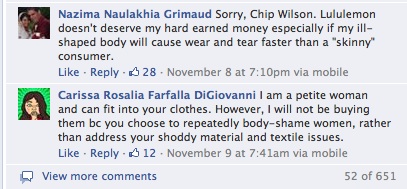
Recently we have published two articles here about Lululemon founder Chip Wilson. The first focused on his foolish ad-libs in a TV interview for which he was clearly not prepared. In the article we said his failure to prepare for the media interview would affect his profits. The second article focused on his poor attempt to apologize for his first blunder, creating a social media fire storm. Now comes the news that he is out as Chairman of the company he helped found, because of… wait for it… wait for it… because of things he said.
Click image to watch video
Chip Wilson’s ad-libs and bad media interview caused him, in large part, to be ousted from the company that he helped start.
Verbal blunders have cost an executive his position in his company.
This should be a wake-up call to all public relations people, executives and CEOs. It should be, but it won’t. Most CEOs and executives will remain too stubborn and arrogant to schedule time for training. Most public relations people will be too timid and afraid of losing their jobs to get in the CEO or executive’s face and demand that they dedicate ample time to prepare for EVERY media interview.
Many CEOs and executives treat media training as though it is a bucket list item – something they do once in life. This is as dumb as me taking one class at putt-putt and thinking I can play golf against Tiger Woods in the PGA.
EVERY interview requires practice.
Media interviews are not something you should ever take lightly.
Media interviews affect your bottom line.
Media interviews are connected to money.
Media interviews affect profits.
Click to watch interview
I’m befuddled to see how corporations spend millions on branding, millions on product development, and millions on all the contracts lawyers write, all to protect profits. Why would any corporation or executive spend so much on all of that stuff… why would they place such a high financial value on all of that stuff… yet completely under estimate the financial value of a media interview?
Wake-up executives.
Wake-up public relations people.
Wake-up corporations.
Wake-up CEOs.
Wake-up Chairmen and boards.
If you invest time and effort in media training it will pay huge dividends.
I’ve witnessed corporations lose millions in moments in a bad interview.
I’ve witnessed corporations make millions in a moment in a well planned and practiced interview.
If you could attach a dollar to every word you say, would you make money or lose money?
https://braudcommunications.com/wp-content/uploads/2020/12/Logo-white-01-300x138.png00gbraudhttps://braudcommunications.com/wp-content/uploads/2020/12/Logo-white-01-300x138.pnggbraud2013-12-11 10:52:122021-05-20 23:17:04Media Training for CEOs and Executives Worldwide May Save Their Jobs & Protect Their Profits – Ask Lululemon Founder Chip Wilson
Watch the news coverage as winter storms move across the United States, leaving many people without power in the cold for up to two weeks. Much of this story is being told through the eyes of the so-called, “citizen journalists.”
Citizen journalism is one of the reasons breaking news got broken. While corporate communicators, corporate executives and corporate lawyers haggle over every word and comma in a news release, eye witnesses to news events are posting their pictures and videos online with astounding speed.
Corporations around the world need to wake up. They need to rethink their approach to media relations and crisis communications. They need to think and act like citizen journalists. They need to post fast to the web.
When I hear a corporate communicator tell me, “Our people will never let us do that,” my first instinct is to channel my inner Ron Burgundy because, “I’d like to punch you in the spleen.” Trust me, in 1994 I heard these same people telling us that we couldn’t use e-mail and websites. They were wrong then and they are wrong now.
But seriously – stop saying you can’t. Here are 5 things to consider.
#1 The Miracle on the Hudson
When U.S. Airways had a jet full of people land in the Hudson River in the media capitol of the world, all of the world’s media used the same image taken by a guy with a smart phone who posted the image to Twitter. I’d wager that U.S. Airways might have not even known they had lost a plane when those first images hit Twitter. You must be that fast to post images of your own news events.
#2 The Virginia Tech Massacre
On that sad day when 32 people died at Virginia Tech, University officials were slow to meet, slow to make decisions, and slow to issue both news releases and emergency communications to their student body. Instead, an engineering student used his smart phone to capture video of police officers on campus as 26 gunshots from the gunman are heard on the video. There was no national news media on the campus at that moment, yet when the students uploaded his video to CNN iReports, the media had all they needed to tell the story from a location where no media would have been allowed. You must be that fast to post video of your own news events.
#3 Stop Analyzing Words and Commas
After more than 30 years in communications, I still don’t understand why corporations spend so much time scrutinizing a written news release, only to have the spokesperson say dumb, un-vetted comments in an interview. If the interview isn’t going to match the written news release then stop spending so much time on the news release and spend that time in media training with the spokesperson.
#4 Stop Writing News Releases from Scratch
Every crisis communications plan should have a huge library of pre-written and pre-approved news releases that can be easily modified through strategically placed fill-in-the-blanks and multiple-choice options. If 100 things could go wrong in your organization, you should have 100 pre-written news releases. The pre-approval process will allow them to be posted to the web and read to the media in less than one hour of the onset of your news event or crisis.
#5 Practice
To be as good as a citizen journalist you must have the necessary Facebook, YouTube and Twitter accounts set up. You must set up accounts with CNN iReports and other media uploading profiles. You need the right phone or tablet device and it must be configured to interface with your social media accounts. You need Skype for live reports. Here is the big one – you must practice your performance on camera as well as your ability to share and publish online from your smart device. This isn’t easy to do, yet you must do it and make it look easy.
The bottom line is someone will be telling your story. It can be an uninformed, yet technologically advanced eye-witness, or it can be an official source who understands the technology, as well as good media relations and crisis communications.
Who will tell your next story?
Want to learn more? Register for this free CommPro.Biz webinar on December 16, 2013 at 1 p.m. EDT
https://braudcommunications.com/wp-content/uploads/2020/12/Logo-white-01-300x138.png00gbraudhttps://braudcommunications.com/wp-content/uploads/2020/12/Logo-white-01-300x138.pnggbraud2013-12-08 03:00:042021-05-20 23:17:52Citizen Journalism: How Breaking News Got Broken and 5 Things You Need to Do Now
Toronto Mayor Rob Ford has done it. So has Lululemon founder Chip Wilson. So have presidential candidates like Herman Cain and Sarah Palin. Each is guilty of saying dumb things in media interviews.
Why do powerful people say dumb things in media interviews?
Here are 3 reasons…
First, powerful people fail to dedicate the appropriate amount of time to preparing for and training for their interviews. Most people who run for office or lead corporations are usually sent to a media training coach so they can learn to effectively communicate with the media. The media trainer should never be a spin doctor who teaches people to avoid answering questions, but rather a thoughtful coach who teaches the spokesperson to craft thoughtful, well worded answers that provide the appropriate amount of context, quotes, and supporting facts. The essence of the best answers requires having a good writer who can write articulate, quotable phrases in the voice of the spokesperson. The spokesperson is then responsible for internalizing these phrases for use in the interview.
One media training class is never enough. Media interviews require practice before each interview, just as an athlete would practice before each game.
Training, practicing and internalizing key phrases requires dedicated time, and many powerful people fail to allocate time, thinking they can do fine without additional practice.
That leads us to reason number two, which is arrogance and overconfidence by the powerful person.
Powerful people have often had some success in the past with spontaneously saying the right thing in the right moment. Politicians have often been told early in their careers that they were good public speakers. However, the stakes get higher each day as a person’s public profile rises. Often, reporters begin to dig a little deeper and question the congruency between what a person has said in the past and their actions in the present.
The increased scrutiny generates harder questions, which requires even more practice and more time spent internalizing powerful, quotable phrases. Yet the arrogant and over confident spokesperson fails to recognize that what got them to this level will not get them to the next level. In other words, a good public speaker needs to become a great professional speaker. Many are never motivated to become as great as they should be.
This brings us to reason number three, which is the spokesperson’s failure to correlate the monetary and reputational impact of what they say and the massive damage that happens when they say dumb things. One of the worst examples I’ve ever seen is a spokesperson who said the wrong thing and derailed a $700-million industrial project.
Just look at the spokespeople we sited above. Rob Ford’s dumb statements have lead his city council to begin stripping him of his power. It is unknown whether his reputational damage will cause him to lose his job come election time. Chip Wilson has seen an outcry on social media as former customers abandon Lululemon yoga wear, all because of a careless adlib on Bloomberg TV. Herman Cain tried to run for president, knowing sexual harassment allegations were part of his past, yet failed to be prepared with a well-written response. Instead, when he was asked if he had ever been accused of sexual harassment, he responded, “Have you ever been accused of sexual harassment?” His campaign contributions dried up and his bid for President ended. Sarah Palin may be able to bring a crowd to their feet in a public rally of supporters, but in media interviews my opinion is she is consistently one of the worst spokespeople I have ever seen. Her failed interview with Katie Couric during her bid for Vice President derailed the presidential campaign of Senator John McCain. Many would say her verbal blunders have kept her from advancing her political career. Her statements may be acceptable to a certain loyal audience, but constant blunders erode her loyal support and empower her detractors.
Powerful people become powerful because they have certain skills or characteristics that propel them forward. The most powerful people are those who can recognize their own weaknesses and either hire people to do those jobs for them, or they hire coaches who will honestly critique their weakness and develop a process to improve in those areas.
Talking to the media is hard. It requires you to think like a reporter and organize your thoughts like a journalist is taught to write a news report. It requires you to know how to punch home a headline, how to begin and end with a great synopsis sentence, how to pepper the interview with well planned quotes, and how to give a few supporting facts without over loading the interview with irrelevant details. A journalist spends four years in college learning this system and practices it daily with each report they write.
No spokesperson should be foolish, arrogant or over confident enough to try to match their amateur status with that of a professional, anymore than they should think that one trip to the putt-putt course makes them ready to play golf in the PGA.
https://braudcommunications.com/wp-content/uploads/2020/12/Logo-white-01-300x138.png00gbraudhttps://braudcommunications.com/wp-content/uploads/2020/12/Logo-white-01-300x138.pnggbraud2013-11-19 07:38:482021-05-20 23:45:073 Reasons Powerful People Say Dumb Things in Media Interviews
When media training a candidate, politician, or elected official, one of the hardest things to teach them is when to shut up.
In every media training class I impart this expert advice to the trainee: “When you are digging a hole for yourself, put down the shovel.”
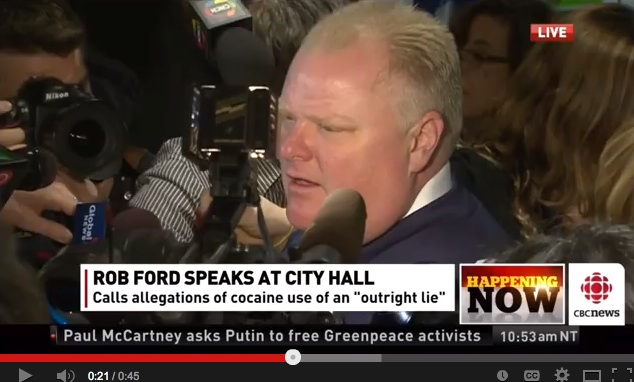
Toronto May Rob Ford has likely never heard this from his media trainer. One must ask, has Rob Ford ever had media training? Instead of putting down the shovel he has brought in a backhoe.
As repulsive as you may find Rob Ford’s latest quote, I’m going to give it to you here just to show what an amazing failure this guy is every time he is questioned by reporters. You can watch the video for yourself.
“Oliver Gondek says that I want to eat her pussy and Oliver Gondek, I’ve never said that in my life to her. I would never do that. I’m happily married. I’ve got more than enough to eat at home,” said Toronto Mayor Rob Ford.
From Vancouver to Toronto, Canadians have dominated the news for the past two weeks for saying things to the media that they should not say. Each time, they make the situation worse with a poorly executed apology. We saw that last week with Lululemon Founder Chip Wilson and now with Toronto Mayor Rob Ford.
Each case, the spokesman created their own crisis by what they said. Dare I say the United States media has not covered this much news from Canada in my lifetime?
Admittedly it is difficult to media train certain people with certain personality types. Certain rich or powerful people are arrogant enough, or over confident enough, that their inflated egos preclude them from seeking expert advice and expert coaching in order to improve their skills in many areas, including talking to the media.
https://braudcommunications.com/wp-content/uploads/2020/12/Logo-white-01-300x138.png00gbraudhttps://braudcommunications.com/wp-content/uploads/2020/12/Logo-white-01-300x138.pnggbraud2013-11-15 09:16:492021-05-20 23:46:46Media Training Advice to Toronto Mayor Rob Ford
By Gerard Braud Navigating the waters of a crisis requires a good crisis communication plan before the waters ever begin to rise. Clear sunny day planning, long before your darkest day, is the secretBy Gerard Braud
Navigating the waters of a crisis requires a good crisis communication plan before the waters ever begin to rise. Clear sunny day planning, long before your darkest day, is the secret. In today’s social media filled world, this has never been more true.
Sadly, in our social media world some public relations people expect to Tweet their way out of a crisis or repair damage using Facebook. Neither is true. While “shiny and new” social media can be part of an effect communications strategy, you must first have the foundation of tried and true media relations, crisis communications, employee communications and stakeholder communications.
Here is a sure fire 5 step approach that must be your foundation.
Step 1: Vulnerability assessment
Before “it” hits the fan, you have to identify everything that could go wrong, including potential sudden crises and smoldering crises. Hire a facilitator to take your organization through the process of a deep examination of the things that could go wrong that would damage the reputation and revenues of the company.
Step 2: Write your pre-written news releases, web posts, and e-mails
Perhaps you’ve heard the expression, “when you are up to your ass in alligators it is hard to think about draining the swamp.” This applies to crisis communications. One of the biggest mistakes public relations people make is that as the crisis is unfolding, they open a blank document on their computer and start writing a news release, which then goes through hours of unnecessary re-writes before it is release. Consider this: on a clear sunny day you should write as many of these potential news releases as possible, leaving blanks that you’ll fill in when you know the details of the actual event. These documents can be pre-approved by leaders, speeding up your ability to release them to the public. I’ve facilitated many crisis communication writing retreats that produced more than 150 pre-written news releases in one day. That kind of productivity rocks!
Step 3: Write your crisis communications plan
Very few documents that public relations people refer to as a crisis communication plan would pass my test for what a plan should be. Most are worthless 6 to 12 page documents that state standard operating procedure and serve absolutely no purpose on the day of your crisis. Yet to be fair, this is what most PR people were taught in school or at some PR seminar. Frustrated by what I kept finding, I invented something new.
My approach is to write a document that is intended to be read and followed during the crisis. It dictates specific, sequential tasks in a very fast moving time frame. It captures all of the perfect behaviors of the most senior communicator, yet is so easy to follow than any one who can read can execute the plan flawlessly. I’ve invested about 2,500 hours of development in my base plan, which is about 50 pages long, which I am now able to customize for my clients during a single afternoon workshop.
Step 4: Annual media training for a crisis
Despite all of the buzz about social media, holding a live news conference within both the first and second hour of a crisis is vital if the media are standing at your door. Many organizations damage their revenues and reputations when untrained spokespeople say dumb things during a crisis.
It is important for every potential spokesperson to recognize that media training is not a bucket list item that you do once in life. Talking to the media is a skill that requires regular practice. I recommend media training for all spokespeople at least once a year, with an expert coach. Then, before every media interview, in-house staff should do a fast refresher course.
Think of it this way – the best athletes achieve great success because they practice often and partner with a great coach. Great spokespeople practice often and partner with a great coach, protecting their reputation and revenues through what they say, and just importantly, what they don’t say.
Step 5: An annual crisis communications drill
Realistic crisis communications drills are the best way to test your communications team and the decision making process of your leaders. A drill once a year allows colleagues to establish trust and good working relationships. A crisis drill allows ample time for leaders to pause and discuss decisions they must make during a real crisis. This helps them avoid decision paralysis during a crisis.
Your crisis communications drill should include at least two mock news conferences during the drill. Hire mock media and never use real media. Your facilitator must write a complicated, yet realistic scenario. It must include a likely crisis, plus all of the social media, employee and media buzz that would surround a real crisis. The facilitator should also hire a team of people to flood your phone lines with constant calls, replicating the calls you would receive from media, customers, and concerned citizens in a real crisis.
Conclusion
All of this takes time. None of it is easy or fast. But, it is much easier to prepare on a clear sunny day than to struggle and fail on your darkest day. Your reputation and revenues depend upon it.
About the author: Gerard Braud (Jared Bro) has helped leaders and organizations on 5 continents write their crisis communications plans, using his one-of-a-kind writing retreat that completes one years worth of work in 2 days. He is regarded as an expert in media training and crisis communications plans and is the author of Don’t Talk to the Media Until… 29 Secrets You Need to Know Before You Open Your Mouth to a Reporter. Contact him at www.braudcommunications.com or gerard@braudcommunications.com
https://braudcommunications.com/wp-content/uploads/2020/12/Logo-white-01-300x138.png00gbraudhttps://braudcommunications.com/wp-content/uploads/2020/12/Logo-white-01-300x138.pnggbraud2013-11-15 03:00:172021-05-20 23:49:04Navigate the Waters of Reputational Repair: 5 Steps to Effective Crisis Communications Planning
A bad media interview caused by insufficient media training is creating a crisis communication problem on social media. Experts will weigh in on this, but I don’t think any one expert has the answer as to the best way to handle this.
As I write this, nearly 500 people have clicked “Like” on this particular Facebook post while more than 700 comments are posted. The vast majority of these comments are negative.
I have several crisis communication questions for you:
1) Do you think the founder, Chip Wilson, has made the situation better or worse by attempting to apologize on Facebook for comments he made on television?
2) Do you think the situation is getting better or worse on the Facebook brand page as the company’s public relations and social media teams try to engage in a conversation with those who post comments?
Without providing an answer to those questions, here is something to consider — Each time the public relations and social media team replies to a comment on the Facebook post, it moves the discussion higher in the news feed of the page followers, increasing the odds that someone new will jump into the conversation.
Was this a big mistake to take this discussion to Facebook?
Could this apology have found a better home in the company’s newsroom?
Was the apology itself poorly worded, leading to more negative comments?
Was the apology made only to employees and not to customers?
If the apology was to employees only, should it not have been posted where only employees would see it?
Could all of this crisis on the back end been eliminated by doing things differently on the front end?
As a father, I’ll tell you that my wife and I had a couple of basic rules when we were raising our two daughters. One rule was that you never have to fix the big things if you fix the little things. In this case, the lesson for all PR people, CEOs, and executive spokespeople, is to understand that the apology would never have been needed if the CEO had not said a foolish ad lib in the interview. The foolishness would have been eliminated if executive media training had been done prior to the original interview.
I’m amazed on a daily basis at how under valued media training is among executives and public relations teams.
In every media training class that I teach, I challenge the CEO or spokesperson with this question, “If you could attach a dollar to every word that you say, would you make money or lose money?”
Of the more than 700 comments on the Lululemon Athletica Facebook page about this issue, many clearly say they will no longer buy the company’s product. Need I say more to prove my point? I think not.
In every crisis you should consider my “Crisis Rule of Thirds,” which states that one-third of the people love your company/brand, one-third will hate your company/brand, and the third in the middle will swing like a pendulum, based on what is popular at the moment.
In a social media crisis, in a world that is already filled with negative comments, I think many companies will lose the battle, lose the war, lose customers, and lose money.
Consider this: Delete the video, delete the Facebook post, and stop talking about it.
What do you think?
https://braudcommunications.com/wp-content/uploads/2020/12/Logo-white-01-300x138.png00gbraudhttps://braudcommunications.com/wp-content/uploads/2020/12/Logo-white-01-300x138.pnggbraud2013-11-12 07:23:322021-05-20 23:50:51Did Lululemon’s Crisis Communication Efforts on Social Media Create a Bigger Crisis?
Media training, media trainers and the executives and spokespeople who go through media training need to understand the importance of practicing before every media interview.
Chip Wilson, Lululemon Founder is being criticized today for comments about how Lululemon pants only fit some women and the ongoing crisis or controversy over allegations that Lululemon pants are “see through.”
Media training requires the spokesperson, executive or CEO to recognize that every word you say can have a positive or negative impact on your corporate sales and revenue. Sales, revenue and the words you say are part of the reputation package you develop over time. As a spokesperson, you either enhance or degrade your reputation and revenues during a media interview.
Media training and the expert who serves as the media trainer, requires us to recognize that while the spokesperson, executive or CEO is invited into a media interview for one topic, other topics may be brought up. This is especially true if the interview is within a reasonable time period of a recent crisis or controversy. This is true for Lululemon and founder Chip Wilson.
Wilson is making headlines because of an interview he did on the Street Smart program on Bloomberg TV with anchor Trish Regan. Wilson appeared on Bloomberg with wife Shannon, who was being interviewed about Whil, a 60 second meditation she was promoting.
Instead of Whil and meditation being the headline in news reports today, the trending headline is “If your thighs rub together, Lululemon’s pants may not be for you.”
Regan asked Chip Wilson, “What’s going on with the pants?”
Wilson replies, “I think everything’s blown up. There is no doubt about it we made a mistake. The thing is we’re a technology company, and when you push technology, something is going to happen every now and then.”
He goes on in his confession to say, “There are a thousand things that could go wrong on a technical fabric and when three of those things go wrong at the same time something is going to happen and it is almost impossible to build a quality control case for each one of those combinations.”
Regan responds, “It’s tough and it continues to be a problem, because now there are complaints of pilling in the fabric.”
Wilson responds with an attempt at an analogy by saying, “There has always been pilling. The thing is that women will wear seatbelts that don’t work, or they will wear a purse that doesn’t work, or quite frankly some women’s bodies just actually don’t work for it.”
“They don’t work for the pants?” Regan asks.
Wilson replies, “They don’t work for some women’s bodies.”
“So it’s more likely they will be more see through on some women’s bodies than others?” Regan follows.
“No, I don’t think that way, because even our small size would fit a woman who is an extra large,” says Wilson. “It’s really about the rubbing through the thighs and how much pressure is there over a period of time and how much they use it…”
Regan injects, “Not every woman can wear Lululemon yoga pants…”
“No, I think they can. It’s just how you use it,” Wilson concludes.
Media training before the interview should have prepared Chip Wilson for a better answer. Media training in the midst of the initial controversy over the alleged “see through” yoga pants should have established a dialogue of carefully parsed, verbatim sentences. With training, Chip Wilson would have been able to say these sentences in an instant if I were to wake him from a dead sleep.
If Gerard Braud, a media trainer from New Orleans, were brought in to provide expert council and media training advice to help the 10th-richest man in Canada and his Vancouver based company, this is how he would have been taught to handle this exchange.
Regan’s initial question was open ended and neither positive nor negative. She asked, “What’s going on with the pants?”
Chip Wilson, like many CEOs, because there is a negative in his mind, focuses on the negative issue, rather than focusing on the positive solution. Remember, Regan implied no negative. Chip Wilson voluntarily went negative.
(By the way Chip Wilson, many CEOs learn this the hard way. My wealthiest CEO client is worth $2.4 Billion and knows that spending a few dollars on media training and a few minutes on practice protects his company, his brand, and his wealth. My number is 985-624-9976. Call me and I’ll let you talk with him directly as one CEO to another.)
If I were in a private executive media training with Chip Wilson, he would be coached to respond with honest truth about the Lululemon yoga pants and not the negative truth about the Lululemon yoga pants. His answer would be, “The popularity of our yoga pants continues to grow. It is humbling to see that we were able to follow our passion and create a form of sports apparel that continues to grow in popularity with men and women.”
Since Regan appears to be fit, I might even instruct Wilson to ask the Bloomberg news anchor, “Trish, do you have a regular exercise routine and are you a Lululemon customer?” This is also something Wilson could have learned prior to the interview. If Wilson had employed this technique of asking Regan a question, chances are the discussion would have turned to Regan and her exercise routine.
There is a chance the interview would have never gone negative. If Regan followed up by saying, “A while back you had issues with women complaining that the pants were see through. Have you fixed that problem?”
Wilson could have replied, “Yes, as we investigated we found that many of these issues were caused by customers loving their pants so much they wore them often and in some cases they sat on rough surfaces, such as concrete. So, while we love the fact that customers want to wear our product a lot, like any fabric… including your favorite pair of jeans… get thinner and you need to buy a new pair.”
There is a good chance the negative tone of the interview would have ended there.
Additionally, in a politically correct, hyper-sensitive world, a CEO, a spokesperson or executive cannot say anything that could be implied as criticism of a woman’s body and shape. Regan baits Wilson with her question, “So it’s more likely they will be more see through on some women’s bodies than others?” This follow up question might never have been voiced if Wilson had used my positive, pre-planned and practiced answer, rather than his bad ad-lib.
Wilson steps in a big pile of “do-do” when he says, “It’s really about the rubbing through the thighs, how much pressure is there over a period of time and how much they use it.”
What my experience as a media trainer also picks up on here is that Wilson is likely an analytical person. Many CEOs are analytical, which causes them to answer with technical facts and confessions, in an effort to be honest. Often a stronger form of honesty can be found in a less technical and more positive answer.
Surely, the entire Lululemon public relations team gave out a loud cry when Wilson mentioned thighs? Or did they? I don’t know.
I do know that I have watched many PR teams simply tell a rich CEO what a great job they did in an interview, rather than providing honest feed back and more media training before then next interview. If you are in public relations, it is your job to provide executive council to the CEO and not be a wimp who is afraid to speak.
(For all of you who have asked, “How do I get a seat at the table?”, the answer is to have the nerve and professionalism to speak up rather than being fearful that you will lose your job.)
Read the article
In the spirit of avoiding negatives, Wilson never needed to use words such as, “There are a thousand things that could go wrong on a technical fabric and when three of those things go wrong at the same time something is going to happen and it is almost impossible to build a quality control case for each one of those combinations.” This, once again, indicates an analytical engineering type mind is answering the question.
Finally, the analogy used by Wilson about seat belts not fitting and purses not being right represents what happens when a media spokesperson does not develop and practice their analogies during their media training class.
The bottom line: Headlines on the internet and headlines in the media focus on words such as, “Chip Wilson, Lululemon Founder: ‘Some Women’s Bodies’ Not Right For Our Pants.”
This didn’t need to be the headline. The CEO is at fault. All CEOs need to recognize the importance of media training and public relations teams must not gloss over media training prior to every interview.
What a nice complement I received today after a crisis communications drill with a nuclear power plant and four government agencies. The Governor’s Office of Homeland Security and Emergency Preparedness thanked our mock media team for the intense questioning and realism of our news mock conferences.
“I participated in a crisis drill last week and the news conferences were kind of a joke,” he said. “They had a bunch of students asking questions and it just got silly. Today felt like the real thing.”
Wow #CrazyFlattered #KeepingItReal
The last thing you want in your crisis communication drill is for people to be silly and treat it as though it is a game. My drills are so serious that I’ve successfully made spokespeople emotionally break down and cry at the podium and on two occasions. People involved have been fired because the drill exposed their complete incompetence in their jobs.
The purpose of a crisis communications drill is to test your skills and abilities so that if necessary, they can be modified after the drill in order to improve performance during a real crisis.
Here are five tips to keep it real:
1) Build your crisis scenario around something that is highly likely, especially if people within your organization are in denial about how likely the scenario is to happen. Such a scenario will immediately send a feeling of dread over many drill participants. It is helpful if the facilitator can immediately and repeatedly bring the roll players to the point at which they mutter, “Oh sh*t.” This emotional trigger is just one of many emotional triggers that you want to employ. In a real crisis, emotions of dread, fear, panic and anxiety are all brought to the surface. It is the job of your facilitator to bring those emotions to the forefront of a drill.
2) Make the drill scenario big enough that a real crisis of this nature would bring out the media, which in the case of the drill, forces you to have several mock news conferences to test your spokespeople. The folks who role play as mock media need to be smart and mature, and capable of asking realistic questions that realistically challenge your spokespeople.
3) Judge your crisis communications team on how well they followed their crisis communications plans. The plans I write are usually about 50 pages long and are designed to be read and executed in sequential order so that nothing is forgotten in the way of communications. Too many flawed plans are just six to ten pages long, they only state standard operating procedures and for the most part, they are useless during your crisis. The 50 page plan I customize for my clients can get you flawlessly through the first two hours of your crisis, with directions for subsequent communications beyond two hours if needed.
4) Social media is a part of the real world and it needs to be a part of your drill. The facilitator and/or mock media role players should inject rumors, photos, videos and posts that might appear on social media if the event were real.
5) Realistically bother the heck out of as many people as possible with phone calls. In a real crisis the media and worried members of the community would be calling employees wanting information. I like to have a phone bank with at least five people who each play five personalities. I provide them with a list of phone numbers of people they should be calling periodically during the drill.
The bottom line is your crisis communications drill is designed to be your preparation for a real event. Make your drill every bit as realistic as an actual crisis event.
https://braudcommunications.com/wp-content/uploads/2020/12/Logo-white-01-300x138.png00gbraudhttps://braudcommunications.com/wp-content/uploads/2020/12/Logo-white-01-300x138.pnggbraud2013-10-17 10:07:452021-05-21 00:24:39Lesson 9: How to Keep Your Crisis Communications Drill Realistic?
How quickly can you get approval for and issue a statement to the media, your employees and other key stakeholders during a crisis? Your crisis communication plan should clearly spell out what is acceptable and what is not acceptable.
It greatly disturbs me to see that some companies and government agencies think five hours from the onset of a crisis is an acceptable time frame to respond within. It disturbs me even more to know that some organizations think tomorrow or the day after is soon enough. Just this week, while speaking to a group of public relations professionals in Washington, D.C. several of the attendees said it often takes their organizations one to two days to approve a news release.
Wow! It is 2013 and we live in a world where social media gives details about a crisis the second it happens. Speed is important.
In every crisis communication plan I write, it states that the first communications should happen in one hour or less. Admittedly, this is about 59 minutes too long, but is likely a realistic amount of time in a corporate setting where statements must be written by the public relations team and approved by executives before being released.
My key to speed is the use of a First Critical Statement. It is a pre-written, fill-in-the-blank document that allows an organization to release a few basic facts until more is known. The goal is to control the flow of accurate information rather than allowing rumors to spread on social media and speculation to run rampant among the media.
If your crisis communications plan has this template in it, you should be using it in your crisis communications drill.
Your crisis communications drill, while allowing you to test your crisis communications plan, allows you to test your public relations department and their ability to gather facts quickly. The team must fill out the First Critical Statement, get it approved by executives, then release it to the world. It also allows you to test your executives, who must be taught that time is critical and that major rewrites can slow the communications process.
Yesterday’s article referred to feeding little bits of information to the media, just as you would serve a buffet. Following that analogy, the First Critical Statement is the salad.
As the crisis communications drill continues to unfold, your crisis communications plan should dictate that by the start of the second hour of your crisis, a more detailed statement should be released to the media, your employees, and other key audiences.
The plans I write for my clients may have over 100 of these pre-written statements in the addendum of the plan. These are also fill-in-the-blank and multiple choice documents written on a clear sunny day that can be quickly modified and released to the key audiences. They can also be pre-approved by executives on a clear sunny day. Such pre-approval eliminates approval delays on the day of your crisis.
Your crisis communications drill allows you to again test the speed at which the documents are modified and the speed at which they are approved.
Speed is critical when you need to communicate in a crisis. Your crisis communications drill helps you to perfect that.
https://braudcommunications.com/wp-content/uploads/2020/12/Logo-white-01-300x138.png00gbraudhttps://braudcommunications.com/wp-content/uploads/2020/12/Logo-white-01-300x138.pnggbraud2013-09-27 03:00:152021-05-21 00:29:40Lesson 4: Test Your Crisis Communication Speed
There are many articles throughout this blog about what makes for a good crisis communications plan. I believe so many documents that proport to be crisis communications plans fall far short of what is needed to effectively communicate when “it” hits the fan.
A great way to find out if your crisis communications plan is up to par is to test it with a crisis communications drill.
During a crisis, anxiety is high, tensions run high, and pressures can be enormous. During times like this, it is easy for important things to fall through the cracks. However, if you write them all down on a clear sunny day and organize them in sequential order, then you have the foundation for a good crisis communications plan. Furthermore, if you can easily read them during your crisis and follow the pre-ordained steps, you are able to achieve effective communication.
I don’t know of anyone else who tells you to read your crisis communications plan during the crisis. That may be because most crisis communications plans only list the rule of standard operating procedures. Most plans fail to be organized chronologically with clear directions that you can read and follow during your crisis. My prescription is to have a plan written with clear directions and follow it every step of the way throughout your crisis communications drill.
This important step accomplishes several goals. First, you get in the habit of carrying your communication plan with you. Secondly, you learn to trust your plan and trust that in your worst times it will guide you toward a brighter conclusion. Thirdly, if there is a flaw in your plan, your crisis communications drill will expose that flaw, allowing you to make important rewrites.
Keep in mind also that the tools of communication change constantly. This means your crisis communications plan needs to be a living document. What worked during last year’s drill may need to be revised this year because the tools of communication have changed. Just look at how in recent years, Facebook, Twitter and YouTube went from being non-existent to being available but irrelevant, to being a vital consideration and important communications tool in a crisis.
A crisis communications drill is designed to let you screw up in private on a clear, sunny day, so you don’t screw up in public on your darkest day. The same is true for your plan. Discover any flaws on a sunny day and fix them before your darkest day comes.
https://braudcommunications.com/wp-content/uploads/2020/12/Logo-white-01-300x138.png00gbraudhttps://braudcommunications.com/wp-content/uploads/2020/12/Logo-white-01-300x138.pnggbraud2013-09-26 10:39:252013-09-26 10:39:25Lesson 3: Test Your Crisis Communications Plan

 Every media training class I teach worldwide begins with this phrase: