Your parents probably taught you there is a right place and a wrong place for everything. That is true for crisis communication and for social media.
Many Gen X & Gen Y communicators think the bulk of their crisis communications can be done exclusively through social media. I disagree for many reasons. In a previous article, we identified the generation gap that indicates many people in your audience, and even your own company, don’t use social media.
In order for you to understand my prejudice and point of view, you need to know that I’m a control freak. When “it” hits the fan, I want you to control as many variables as you can. That means you need to know your audience and know where to find my audience.
I read a blog post recently about a small coffee shop that was being challenged by their local health department because they allow dogs into their store. The coffee shop successfully used Twitter to reach their customers for support. This is a very low level crisis and the fit is right. Most crises I deal with are far greater.
Even in the case of the coffee house, I would be using other communications tools first. I would be using my website, my e-mail list, a video on my website… all things I have direct control over. I would conduct an Ambassador Training class for my staff. Ambassador Training is a system I pioneered many years ago that is similar to Media Training. It teaches employees how to properly talk about a negative issue with customers. In a crisis, word of mouth is important.
Social media channels can be good tools for ambassadors and employees who support you, provided the audience is of the right age group. In the end, social media is one of many tools to consider and it is not, be default, the highest priority tool.
https://braudcommunications.com/wp-content/uploads/2020/12/Logo-white-01-300x138.png00gbraudhttps://braudcommunications.com/wp-content/uploads/2020/12/Logo-white-01-300x138.pnggbraud2014-05-26 03:00:502021-05-20 21:15:30The Social Media Force Fit Versus the Right Fit for Crisis Communications
As we examine the leadership gap, the generation gap, and shiny new object syndrome, let’s note that in many cases, in the world of crisis communications, social media can be a greater source of bad than good.
The fact that a citizen can post a picture of a plane crash before the airline knows about it is not good. The fact that a student is broadcasting a shooting to CNN before you even know about it is not good. The fact that your employees are part of a social media gossip loop before you send official communications to them is not good. Now, let us add to the discussion the fact that sometimes, social media is your crisis.
Case in point, Easter Day, April 16, 2009. Two employees at a Domino’s Pizza outlet were bored and started to shoot a video of themselves. One captured the other putting cheese in his nose, before placing the cheese on a pizza he was making. They then uploaded the video to YouTube.
It was an astute blogger who had a Google Alert for the word Domino’s that first saw the video. The blogger called Domino’s headquarters. The folks at Domino’s were not amused and not pleased, and they took steps internally to identify the employees and the store. But Domino’s did not anticipate that this video would become a viral wonder. They underestimated the YouTube audience. So here, we see multiple failings. There is the classic leadership gap, there is decision paralysis, and there is the generation gap.
Earlier in this collection of articles I told you that a cardinal rule of every crisis communications plan that I write is a mandate to communicate within one hour or less of the crisis going public. Obviously Domino’s did not have such a plan, because the one hour mark would have been reached one hour after they heard from the blogger. In many crises, at that one hour mark, depending upon the severity of the crisis, you would speak to any media who have arrived at your site; you would publish something to the web; and you would communicate with employees, via the web, via e-mail, and in severe situations, with an in person meeting.
In the world of decision paralysis, one of the problems is the fear that if the company says something, they may turn a nothing story into a bigger story than it should be. Hence, many companies, often on the advice of both attorneys and the communications department, say nothing. I have never subscribed to that rule and never will. I have successfully defused events that could have become major stories and lead to major lawsuits by bringing the story directly to traditional media. I believe that being pro-active and communicating bad news on your own is your best defense.
Add to your to-do list the need to have a discussion with your leadership and your legal department. In that discussion, you need to ask them under which circumstances they would suggest saying nothing. It needs to ultimately conclude with a decision to speak and disclose your potential crisis in almost every situation.
The system that I have created, using pre-written communications templates, has resolved that situation for all of my clients. This is due to the fact that lawyers get to see exactly what we plan to say, giving them time to approve all of the statements – sometimes months or years in advance.
The Domino’s case presents a to unique opportunity to respond in-kind, meaning respond to a YouTube video with a YouTube video and do it within one hour. Let me explain the magic of this approach. Domino’s eventually responded with a YouTube video, which we will discuss further in a moment. However, inside sources tell me that the general discussion within the organization was that for a company as big as Domino’s, if the story wasn’t on the front page of U.S.A. Today, then there was nothing to worry about.
Wrong! The offending video was posted late Sunday and by Tuesday evening, more than 250,000 people… more than a quarter of a million people had watched the video. By noon Wednesday, just 18 hours later, the video had more than 1 Million views on YouTube. The company learned the word Domino’s was being typed into more search engines than the word Paris Hilton. Domino’s was still thinking that out of 307 million people in the United States, only 1 million had seen the video, which was minimal in the big picture. I At 1 million hits the video got the attention of mainstream media and became a story among all major media outlets across the U.S.
So, what would you do? My answer is I would have had a YouTube video on YouTube within one hour of learning of the event, even if I didn’t know all of the facts. Why? Let me explain.
Rule 1. Respond within one hour or less, but in the case of social media we add a new rule.
Rule 2. Respond in-kind, meaning answer a YouTube video with a YouTube video. If, when you post your video, you use the same key words as the offending video, you can achieve nearly equal search engine optimization. That means that every time someone types the word Domino’s in a search engine, the corporate response would show up nearly as often as the offending video.
Domino’s eventually posted a message from the CEO to the web and they claim it was posted 48 hours after the offending video was posted. Furthermore, they claim this was ground breaking. For the record, I’ve been a corporate Vice President and I council executives on a regular basis as a crisis communications expert. I can imagine what was going on inside the company. Many executives were on Easter vacation and they were attempting to tackle the problem by long distance. People were busy trying to prosecute the employees. People were busy wordsmithing messages; people were massaging words. That’s always such bull.
Just as I shot a 15 second video in my snowy front yard and posted it as an i-Report for CNN with less than an hour’s work, I could shoot a very brief on camera message that says,
“Hi, I’m Gerard Braud with Domino’s Pizza. There is a YouTube video circulating around with two people who identify themselves as Domino’s employees. In the video, they’re doing some pretty nasty stuff in the store. Chances are if you’re watching this, you’re looking for the other video. Let me just say that we’re in the process of identifying the people in the video so we can get to the bottom of this. Our focus now is to find out exactly what’s going on and how we can keep it from happening again. Stay tuned for an update.”
That’s it. That’s all that was needed. I don’t need to see a CEO. Some crisis communications trainers believe you should always send out “the top dog first.” I say bull. Usually the first person I push out the door as a spokesperson is a public relations spokesperson. I’ll send the CEO out later if the situation is severe enough, but in many cases a high level manager makes a good spokesperson, if he or she as been through proper media training.
Add to your to-do list the need to have a discussion with your team and your leadership to establish an understanding of who should be your first spokesperson in a crisis, and how many people you feel should undergo media training so they can serve as subject matter experts in the subsequent hour of your crisis.
I am a big believer that the CEO needs to be busy managing the crisis, especially in the early hours of the crisis, while others serve as the spokesperson. Only in the most extreme cases do I make the CEO the spokesperson, and even then, I generally roll out lower level experts first.
Now, back to the video from the Domino’s CEO. Yes, eventually it was posted. The CEO did a poor job of reading from cue cards off camera. No teleprompter, he made no eye contact with the camera and no, he isn’t someone who can ad lib well. Add to that, the statement was worded as an angry rant and by the time it was recorded, the CEO was an angry person. It was bad, it was too little and it was too late.
The Domino’s head of PR claims in an article published by the Public Relations Society of America (PRSA), that what Domino’s did was unprecedented and ground breaking. I disagree on several points. I’ve used YouTube videos many times before his crisis, and I’ll share some of those examples for you a bit later. I also live by the rule to communicate in one hour or less… not the Domino’s rule of one week or less. This isn’t rocket science, but it is about writing a crisis communications plan that works, using that plan, communicating in one hour or less, and involving leaders in crisis communications drills annually. Annual drills condition them to the idea that you must communicate quickly and that the CEO doesn’t have to be the primary spokesperson.
One final note on this topic – Every crisis communications plan that I write contains dozens of pre-written templates and your plan should too. Every item the leaders identify in the vulnerability assessment should have a companion, pre-written communications template. On a clear sunny day, when there is no anxiety and you have clarity of thought, you can write 75%-95% of what you would say on the day of the crisis. In the case of a restaurant chain, you would have a document that describes food tampering. When the crisis hits, you’re not looking at a blank piece of paper. Rather, you are looking at a well-worded document that has already been vetted by the leaders and the legal department. You are looking at the same type of template that your leaders would have seen and used when you conducted your crisis communications drill. Spokespeople would be looking at and reading from the very same document they used during their media training class. This system gives everyone the confidence needed to communicate quickly in a crisis.
With that, get your to-do list out. If your crisis communications plan does not contain dozens of pre-written statements for all of the possible crises you could face, then you need to create such templates. If your plan does have templates, you need to schedule a quarterly review to determine if new templates need to be written.
If you don’t know how to write such templates, contact me and we can schedule a writing retreat for your team so that you can quickly fill your plan with the templates you will need.
https://braudcommunications.com/wp-content/uploads/2020/12/Logo-white-01-300x138.png00gbraudhttps://braudcommunications.com/wp-content/uploads/2020/12/Logo-white-01-300x138.pnggbraud2014-05-23 03:00:522021-05-20 21:18:27Social Media for Crisis Communications: Social Media as the Cause of Your Crisis
In every crisis communications plan that I write for a client, I have a page that establishes a severity level for the crisis. Traditionally the severity level is determined by injuries and/or fatalities, as well as the speed at which media cover the event, as well as how long the event remains in the news.
I believe all crisis communications plans must be living documents that are updated as communications styles and standards evolve. Several years ago I had to modify the severity levels of my plans to include the impact of social media and how quickly people would begin making postings about a company’s crisis and how long they would remain in the cycle of communications.
Add to your to-do list the need to modify how you categorize the severity of your crisis in your crisis communications plan.
In keeping with our last discussion about the generation gap and leadership gap as it relates to social media, this change to your crisis communications plan must be accompanied by training for all involved in the crisis process, including leaders, emergency responders and risk managers.
As we explore the generation gap, we must also look at a problem 180 degrees away on the opposite side of the spectrum. One of my great fears about social media is that many Gen X & Gen Y people involved in communications suffer from what I will describe as shiny new object syndrome. In other words, they are enamored with the tools and technology. They treat social media as though it is the greatest communications tool ever invented. They also think social media should supersede other forms of communications. I think that is a mistake.
Add to your to-do list an evaluation of yourself and those around you. Identify whether you or others suffer from shiny new object syndrome. Recognize the symptoms and use the rest of this document as therapy.
I’m especially harsh on Twitter because I think a big part of Twitter’s popularity comes from the fact that people who were not part of the original launch of MySpace and Facebook were afraid they would be left out or left behind. But according to PEW Research,
As of December 2012, only 16% of online adults say they use Twitter.
Once again, I’ll say that all social media tools are part of a mix. In certain crises, there are high value listeners on Twitter, including a lot of people in the media. A direct tweet to a reporter at just the right time can significantly impact the coverage a story gets.
Another fear I have is that the shiny new object syndrome affects younger communicators the most. Because they and all of their friends tend to use these tools 24/7, they perceive that the entire world is likewise using them. We might also note at this point that the mainstream media are trying very hard to use social media and that they too may be suffering from shiny new object syndrome.
If you pull back the curtain, the media are using these tools as a way to reach the younger audience that they have not been able to reach through conventional publications or TV news broadcast. For the mainstream media, Facebook and Twitter are marketing tools to capture a new, younger audience. The media are fully aware that their older, traditional audience, is not a full participant in social media.
One final thought about shiny new objects – remember MySpace? It was replaced by the shiny new Facebook. These days, as parents and grandparents use Facebook to keep tabs on their grandkids, young people are abandoning Facebook for Instagram. This means that social media continues to be a moving target creating challenges for communicators.
In our next article, we’ll look at crises caused by social media.
https://braudcommunications.com/wp-content/uploads/2020/12/Logo-white-01-300x138.png00gbraudhttps://braudcommunications.com/wp-content/uploads/2020/12/Logo-white-01-300x138.pnggbraud2014-05-22 03:00:212021-05-20 21:32:16Social Media, Crisis Communications and the Severity Level of Your Crisis
As we discuss social media as a crisis communication tool that allows you to reach your core audience, this is a good time to explore what I will describe as both the leadership gap and the generation gap, that social media presents.
People in leadership positions, traditionally perform poorly in a crisis because it is an out of the ordinary event for which they are seldom trained. They don’t plan on a clear sunny day for the things that will affect them on their darkest day. They ignore the old adage, “If you fail to plan, plan to fail.”
You can rectify this in several ways. If you don’t have a crisis communications plan, include leaders in the process of conducting a vulnerability assessment that explores all the things that could go wrong where you work. As I mentioned in an earlier article, I facilitate many executive meetings throughout the year to conduct such vulnerability assessments. Leaders are often stunned when they see the long list of potential ways that “it” could hit the fan.
So add to your to-do list the need to conduct a vulnerability assessment in a facilitated setting with your leadership team.
If you already have a crisis communications plan, leaders should be trained in two ways; that would include annual media training and at least one crisis drill each year.
Just because someone holds a leadership title, doesn’t mean they have leadership qualities. Among the qualities I look for in someone who has leadership qualities is the ability to manage a crisis. The leadership gap is most often personified by decision paralysis. In other words, leaders are paralyzed by the fear that the decisions they will make will be the wrong decision, therefore they do nothing.
In the world of crisis communications, decision paralysis is personified by people in leadership positions not authorizing or allowing you to issue a statement in the first hour of a crisis. Often, lawyers advise them against saying anything for fear that they will say the wrong thing. My belief is that you must begin communicating something, even if it is only partial facts.
A crisis communications drill will get your leaders used to the speed at which a crisis unfolds and media training will give your spokespeople the confidence to stand before an audience of employees or the media, to let them know what is happening. I’ve seen some remarkable changes among the leaders whom I media train and the organizations for which I annually conduct crisis communications drills. If you fail to conduct media training and you fail to conduct crisis communications drills annually, you can expect your leadership team to fail you during your crisis. You can expect your leaders to fall back into decision paralysis. Think of it this way; a great athlete practices constantly and has great coaches. Well, your leaders likewise need to practice and have great coaches in order for them to perform well when they need to.
This brings us to the generation gap. We’ve already established that in the world of traditional media, leaders are slow to respond and issue statements. In the days of traditional media, when I was a television and newspaper reporter, if a crisis happened, it usually took us about one hour to arrive on the scene and begin reporting. But these days, any employee or any person on the street can communicate the crisis to the entire world in a matter of seconds. Instead of the 24 hour news cycle, we now have the 140 character news cycle. For those new to social media, 140 characters is the maximum message size allowed by Twitter.
Many leaders do not use social media. Many leaders still don’t know what social media is. Many leaders have no idea how fast messages get communicated by social media. Some leaders may have heard of the various outlets, such as Facebook and Twitter. But the reality is, they have no idea what these tools do and how they work.
I’m asked to give keynote speeches at many association and corporate conferences and a few years ago I introduced a new keynote called, Social Media When “It” Hits the Fan. The keynotes give me an opportunity to create a dialogue from the stage with leaders as I ask them what they know about social media. Here are my questions and the responses received.
• When asked how many use LinkedIn.com, 10% – 20% usually say yes.
• When asked how many use Facebook, fewer than 15% usually say yes.
• When asked how many have watched a video on YouTube.com, about 25% usually say yes.
• When asked how many have ever posted a video to YouTube.com, the response drops to 2%.
• When asked how many use Twitter, the response is usually 1-2%.
I then ask, how many have no idea what I just said and what I’m talking about, to which most hands go up and there is an uproarious laugh.
This represents both the leadership gap and the generation gap. While Gen X & Gen Y employees post comments, pictures and video to social media sites, often via their smart phones, older employees – especially leaders – are oblivious to the far reaching impact of these tools and trends.
In an earlier article in our series, I told you the best research on social media behavior comes from the experts at PEW Research.
As of December 2012:
15% of online adults say they use Pinterest
13% of online adults say they use Instagram
6% of online adults say they use Tumblr
67% of online adults say they use Facebook
16% of online adults say they use Twitter
• 20% of online adults say they use LinkedIn as of August 2012.
At this point, take out your to-do list and place on the list the need to do social media training; that is to say, you need to conduct programs to educate leaders on the impact of social media both on good days and in a crisis.
If you have a corporate meeting planned or if your leaders attend specific association meetings, you can always ask the meeting planner to invite me or you can call me with their contact information. That way, I can help you close the generation gap and solve the leadership gap if you would like my help.
https://braudcommunications.com/wp-content/uploads/2020/12/Logo-white-01-300x138.png00gbraudhttps://braudcommunications.com/wp-content/uploads/2020/12/Logo-white-01-300x138.pnggbraud2014-05-21 03:00:422021-05-20 21:37:59Social Media for Crisis Communications: Social Media for Crisis Communication and the Generation Gap
Media training in New Orleans, Baton Rouge and other cities in Louisiana carry a special set of challenges. Usually the training is for spokesmen – as in all men. Seldom is the media training for spokespeople, representing both genders. The spokesmen generally work in the oil and chemical industry. Most are not trained public relations professionals. Most are managers and supervisors in a chemical plant or an oil refinery.
In Louisiana’s industrial corridor, the bulk of the media training is to prepare someone for crisis response. Often companies call asking for crisis communications training or crisis management training. Seldom do they ask for media training because many do not know what the training should be called.
At the risk of generalizing, many of these spokesmen grew up as I did. We were taught to tell it like it is. Telling it like it is usually starts with negative information, followed by a justification for the bad news or event. After the bad news and the justification, Louisiana men often tell you what they are going to do differently.
Analyzed, it looks like this:
Bad News – Repeat the negative
Bad News – Repeat the negative
Good News
When I was a television reporter, I was often first on the scene when a chemical plant blew up between Baton Rouge and New Orleans. Often the spokesperson would share too many negative details that should not have been shared. They might say something such as, “Well we’ve been having problems with the vessel in the hydrocarbon unit for the past month. We had one small fire that we put out last week. But we don’t know what caused the explosion today. But I promise you, safety is our top priority.”
To be an expert spokesman in media interviews, the fewer negatives you repeat, the better you will be. In media training, you need to learn to say positive news first and as little of the negative news as possible.
The statement above might have better been worded by saying, “Our goal is to always be protective of human health and the environment. What has happened here today will require us to investigate so we can find out what happened, how it happened, and how we can keep it from ever happening again.”
Are you up to the challenge for a media interview?
https://braudcommunications.com/wp-content/uploads/2020/12/Logo-white-01-300x138.png00gbraudhttps://braudcommunications.com/wp-content/uploads/2020/12/Logo-white-01-300x138.pnggbraud2014-04-03 03:00:232021-05-20 22:29:38Media Training in New Orleans, Baton Rouge & Louisiana
Can we have an intimate, professional conversation? The presumption is you are an expert in public relations and that the executives and leaders where you work need expert key messages for media training, to be an expert spokesperson. Here we go:
Good looking
Intelligent
Public relations professional
Mistakes of the past
Bullet points bad
Did we just have a conversation? I don’t think so.
Why?
Because I used bullet points and bullet points are not a conversation. Bullet points are phrases. Bullet points are not sentences.
So, should it then also be true that bullet points are not key messages?
Consider this: If you are training someone for a media interview, and you’ve given them nothing but bullet points, you have only given them an outline from which you now want them to ad lib.
Have you ever noticed that the most embarrassing interviews with reporters are the ones with bad ad-libs?
Have you ever noticed that the media crave a well-worded quote?
This is your call to action to stop believing that key messages should be bullet points. Key messages for media training should consist of well-worded, quotable sentences. Expert spokespeople speak in great, well-worded quotes and not in bullet points.
You are a good looking, intelligent, public relations professional who should stop repeating the mistakes of your public relations forefathers or foremothers, who believe bullet points are sufficient as key messages.
https://braudcommunications.com/wp-content/uploads/2020/12/Logo-white-01-300x138.png00gbraudhttps://braudcommunications.com/wp-content/uploads/2020/12/Logo-white-01-300x138.pnggbraud2014-04-02 03:00:562021-05-20 22:30:23Expert Advice for Media Training Key Messages
Ask any expert in global crisis communications how Malaysia Airlines should be communicating during their crisis and you will get varied opinions. Having worked in Malaysia many times writing crisis communications plans and teaching media training, I would like to offer five things worth considering, should you face a prolonged crisis that draws global media attention.
Culture – Problem #1
Malaysian’s culture and religion are different from traditional western culture and religion. Their language also includes a mix of Malay, Mandarin Chinese and English. Prior to my trips, I’ve taken classes to help learn and respect their culture. I’ve even learned to speak some Malay.
Sadly, western media wants to play by western rules, often with little regard for the culture of another country. Media are not known to stop what they are doing to take cultural sensitivity classes. U.S. media can be especially pushy and overbearing. Chances are western media will not adjust to or fully respect Malaysia’s culture. Hence, if you work for the airline, you must be prepared to adjust to all of the many global media outlets and their ways. This is no easy task.
Accomplishing this means that long before you ever have a global crisis, you need to write a crisis communications plan that takes this into account. Next, you need to practice it at least once a year in a crisis communications drill until you are an expert communicator and public relations professional. The drill will also help your leaders better understand what they will face during a crisis, provided your drill includes intense mock media and mock news conferences.
Joint Information Centers (JICs) – Problem #2
In the U.S., when your corporation has to share the stage, microphone and crisis with government agencies, often all parties agree to set up a Joint Information Center (JIC). Often, the government agencies want to take the lead and usually corporations are too willing to let the investigating agencies bear the burden of the media interviews. This usually happens because the corporation has failed to write a good crisis communications plan, they have failed to train their spokespeople, and they have failed to hold annual crisis communications drills. Due to their failures – all of which could have been avoided – they capitulate to government agencies, praying the government agencies have good spokespeople.
I despise when this is done. I especially despise when a corporation depends entirely on government spokespeople to communicate.
Consider that government agencies cannot and will not communicate empathy to the affected parties. Their communications is only about the issues related to their investigation and fact gathering. Government agencies have a different communications motive than the affected company. Only the offending party – in this case the airline – can adequately communicate empathy to the family members of passengers.
You have an obligation to media train your spokespeople to the highest level so they can hold their own in a news conference.
Separate Media From Grieving Families – Problem #3
Never house family members in a building or hotel where the media has easy access to them. Crying family members amid the media makes for a great story for the media and a horrible story for your company.
When I was a reporter, I hated talking to family members in situations like this. I recall covering the derailment of an Amtrak passenger train with a high fatality count. The train plunged off of a bridge late one night and the passengers were trapped in the rail cars deep in a river. Family members were holding out hope that there were air pockets with people alive in the cars, just as Malaysian Airline families are holding out hope that their family members are alive somewhere on a remote island.
In the story I was covering, the trauma went on for days, with Amtrak housing the families in the lobby of a hotel with us – the media. The families never got a break from the cameras and the microphones and our producers kept asking for more interviews. Amtrak looked bad every time someone fell to pieces emotionally in the hotel lobby.
If your company might face this type of crisis with a high fatality count, your crisis communications team must work with your risk management team to identify, in advance, facilities where families can be housed without the media being anywhere around.
Brute Force Never Plays Well In Front of the Media – Problem #4
When Malaysian authorities hauled away a grieving family member earlier this week, it made a bad situation look worse. Authorities lost their cool. This happens all over the world. When they lose their cool, authorities seldom ask, “How will this play on TV?” This is one more reason to follow the advice above to keep the families separate from the media.
My experience in Malaysia assures me there are many gated resorts that the airline could take over as their base for families. These resorts have sleeping accommodations, restaurants and beaches. Malaysia Airlines should be using one of these resorts. The risk management team should be prepared to buy out the entire resort, keeping families content behind gates, keeping the media on the other side.
Manage Speculation With More Spokespeople – Problem #5
In an ongoing crisis like this, the media lack facts, so they turn to third party experts and ask speculative questions to get speculative answers. If your company is the offending company, you need to have highly trained spokespeople speaking on behalf of your company in every country where your customers have a presence. Those trained spokespeople need to:
A.) state the obvious facts in well worded quotes
B.) constantly communicate empathy and what is being done for the families
C.) constantly discourage speculation
If we look at the Malaysian Airlines case study, speculation has been generated by:
A.) an oil slick near Vietnam
B.) debris at sea near China
C.) possible debris spotted by Australia
D.) rumors that the plane landed safely on some remote airstrip
E.) rumors about the pilots and their routes.
When you fail to provide good information in a crisis, the media fill the void with speculation.
Conclusion
Never believe that any crisis is too big or too complicated to prepare for. You can prepare a crisis communications plan that will address every scenario you may face. Your crisis communications plan can have an addendum of pre-written news releases and media advisories for even an extended crisis like Malaysian Airlines. You can test your crisis communication team, your crisis management team and your spokespeople with a crisis communications drill annually. You can conduct media training annually for everyone who may have to serve as a spokesperson.
This isn’t rocket science, but it does require a commitment from the public relations team and from the leadership team.
So, will you prepare and perform flawlessly or will you leave everything to chance?
https://braudcommunications.com/wp-content/uploads/2020/12/Logo-white-01-300x138.png00gbraudhttps://braudcommunications.com/wp-content/uploads/2020/12/Logo-white-01-300x138.pnggbraud2014-03-21 08:14:392021-05-20 22:44:17Crisis Communication Case Study: Malaysia Airlines
While teaching interview skills in a media training class, a participating executive provided expert insight to the lesson I was teaching.
“So you don’t want us to word vomit everything we know in a media interview, right?” he asked.
That isn’t how I would have phrased it, but now that I think about it, many spokespeople, and the public relations people who write the key messages for the spokespeople, are guilty of “word vomit.”
Before every media training class I teach, I ask the PR team to provide me with their existing key messages. Most are word vomit.
Many public relations people “vomit” every word they can, every cliché they can, and every statistic they can onto the page they submit to me. As you might guess, I have to do major key message re-writes before every media training class.
When a spokesperson is being interviewed, more is less. You must help them fight the urge to say everything they know about the company or organization.
The more you say to a reporter, the more you subject yourself to editing that you may not like.
As gross as it may sound, today’s media training expert advice is:
a) Avoid word vomit when you write your key messages.
b) Avoid word vomit when you are speaking to a reporter in a media interview.
If someone read your key messages right now, would they think, “Ew Gross. Word vomit.”?
https://braudcommunications.com/wp-content/uploads/2020/12/Logo-white-01-300x138.png00gbraudhttps://braudcommunications.com/wp-content/uploads/2020/12/Logo-white-01-300x138.pnggbraud2014-03-19 11:21:432021-05-20 22:44:52Media Training and Word Vomit (Ew! Gross)
In crisis management and crisis communication you must manage the rule of thirds, as it relates to your brand and the management of your reputation.
Define the rule of thirds this way:
One third of the audience loves you – and nothing can change that.
One third of the audience hates you – and nothing can change you.
One third of the audience swings like a pendulum and they love or hate you based on what is trending at that moment.
Please see exhibit A: Justin Bieber.
His self-made series of recent crises have eroded his credibility with the middle third.
Do you know parents who have supported their daughters, who love Bieber? Did those parents in some way also think Bieber was a nice guy?
If you had asked them a year ago, they would have said, “He’s a nice kid, he has great God given talent, and his mom seems to be trying to keep him grounded.”
Ask them today, they might say, “Justin Bieber is a spoiled little a**hole.”
Want more proof of how this works?
1) Bieber is officially the butt of an increasing number of jokes. During the Olympics, the trending joke was that the loser of the U.S. versus Canada hockey game had to keep Bieber. Hashtag – that’s funny for us. Hashtag – that’s sad for Bieber.
By Gerard Braud Our focus on media training, crisis communications and public relations extends into the Duck Dynasty controversy and three lost opportunities. Put your politics, religion and personaBy Gerard Braud
Our focus on media training, crisis communications and public relations extends into the Duck Dynasty controversy and three lost opportunities.
Put your politics, religion and personal views about gender, sexuality and race aside for a moment in order to put these observations into the context for which they are intended.
Today’s primary question: Did those reacting to Duck Dynasty’s Phil Robertson each miss a golden opportunity in their reactions to advance their respective causes?
A secondary question: Is the media, in many cases, misreporting this story because most who are reporting on it are not reacting to the original GQ story? Instead, are they reacting to headlines they have heard from from others in the media, and from others who are reacting, who have labeled Robertson as homophobic, anti-gay and a racist?
Remember… put your politics, religion and personal views aside to look at the questions from a public relations point of view…
Also, read the Bible passage that Phil makes reference to.
Once you’ve done your background research, you can read on…
Here are the missed media opportunities by A&E, gay activist groups, and groups representing blacks.
Lost Opportunity #1 – Gay Organizations are failing to advance their cause because they opted to be reactive rather than pro-active in their statements. This is especially true for what I’ve read from GLADD. From a media training, crisis communications and public relations perspective, their statements vented anger back at Robertson. This approach divides all audiences into pro-gay and anti-gay factions. If GLADD took a calmer approach and removed anger, hurt and outrage from their statement, they could – from a media and public relations standpoint – leverage the situation to their advantage.
If I were writing their statement for them, it would have said, “We recognize that many people in America share a similar Biblical belief as expressed by Phil Robertson, including the belief that it is sinful for a man to sleep with a woman he is not married to and for a woman to sleep with a man she is not married to. What we share with Robertson is the belief that monogamous relationships have value, and therefore underscores our support that marriage equality be extended to partners of the same gender. We also recognize that many people believe homosexuality is a choice and we continue to strive to educate people that a person’s gender, sexual orientation, and gender identity are defined in the womb. This is a belief shared my many Christians, who are both heterosexual and homosexual.”
The statement calls Robertson “racist” and “homophobic.” (A side note – this joint statement surprises me since many Christian blacks very much share Robertson’s Biblical views and believe in the same Bible passage which he referenced in GQ.)
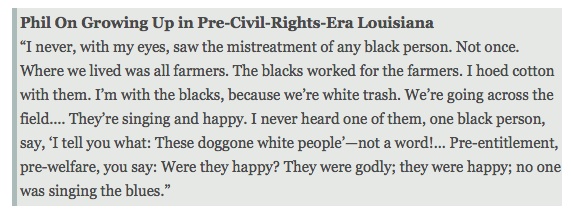
In GQ Robertson talked about his own perception of blacks he knew and worked with growing up. The statements referenced his perception from where he lived, and from my read of the article, spoke of no hate toward blacks, yet the joint letter and the media have labeled Robertson as racist.
Again, the NAACP and HRC are using angry and accusatory language that reflects the hurt they feel. They are effectively driving the story and the headlines in the first phase of the story. However, for the sake of gaining a headline, did they fail to seize on a greater public relations opportunity to advance their cause?
My advice would have been to issue a statement that would have said, “Some in the black community will interpret the remarks made by Phil Robertson as racist. We, however, see it as a personification of what blacks endured during the civil rights period. In many parts of America, our white brothers and sisters did not see the discrimination that many of our black brothers and sisters were experiencing. It is for that reason that we have spent the last 50 years fighting for equality and justice for all and the reason we will continue to our efforts to bring awareness to the need for equality.”
Lost Opportunity #3 – A&E could have addressed this matter without Phil’s suspension. A&E quickly bowed to pressure from the above mentioned groups, who are well organized, well funded, and have a public relations machine already in place. Television networks usually make their decisions based on their own revenue and the reaction of advertisers, who get pressured by activist organizations.
A simple statement without the suspension could have been the wisest way the network could have responded to the unfolding media crisis. They could have simply issued a statement that said, “We realize that many people will be offended by Phil’s remarks, while many people share his belief. However, even if we, as a network do not agree with all that Phil has said, we respect his First Amendment rights and his freedom of speech. We ask for understanding by all of our employees, viewers, and sponsors. We also apologize to anyone who may have been offended by Phil’s remarks.”
While Duck Dynasty viewers are not currently as well organized as the above mentioned groups, I think A&E will see that they too vote with their dollars and have the ability to organize and mobilize through social media to put pressure on the network and the sponsors of Duck Dynasty. This program draws one of the largest audiences on cable television and A&E.
Crisis Management for Duck Dynasty
Now consider this media relations, crisis communication and public relations truth – We’ve seen many people who are in the media spotlight for a controversy, make it worse when they either respond or attempt to issue an apology. Paula Deen was horrible in her live Today Show interview with Matt Lauer. Chip Wilson, founder of Lululemon was forced out of his job because his apology was poorly worded and poorly executed.
The next move for Phil Robertson and the Duck Dynasty family is the most critical. A poorly executed post-crisis interview, like the one by Paula Deen, could spell disaster. While saying nothing in the short term is an option, every time any of the Duck Dynasty stars are in public, you can bet someone from the media will be there shouting a question or asking for a comment about the controversy.
Every member of the Robertson family – if they want to manage this properly – must sit down with the best media expert and best media trainer they can find – and spend some serious time preparing for their verbal and non-verbal reactions. The clever one-liners used on the television show will not play well in media interviews. The media trainer must work with the family members to keep them authentic and to recognize that they can still speak their mind, but that each word they say is important and each word they do not say is important.
Careless phraseology by an authentic person is what started this controversy. Careless phraseology will make the controversy worse.
There are many moving parts to this media crisis and there are many opportunities that have been missed and are yet to be taken.
https://braudcommunications.com/wp-content/uploads/2020/12/Logo-white-01-300x138.png00gbraudhttps://braudcommunications.com/wp-content/uploads/2020/12/Logo-white-01-300x138.pnggbraud2013-12-20 10:56:502021-05-20 23:10:21Media Training Advice: 3 Lost Public Relations Opportunities in the Duck Dynasty Reaction

 Your parents probably taught you there is a right place and a wrong place for everything. That is true for crisis communication and for social media.