Posts

Navigate the Waters of Reputational Repair: 5 Steps to Effective Crisis Communications Planning

By Gerard Braud Navigating the waters of a crisis requires a good crisis communication plan before the waters ever begin to rise. Clear sunny day planning, long before your darkest day, is the secretBy Gerard Braud

DSC_0076Navigating the waters of a crisis requires a good crisis communication plan before the waters ever begin to rise. Clear sunny day planning, long before your darkest day, is the secret. In today’s social media filled world, this has never been more true.

Sadly, in our social media world some public relations people expect to Tweet their way out of a crisis or repair damage using Facebook. Neither is true. While “shiny and new” social media can be part of an effect communications strategy, you must first have the foundation of tried and true media relations, crisis communications, employee communications and stakeholder communications.

(Hear from Gerard in person during this special free webinar on November 20, 2013 1:00 p.m. EST)
Want to know the secret ingredients? Read on…

Here is a sure fire 5 step approach that must be your foundation.

Step 1: Vulnerability assessment

Before “it” hits the fan, you have to identify everything that could go wrong, including potential sudden crises and smoldering crises. Hire a facilitator to take your organization through the process of a deep examination of the things that could go wrong that would damage the reputation and revenues of the company.

Step 2: Write your pre-written news releases, web posts, and e-mails

Perhaps you’ve heard the expression, “when you are up to your ass in alligators it is hard to think about draining the swamp.” This applies to crisis communications. One of the biggest mistakes public relations people make is that as the crisis is unfolding, they open a blank document on their computer and start writing a news release, which then goes through hours of unnecessary re-writes before it is release. Consider this: on a clear sunny day you should write as many of these potential news releases as possible, leaving blanks that you’ll fill in when you know the details of the actual event. These documents can be pre-approved by leaders, speeding up your ability to release them to the public. I’ve facilitated many crisis communication writing retreats that produced more than 150 pre-written news releases in one day. That kind of productivity rocks!

Step 3: Write your crisis communications plan

Very few documents that public relations people refer to as a crisis communication plan would pass my test for what a plan should be. Most are worthless 6 to 12 page documents that state standard operating procedure and serve absolutely no purpose on the day of your crisis. Yet to be fair, this is what most PR people were taught in school or at some PR seminar. Frustrated by what I kept finding, I invented something new.

My approach is to write a document that is intended to be read and followed during the crisis. It dictates specific, sequential tasks in a very fast moving time frame. It captures all of the perfect behaviors of the most senior communicator, yet is so easy to follow than any one who can read can execute the plan flawlessly. I’ve invested about 2,500 hours of development in my base plan, which is about 50 pages long, which I am now able to customize for my clients during a single afternoon workshop.

Step 4: Annual media training for a crisis

Despite all of the buzz about social media, holding a live news conference within both the first and second hour of a crisis is vital if the media are standing at your door. Many organizations damage their revenues and reputations when untrained spokespeople say dumb things during a crisis.

It is important for every potential spokesperson to recognize that media training is not a bucket list item that you do once in life. Talking to the media is a skill that requires regular practice. I recommend media training for all spokespeople at least once a year, with an expert coach. Then, before every media interview, in-house staff should do a fast refresher course.

Think of it this way – the best athletes achieve great success because they practice often and partner with a great coach. Great spokespeople practice often and partner with a great coach, protecting their reputation and revenues through what they say, and just importantly, what they don’t say.

Step 5: An annual crisis communications drill

Realistic crisis communications drills are the best way to test your communications team and the decision making process of your leaders. A drill once a year allows colleagues to establish trust and good working relationships. A crisis drill allows ample time for leaders to pause and discuss decisions they must make during a real crisis. This helps them avoid decision paralysis during a crisis.

Your crisis communications drill should include at least two mock news conferences during the drill. Hire mock media and never use real media. Your facilitator must write a complicated, yet realistic scenario. It must include a likely crisis, plus all of the social media, employee and media buzz that would surround a real crisis. The facilitator should also hire a team of people to flood your phone lines with constant calls, replicating the calls you would receive from media, customers, and concerned citizens in a real crisis.

Conclusion

All of this takes time. None of it is easy or fast. But, it is much easier to prepare on a clear sunny day than to struggle and fail on your darkest day. Your reputation and revenues depend upon it.

About the author: Gerard Braud (Jared Bro) has helped leaders and organizations on 5 continents write their crisis communications plans, using his one-of-a-kind writing retreat that completes one years worth of work in 2 days. He is regarded as an expert in media training and crisis communications plans and is the author of Don’t Talk to the Media Until… 29 Secrets You Need to Know Before You Open Your Mouth to a Reporter. Contact him at www.braudcommunications.com or gerard@braudcommunications.com

 

Did Lululemon’s Crisis Communication Efforts on Social Media Create a Bigger Crisis?

By Gerard Braud

A bad media interview caused by insufficient media training is creating a crisis communication problem on social media. Experts will weigh in on this, but I don’t think any one expert has the answer as to the best way to handle this.

reax Lululemon FBI really want to know what you think.

The founder of Lululemon has posted a video to the company Facebook apologizing for comments he made in an interview on Bloomberg Television. Read the full details on my blog from last week.

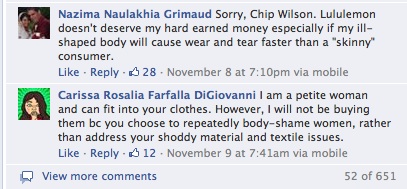
As I write this, nearly 500 people have clicked “Like” on this particular Facebook post while more than 700 comments are posted. The vast majority of these comments are negative.

I have several crisis communication questions for you:

1) Do you think the founder, Chip Wilson, has made the situation better or worse by attempting to apologize on Facebook for comments he made on television?

2) Do you think the situation is getting better or worse on the Facebook brand page as the company’s public relations and social media teams try to engage in a conversation with those who post comments?

Without providing an answer to those questions, here is something to consider — Each time the public relations and social media team replies to a comment on the Facebook post, it moves the discussion higher in the news feed of the page followers, increasing the odds that someone new will jump into the conversation.

Was this a big mistake to take this discussion to Facebook?

Could this apology have found a better home in the company’s newsroom?

Was the apology itself poorly worded, leading to more negative comments?

Was the apology made only to employees and not to customers?

If the apology was to employees only, should it not have been posted where only employees would see it?

Could all of this crisis on the back end been eliminated by doing things differently on the front end?

As a father, I’ll tell you that my wife and I had a couple of basic rules when we were raising our two daughters. One rule was that you never have to fix the big things if you fix the little things. In this case, the lesson for all PR people, CEOs, and executive spokespeople, is to understand that the apology would never have been needed if the CEO had not said a foolish ad lib in the interview.  The foolishness would have been eliminated if executive media training had been done prior to the original interview.

I’m amazed on a daily basis at how under valued media training is among executives and public relations teams.

In every media training class that I teach, I challenge the CEO or spokesperson with this question, “If you could attach a dollar to every word that you say, would you make money or lose money?”

StopSpending LuluLemmon FBOf the more than 700 comments on the Lululemon Athletica Facebook page about this issue, many clearly say they will no longer buy the company’s product. Need I say more to prove my point? I think not.

In every crisis you should consider my “Crisis Rule of Thirds,” which states that one-third of the people love your company/brand, one-third will hate your company/brand, and the third in the middle will swing like a pendulum, based on what is popular at the moment.

In a social media crisis, in a world that is already filled with negative comments, I think many companies will lose the battle, lose the war, lose customers, and lose money.

Consider this: Delete the video, delete the Facebook post, and stop talking about it.

What do you think?

Media Trainer Gives Advice to Chip Wilson, Lululemon Founder

By Gerard Braud

Chip Wilson Bloomberg

Watch the full interview

Media training, media trainers and the executives and spokespeople who go through media training need to understand the importance of practicing before every media interview.

Chip Wilson, Lululemon Founder is being criticized today for comments about how Lululemon pants only fit some women and the ongoing crisis or controversy over allegations that Lululemon pants are “see through.”

Media training requires the spokesperson, executive or CEO to recognize that every word you say can have a positive or negative impact on your corporate sales and revenue. Sales, revenue and the words you say are part of the reputation package you develop over time. As a spokesperson, you either enhance or degrade your reputation and revenues during a media interview.

Media training and the expert who serves as the media trainer, requires us to recognize that while the spokesperson, executive or CEO is invited into a media interview for one topic, other topics may be brought up. This is especially true if the interview is within a reasonable time period of a recent crisis or controversy. This is true for Lululemon and founder Chip Wilson.

Wilson is making headlines because of an interview he did on the Street Smart program on Bloomberg TV with anchor Trish Regan. Wilson appeared on Bloomberg with wife Shannon, who was being interviewed about Whil, a 60 second meditation she was promoting.

Instead of Whil and meditation being the headline in news reports today, the trending headline is “If your thighs rub together, Lululemon’s pants may not be for you.”

Regan asked Chip Wilson, “What’s going on with the pants?”

Wilson replies, “I think everything’s blown up. There is no doubt about it we made a mistake. The thing is we’re a technology company, and when you push technology, something is going to happen every now and then.”

He goes on in his confession to say, “There are a thousand things that could go wrong on a technical fabric and when three of those things go wrong at the same time something is going to happen and it is almost impossible to build a quality control case for each one of those combinations.”

Regan responds, “It’s tough and it continues to be a problem, because now there are complaints of pilling in the fabric.”

Wilson responds with an attempt at an analogy by saying, “There has always been pilling. The thing is that women will wear seatbelts that don’t work, or they will wear a purse that doesn’t work, or quite frankly some women’s bodies just actually don’t work for it.”

“They don’t work for the pants?” Regan asks.

Wilson replies, “They don’t work for some women’s bodies.”

“So it’s more likely they will be more see through on some women’s bodies than others?” Regan follows.

“No, I don’t think that way, because even our small size would fit a woman who is an extra large,” says Wilson. “It’s really about the rubbing through the thighs and how much pressure is there over a period of time and how much they use it…”

Regan injects, “Not every woman can wear Lululemon yoga pants…”

“No, I think they can. It’s just how you use it,” Wilson concludes.

Media training before the interview should have prepared Chip Wilson for a better answer. Media training in the midst of the initial controversy over the alleged “see through” yoga pants should have established a dialogue of carefully parsed, verbatim sentences. With training, Chip Wilson would have been able to say these sentences in an instant if I were to wake him from a dead sleep.

If Gerard Braud, a media trainer from New Orleans, were brought in to provide expert council and media training advice to help the 10th-richest man in Canada and his Vancouver based company, this is how he would have been taught to handle this exchange.

Regan’s initial question was open ended and neither positive nor negative. She asked, “What’s going on with the pants?”

Chip Wilson, like many CEOs, because there is a negative in his mind, focuses on the negative issue, rather than focusing on the positive solution. Remember, Regan implied no negative. Chip Wilson voluntarily went negative.

(By the way Chip Wilson, many CEOs learn this the hard way. My wealthiest  CEO client is worth $2.4 Billion and knows that spending a few dollars on media training and a few minutes on practice protects his company, his brand, and his wealth. My number is 985-624-9976. Call me and I’ll let you talk with him directly as one CEO to another.)

If I were in a private executive media training with Chip Wilson, he would be coached to respond with honest truth about the Lululemon yoga pants and not the negative truth about the Lululemon yoga pants. His answer would be, “The popularity of our yoga pants continues to grow. It is humbling to see that we were able to follow our passion and create a form of sports apparel that continues to grow in popularity with men and women.”

Trish ReganSince Regan appears to be fit, I might even instruct Wilson to ask the Bloomberg news anchor, “Trish, do you have a regular exercise routine and are you a Lululemon customer?”  This is also something Wilson could have learned prior to the interview. If Wilson had employed this technique of asking Regan a question, chances are the discussion would have turned to Regan and her exercise routine.

There is a chance the interview would have never gone negative. If Regan followed up by saying, “A while back you had issues with women complaining that the pants were see through. Have you fixed that problem?”

Wilson could have replied, “Yes, as we investigated we found that many of these issues were caused by customers loving their pants so much they wore them often and in some cases they sat on rough surfaces, such as concrete. So, while we love the fact that customers want to wear our product a lot, like any fabric… including your favorite pair of jeans…  get thinner and you need to buy a new pair.”

There is a good chance the negative tone of the interview would have ended there.

Additionally, in a politically correct, hyper-sensitive world, a CEO, a spokesperson or executive cannot say anything that could be implied as criticism of a woman’s body and shape. Regan baits Wilson with her question, “So it’s more likely they will be more see through on some women’s bodies than others?” This follow up question might never have been voiced if Wilson had used my positive, pre-planned and practiced answer, rather than his bad ad-lib.

Wilson steps in a big pile of “do-do” when he says, “It’s really about the rubbing through the thighs, how much pressure is there over a period of time and how much they use it.”

What my experience as a media trainer also picks up on here is that Wilson is likely an analytical person. Many CEOs are analytical, which causes them to answer with technical facts and confessions, in an effort to be honest. Often a stronger form of honesty can be found in a less technical and more positive answer.

Surely, the entire Lululemon public relations team gave out a loud cry when Wilson mentioned thighs? Or did they? I don’t know.

I do know that I have watched many PR teams simply tell a rich CEO what a great job they did in an interview, rather than providing honest feed back and more media training before then next interview. If you are in public relations, it is your job to provide executive council to the CEO and not be a wimp who is afraid to speak.

(For all of you who have asked, “How do I get a seat at the table?”, the answer is to have the nerve and professionalism to speak up rather than being fearful that you will lose your job.)

Trish Regan 2

Read the article

In the spirit of avoiding negatives, Wilson never needed to use words such as, “There are a thousand things that could go wrong on a technical fabric and when three of those things go wrong at the same time something is going to happen and it is almost impossible to build a quality control case for each one of those combinations.” This, once again, indicates an analytical engineering type mind is answering the question.

Finally, the analogy used by Wilson about seat belts not fitting and purses not being right represents what happens when a media spokesperson does not develop and practice their analogies during their media training class.

The bottom line: Headlines on the internet and headlines in the media focus on words such as, “Chip Wilson, Lululemon Founder: ‘Some Women’s Bodies’ Not Right For Our Pants.”

This didn’t need to be the headline. The CEO is at fault. All CEOs need to recognize the importance of media training and public relations teams must not gloss over media training prior to every interview.


Lesson 2: “This is a Drill”

By Gerard Braud

Media_Relations_CamerasRule number one during a crisis communications drill is to never have anyone accidentally think a real crisis is happening, when it is not. Hence, in all written communications and on every phone conversation and radio conversation, you must generously use the phrase, “This is a Drill.”

For phone calls, the first words out of your mouth when the other party says, “Hello,” should be, “This is a Drill.” When the other party hears these words from you, they should reply, “This is a Drill.”

These basic rules need to be covered by your drill facilitator before and during the drill.

Likewise, when your phone call is concluded, your last words should be, “This is a Drill.” At that time the other party should reply, “This is a Drill.”

The reason this is important is because you never want someone to overhear details that sound like a crisis and think there really is a crisis, which might trigger panic, rumors, or other unintended consequences.

If two-way radios are a part of your drill, the same protocol should also be followed.

If e-mails are used during the drill, the phrase, “This is a Drill,” should be used in the subject line. It should then open and close the message within the e-mail. If Word Documents, PDFs or printed documents are used during the drill, each one should have a bold message at the beginning and end of the text that says, “This is a Drill.” Also, create a 50% watermark on an angle within these documents that says, “This is a Drill.”

In addition to avoiding unintended consequences internally, this phrase is important so that agencies such as police, the fire department, or the media don’t somehow hear a radio transmission and respond.

As a courtesy, you may wish to call your local police and fire dispatcher to inform them that a drill is underway. Generally, I do not tell the media a drill is happening because I don’t want the media to attempt to create a news story about my drill, because I don’t want to enlighten the media about some ugly events that might actually be a possibility.

Braud Crisis Plans_6113Sometimes when a drill involves a school or airport, and it is conducted in conjunction with police and fire departments, the agencies turn it into a news event designed to be a media event that shows their preparedness. I’m not a fan of this, because when things go wrong in a drill, I don’t want the organization’s unpreparedness to become part of a news story.

Remember, the goal of a drill is to create an opportunity for organizations to practice how to do things right, with that ability to allow people to screw up in private so they don’t screw up in public during an actual event.

“This is a Drill.” This is not a publicity event.

In our next article we will discuss some of the goals and objectives of your drill, so you will have a clear idea of how to measure success.

3 Things You NEED to Finish Before the End of the Year

Yearly Budget - Gerard Braud Crisis Communications expertBy Gerard Braud

The pretty stuff always gets more attention than the ugly stuff. Preparing for media interviews and crisis communications is not as sexy as a newsletter or brochure. But when “it” hits the fan, will your customers, employees, and the media be remembering your great graphics? Or will they form their opinion of your company based on dumb things said by a spokesperson or horrific images of your crisis?

Media training, a properly written crisis communications plan, and a well-planned and executed crisis communications drill should be on your list of tasks to be completed before the end of this year.

Excuses are easy to come by for why these three things won’t get done before the end of the year. “It’s not in our budget” is the most common. Here’s a secret: Never take a “No” earlier in the year as a “No” at the end of the year. As sales, revenues, and the economy get better, most companies are seeing training budgets improve. Ask again. You may get a firm yes for this year. Remember: your company will spend far more on a holiday party than they will on any or all of these three tasks.

The second most popular excuse is, “We can’t get on everyone’s calendar.” Here’s a secret: Ask everyone involved if they have time on their calendar to play in a charity golf game. You will be amazed at how many people suddenly have an open day.

Now for the nitty-gritty and why you should do media training, a crisis communications plan, and a crisis communications drill before the end of the year.

In no particular order I’ll say this about each:

A crisis communications drill is the absolute best way to test everyone in your organization to see exactly how well (or how poorly) they will perform in a crisis. You get to test your crisis communications plan (if you have one), and your spokespeople. You will discover who on your leadership team has true leadership skills when “it” hits the fan and who will create constant roadblocks and impediments to success in both the drill and a real event.

Media training should be treated like a sport, with the understanding that regular practice is the key to being good. Every potential spokesperson should go through a rigorous initial media training class, then each year after that go through a refresher course. Too many executives think of media training as a bucket list item, which they only have to do once in their lives. Anyone who believes that may actually die at the podium when you need them the most. By the way, a crisis communications drill is a great time to realistically test your spokespeople. During and following a drill, many potential spokespeople realize that they are perhaps not as prepared as they should be. A little humility in a drill goes a long way toward instilling in people the concept of an annual media training refresher course.

Crisis communications plans have never been more of a necessity than they are now, in large part because of how a crisis now plays out in social media. Any crisis communications plan must equip you to communicate quickly through multiple means, including news conferences, web postings, emails to employees, and updates on social media. Yet many crisis communications plans really cannot help you achieve these goals because they were written with flaws from the beginning and because they haven’t been updated.

The biggest flaw with most plans is that they state only standard operating procedures. If your plan is only 6-20 pages long, chances are you need a major overhaul.  I’m standing by to get the right plan in your hands through an intense two-day writing workshop that delivers to you a plan that is so thorough that nothing is forgotten, yet so simple to execute that anyone who can read execute it flawlessly. The plan is also ultra fast to use, because it contains a huge library of pre-written news releases that can be approved by your leadership on a clear sunny day, preventing time consuming delays on your darkest day.

If you are wondering if your plan is up to the task, you can always call me for a free review of your plan.

Ultimately, all three of these end-of-the-year tasks allow you to test your people and your plans on a clear sunny day, so you can perform your best on your darkest day.


Three Media Lessons from Paula Deen

by Gerard Braud

Gerard Braud Paula Deen“I is what I is, and I’m not going to change.” That is the costly statement made by Paula Deen to Matt Lauer in an NBC Today Show.

“If you could attach a dollar to every word you say, would you make money or lose money?”

Those are the first words every executive hears when they attend one of the executive media training classes I teach, designed to help them become more effective communicators and a better spokesperson. [An entire chapter is dedicated to this issue in my book, Don’t Talk to the Media Until… 29 Secrets You Need to Know Before You Open Your Mouth to a Reporter.]

Paula Deen’s interview with the NBC Today Show and Matt Lauer is a living example of three common mistakes made by powerful people who fail to adequately prepare for a  media interview.

Lesson One: Plan Your Quotes

Granted, the racial slur in question is the event everyone focuses on. But in the June 26, 2013 interview with Matt Lauer, it wasn’t her use of a slur, but her failure to plan great quotes and her propensity to ad lib statements that could be taken out of context, that created the greater problem.Paula Deen Today Show

“I is what I is, and I’m not going to change,” Deen said, as my wife and I shared a cup of coffee in the kitchen, watching Today.

As soon as she said it, I told my wife, there’s the sound bite of the day. Sure enough, that was the sound bite that showed up moments later on CNN and every other network. Outside of the context of the full interview, this is a damning sound bite. If you are a person who believed before the interview that Deen was a racist, and then you saw just that quote on the news, she essentially said to you, “I am a racist and I’m not changing.”

Wow? Every day spokespeople continue to say dumb things in interviews and it appears there is no end in site. I would really like to know what, if any preparation she did before this interview. I would love to know if Paula Deen had a media trainer, or if, like many high powered people, she decided to just “wing it.” Did she mistakenly believe that because she is on television so often that no preparation was needed for an interview worth tens of millions of dollars?

In media training, I tell every potential spokesperson, “When you wing it, you crash and burn.”

It is amazing that companies will spend countless hours negotiating multi-million dollar contracts, yet spend little or no time training a spokesperson for an interview that could potentially cause them to lose millions of dollars in revenue with a single misplaced word or sentence.

Lesson Two: Apologize, Yet Understand the Rule of Thirds

Deen does get high marks from me for agreeing to do an interview. If you are in trouble, you need to apologize and make the apology good. She tried, but failed to get full credit for her effort because of her ad lib, oh shucks, I’m from the south persona.

My rule of 3rds applies to Deen’s case. I believe that for any public figure, 1/3rd of the people love you, 1/3rd of the people hate you, and 1/3rd swing like a pendulum, siding with the popular 1/3rd. To that extent, Deen will never lose her loyal following. Media stories showed supporters, black and white, outside of her restaurant verbalizing their love for the southern cooking icon. The monetary loss of sponsors begins when the 1/3rd in the middle decide not to buy your products any more, with, in my opinion, the nail in the coffin being a bad ad lib.

Great quotes must be planned, practiced, and delivered. Great quotes are not an accident.

Refer to this previous blog post and video for lessons on how a planned quote works, even to the point of making you a front-page headline.

Lesson Three: If You Could Attach a Dollar to Every Word You Say, Would You Make Money or Lose Money?

Ultimately, “I is what I is, and I’m not changing,” caused Deen to likely lose tens of millions of dollars. It became the trigger that caused more sponsors and retailers to drop her.

So let me ask you, before an interview, are you willing to ask an interview expert to help you prepare, or would you rather just “wing it?”


Tutorial #21: Great New Gadgets for iReporting and Web Videos

Tutorial #21 by Gerard Braud, iReporter Evangelist

(Editor’s note: In 2013, CNN selected me as one of their top iReporters, out of more than 11,000 reporters. This is part of a series of articles that share how to be a good iReporter and how to make CNN iReports a vital part of your crisis communication and media relations strategy.)

Click image to watch video

Click image to watch video

In my previous tutorials I’ve talked about lighting, audio, and holding your smart device at arm’s length. However, I have recently purchased several cool items that I want you to know about.

Watch today’s video tutorial to see them in action. They include device that allow you to attach your iPhone or iPad to a camera tripod. This can help to keep your shot steady, while still allowing you to move it some.  I paid about $12 for the iPhone attachment and about $69 for the iPad attachment.

You’ll see a really cool LED video light that mounts to the top of the iPad bracket using what is known as a “hot shoe.” This helps to put light on your face and maintain flesh tones when your face might otherwise be too dark. I paid about $25 for it.

For good audio, I’ve purchased a lavaliere microphone that plugs into the headphone jack on my smart device. This gives me better sound for my on camera narrations. I paid about $25 for it.

Each can make your CNN iReport or web video a little better. Best of all, I bought all 4 item at a great price.

This link will take you to my tutorials on the CNN iReporter website. I hope you take the time to view, study, and share all 23 videos and articles.

This link will take you to the index for all of the articles and videos.

If you, like many others, think this information would be valuable as a workshop at a conference or corporate meeting, please call me at 985-624-9976. You can also download a PDF that outlines the program,Social Media iReports.pdf,  so you can share it with your meeting planner or training manager.


Dark Day Crisis Planning Must Begin on a Sunny Day

By Gerard Braud

DSC_0265

Few organizations in the world face the communications challenges of America’s Rural Electric Cooperatives.

On any given day customers could be protesting over electric rates. Workers could be under attack for disconnecting service. Board members could be scrutinized for per diems, travel or expenses. Add to that the growing influence of negative social media comments and big city media covering more co-op controversies, and you have a storm brewing. That storm demands effective communications from all executives, board members, and co-op public relations teams.

Here are three steps every cooperative should take:

Step 1: Annual Media Training with Good Key Message Writing

There is no excuse, in this modern age of media, for any executive, board member or public relations person to mess up when talking to the media. But it still happens.

Many rural people tend to be friendly, honest and sometimes too chatty. Unfortunately many executives, board members and public relations people mistake the gift of gab for the ability to be an effective communicator with the media. Many board members mistakenly believe the respect they get from their status in their communities will transfer to respect from the media. That isn’t true. The fact is many of the habits you have in everyday conversation have to be avoided when talking with a reporter.

Don’t worry, there is hope. The secret is to set aside one day every year to sit down in front of a television camera with a media training coach to practice realistic interview scenarios.

Since most reporters really do not fully understand the history and inner workings of cooperatives, your media training must adopt the newest innovations in training. Never settle for training that provides only bullet points as talking points. This outdated method leads to bad ad-libs and ugly quotes.

Modern training requires a library of pre-written quotes, learned and internalized by each executive, board member and spokesperson. When written properly, internalized, and practiced, these verbatim sentences provide context, information and strong quotes.  These are all elements reporters need in their story. Also, when written in a conversational sentence structure, these sentences are easy to work into everyday conversations by leaders and employees alike.

Consider that many executives who are interviewed complain that they are taken out of context and misquoted. A well-worded, pre-planned opening sentence delivered by the spokesperson can serve as a pre-amble statement that provides context to your cooperative’s goals and purpose. This forever eliminates the issue of being taken out of context.

With annual media training you will be a good spokesperson for good news, as well as when you have to speak to the media during a crisis.

Step 2: Write a Strong Crisis Communications Plan

The worst time to deal with a crisis is during the crisis. The best time is on a clear sunny day.

  • During good times, your cooperative must conduct a vulnerability assessment to identify all potential crises.
  • You must write a crisis communications plan that chronologically tells you every step you must take to effectively communicate during the crisis.
  • You must write a preliminary fill-in-the-blank statement to use in the first hour of your crisis when facts are still being determined.
  • You must create a more detailed news release style statement for each potential crisis that you identified in your vulnerability assessment.

Katrina Media_0318If you identify 100 potential crises, then you need to write 100 potential news releases, using evergreen facts, fill in the blanks and multiple-choice options. This is best done through a facilitated writing retreat with your communications team.

A classic mistake cooperatives make is to prepare communications only for natural disasters, power outages and worker injury. A modern crisis communications plan must also cover smoldering crises such as executive misbehavior, discrimination, financial mismanagement, per diems, and even crises involving social media.

When pre-written on a clear sunny day, these documents are ready for quick release to the media, employees, customers, the Internet and other key audiences. This process is not easy and is time consuming, but it pays huge dividends during your crisis. Many organizations experience a crisis, then in the midst of it, look at a blank word document and try to spontaneously draft a statement. The statement then goes through unprecedented scrutiny and rewrites, resulting in massive delays. In the modern age of fast communications, this is lunacy. You should never put off until tomorrow what you can write today.

Writing your Crisis Communications Plan is the perfect way to get all employees, executives, and board members on the same page. On a clear sunny day you can all agree on the policies and procedures that need to be followed for effective crisis communications. Make sure your plan goes beyond standard operating procedures.  Also, make sure it doesn’t rely on only the expertise of your public relations team. The plan must be so thorough that nothing in the process is forgotten, yet easy enough to understand and follow that it can be executed by anyone who can read.

Step 3: Hold an Annual Crisis Drill

Too many cooperatives make the mistake of thinking their executives can wing it in a crisis. They think a gift of gab equates to being a great spokesperson. They also think that knowledge of the business equips them to manage a crisis and the communications for that crisis.

The secret to getting it right on your darkest day is to set aside time on a clear sunny day to hold a crisis drill. During your drill your emergency managers can run a table-top exercise. Your communications team and executives act out a real-time exercise, complete with news conferences, using role players to portray the media.

DSC_0011When done correctly, a drill exposes bad decision-making, bad behavior and outright incompetence among responders, spokespeople and those in leadership roles. Conversely, annual drills teach your team members how to effectively work together during a crisis. Team members are taught to achieve effective communications while also working to end the crisis.

As your facilitator prepares your drill scenario, make sure you include realistic elements of social media, since social media can spread good and bad news faster and further than the reach of traditional media.

Conclusion

As more cities sprawl into rural areas, they bring more homes and electric customers into your cooperative territory. The sprawl also brings more media attention and more scrutiny of your operations.

The best way to prepare for the increased attention you will get, is to plan on a clear sunny day and never to wait for the dark clouds to roll in.

##30##

Type in the coupon code: CRISISCOMPLAN

About the author: Gerard Braud, CSP, Fellow IEC has helped organizations on 5 continents communicate more effectively with the media, employees and customers in good times and bad. He facilitates writing retreats and workshops to help cooperatives write and complete their crisis communications plans in just 2 days. He also trains cooperative board members and leaders on how to become effective spokespeople.

{Attendees at 2014 NRECA CEO Close-up can download a copy of the handouts hereAttendees at the 2013-Leader-Fan-PowerSouth can download a copy of the handouts here: Attendees at 2013-HitsFan-OK-Coops: Attendees for MREA Co-op Communicators Meeting can download your handouts here: Attendees at the NRECA Connect 2013 can download a copy of the handout here: Braud-NRECA-Handout.}

Prescriptions for Great Media Interviews: Secrets You Need to Know Before Talking to Reporters

By Gerard Braud

Braud MDU3 copyThe doctor’s resume was impressive. It demonstrated a successful practice, plus a history of research and teaching. The ABC News program 20/20 wanted to do a story about the doctor’s research. The teaching hospital selected me to be the media trainer.

After the best research possible, to prepare, I called the public relations department at the doctor’s hospital.

“What exactly does this person do?” I asked.

“We don’t know,” said the public relations director. “That’s why we hired you.”

“Hum? This is going to be a challenge,” I thought.

The media training class began as normal, with the doctor being recorded on camera for a baseline interview, to evaluate the spokesperson’s natural strengths and weaknesses. The baseline interview is usually followed by a critique and suggestions for good key messages that will help guide the interview.

There was just one problem. After the baseline interview, I still had no idea what the doctor was saying. No matter how I tried to get the doctor to simplify the information, we were getting nowhere, until the fourth hour.

Yes, it was four hours into the day when I sketched out a simple diagram with a cause and effect explanation. I presented it to the doctor and asked,  “Is this what you do?”

“That’s perfect,” The doctor responded.

“Then why didn’t you say that four hours ago?” I asked.

“Well what would my peers think?” the doctor replied. “I don’t want to dumb it down.”

“The goal of this interview is to put butts in your waiting room and money in your pocket,” I replied. “We’re not here to impress your peers. We’re here to talk to potential patients.”

Many medical professionals fall into this same trap. They are afraid to “dumb it down.” The truth is, you don’t need to dumb it down, but you need to simplify it.

With that said, let us examine three great rules for more effective media interviews.

Gerard-Braud-Author-BookRule #1: Don’t talk to the media, but rather talk to the media’s audience.

Spokespeople mistakenly put reporters on a pedestal. The reality is, most reporters are generalists who know a little about a lot and can make an audience think they are smarter than they really are. Don’t try to talk at a high level. Besides, the reporter isn’t your audience.

Your audience is made up of the people at home. Research tells us the average person watching television has a 6th grade education and the average person reading a newspaper or other written source has an 8th grade reading level.

This means that anything you say must be said at a 6th grade level if you want to be a great communicator. You don’t win prizes for using big words. Additionally, never give too many details.

Many spokespeople shun this advice, saying they don’t want to “dumb down” their information. The best mindset you can adopt is the same one learned through diversity training, which is to respect all people and to be inclusive of all audiences.

Also remember, when you use big words and technical terms, often the reporter has no idea what you are saying. Which leads us to the second rule, based on how little most interviewers know about your topic.

Rule #2: You should always know the first words that will come out of your mouth.

The goal is for you to know two great sentences that instantly adds context to your interview and simultaneously states a great quote.

The two most often heard complaints by spokespeople after interviews is that they were taken out of context and their best stuff was left on the cutting room floor. That will never be the case when you follow this rule. These first two sentences become a verbal headline.

Many spokespeople reject this rule. First, they don’t believe you can know what to say without knowing the question they will be asked. Secondly, they don’t want to sound scripted or rehearsed.

Here is a confession from my 15 years as a journalist, combined with a revelation from 20 years as a coach to spokespeople. Think AED Hears sign_633back to your last media interview. While you were talking, were you partially wondering what the next question would be? Confession: when I was a reporter and my guest was blabbing, I was wondering what my next question would be, because their answer was rambling, full of jargon, too detailed, or lacking quotes.

The revelation is that both the reporter and guest are wondering what their next question is and no one is concentrating on the current answer. This creates an amazing opportunity. Your pre-planned answer will provide context to all you believe about your subject, it will be quotable, it alleviates the jitters about not knowing what to say, and it becomes a preamble to eventually answering the question you were specifically asked.

Furthermore, when written for the mouth and ear, and used in daily conversation following your media training, your pre-planned sentences become internalized and never sounds rehearsed. In fact, you will sound spontaneous and natural.

Rule #3: Talk about the benefit you bring to your patients and not the scientific details. Focus on what’s in it for them and work to manage their expectations.

If you think details are important, do a quick self-examination. When you read the newspaper, do you read every story? No. Of the stories you read, how often do your read until the end? Often you don’t. Chances are you read the headline and the first few paragraphs.

So, if you are not interested in everyone else’s details, what makes you think people want to know your details?

Finally, remember that media training is designed to let you mess up in private so you’ll be great when the real interview happens. In a career where perfection is expected, it takes humility to subject yourself to training. But the most effective communicators train at least once a year and before every interview.

##30##

About the author: Gerard Braud is the author of Don’t Talk to the Media Until… 29 Secrets You Need to Know Before You Open Your Mouth to a Reporter. He is a media training expert who helps spokespeople communicate more effectively. Braud has appeared on TV more than 5,000 times and been quoted in more than 500 publications around the world.

What Leaders & PR People Can Learn from Lance Armstrong: Denial & Crisis Communication

By Gerard Braud

Lance Armstrong’s denial of doping over the years provides a valuable crisis communications and public relations case study for analyzing denial by powerful people and how they communicate in a crisis.

This is important for two reasons:

1) Public relations people may give excellent advice and professional council, but be rebuffed by their corporate leaders.

2) Corporate leaders may be blinded by the view from their high perch and ignore the wise council of their public relations professionals.

Lance Armstrong appears to have shifted from a position of denial to a position of doing his duty and coming clean.

Denial is also a critical marker in crisis communications, especially in a smoldering crisis. Penn State is a perfect example of an entire institution where the leaders were in denial.

As a rule, the longer you remain in denial, the more you cause monetary and reputational harm to the institutions with which you are associated.

Lance Armstrong has harmed his Livestrong Charity, his sponsors and his businesses. (PR Daily, CNN)

This is true for denial at Penn State and many other organizations with allegations of child sexual abuse being swept under the rug.

PR people – When you see denial, urge the leader to come clean. If they don’t come clean and follow your advice, then it is time for you to polish your resume and find a job where you are respected for your advice and where the leaders have higher ethics

Leaders – When your public relations team tells you that the best thing to do is to come clean, please humble yourself to take their advice.

Here are a few important leadership lessons.

In every crisis I have witnessed and in every case study I have analyzed, individuals in leadership positions follow distinctive, easy to identify patterns that foreshadow their future success or failure.

• Some leaders do their duty, while others are in denial.

• Some take action, while others are arrogant.

If a leader does their duty and takes action, then their constituents (employees, stakeholders, etc.) will be responsible and remain loyal. However, when the person in the leadership position is in denial and is arrogant, their constituents blame everyone for the failings that occur, and the individual in denial and showing arrogance also blames everyone for his or her failings. (In the case of Lance Armstrong, he has spent years blaming his accusers.)

Remember this:

Duty vs. Denial

Action vs. Arrogance

Being Responsible vs. Blame


The best way to exhibit leadership in a crisis is to plan ahead on a clear sunny day, starting with a three-plan approach including a crisis communications plan, an incident command plan and business continuity plan.  Armstrong makes a perfect example for this three-plan approach because he is a leader and CEO who is continuously in the media, he is a brand, and he runs a business.  Most organizations and leaders are up to date on their incident command and business continuity plans, but most fail to plan for speaking to the media, employees, and other key audiences.

My crisis communications plans usually have 100 or more pre-written and pre-approved templates, each containing the words a leader would

use to communicate when “it” hits the fan, especially during the early hours of a crisis when emotions and anxiety are high.

As new issues arise, a document must be created for these new issues. This is especially true of smoldering issues, such as allegations harmful to the brand. Having the proper statement depends upon the leader telling the truth and not being in denial.

The best time to write such templates is on a clear sunny day and the worst time to write and formulate your words is in the throes of a crisis.

Managing a business and making money are too often the characteristics executives consider the mark of a good leader.

In my world, a leader is someone who uses effective communications in critical times to get their audience and themselves through what may be our darkest hours, so we can emerge into a bright new day.

Feel free to download this PDF and share it with your fellow leaders and PR teams.