Posts

Social Media for Crisis Communications: Social Media for Crisis Communication and the Generation Gap

By Gerard Braud

IMG_2621As we discuss social media as a crisis communication tool that allows you to reach your core audience, this is a good time to explore what I will describe as both the leadership gap and the generation gap, that social media presents.

People in leadership positions, traditionally perform poorly in a crisis because it is an out of the ordinary event for which they are seldom trained. They don’t plan on a clear sunny day for the things that will affect them on their darkest day. They ignore the old adage, “If you fail to plan, plan to fail.”

You can rectify this in several ways. If you don’t have a crisis communications plan, include leaders in the process of conducting a vulnerability assessment that explores all the things that could go wrong where you work. As I mentioned in an earlier article, I facilitate many executive meetings throughout the year to conduct such vulnerability assessments. Leaders are often stunned when they see the long list of potential ways that “it” could hit the fan.

So add to your to-do list the need to conduct a vulnerability assessment in a facilitated setting with your leadership team.

If you already have a crisis communications plan, leaders should be trained in two ways; that would include annual media training and at least one crisis drill each year.

Just because someone holds a leadership title, doesn’t mean they have leadership qualities. Among the qualities I look for in someone who has leadership qualities is the ability to manage a crisis. The leadership gap is most often personified by decision paralysis. In other words, leaders are paralyzed by the fear that the decisions they will make will be the wrong decision, therefore they do nothing.

In the world of crisis communications, decision paralysis is personified by people in leadership positions not authorizing or allowing you to issue a statement in the first hour of a crisis. Often, lawyers advise them against saying anything for fear that they will say the wrong thing. My belief is that you must begin communicating something, even if it is only partial facts.

A crisis communications drill will get your leaders used to the speed at which a crisis unfolds and media training will give your spokespeople the confidence to stand before an audience of employees or the media, to let them know what is happening. I’ve seen some remarkable changes among the leaders whom I media train and the organizations for which I annually conduct crisis communications drills. If you fail to conduct media training and you fail to conduct crisis communications drills annually, you can expect your leadership team to fail you during your crisis. You can expect your leaders to fall back into decision paralysis. Think of it this way; a great athlete practices constantly and has great coaches. Well, your leaders likewise need to practice and have great coaches in order for them to perform well when they need to.

This brings us to the generation gap. We’ve already established that in the world of traditional media, leaders are slow to respond and issue statements. In the days of traditional media, when I was a television and newspaper reporter, if a crisis happened, it usually took us about one hour to arrive on the scene and begin reporting. But these days, any employee or any person on the street can communicate the crisis to the entire world in a matter of seconds. Instead of the 24 hour news cycle, we now have the 140 character news cycle. For those new to social media, 140 characters is the maximum message size allowed by Twitter.Twitter over capacity

Many leaders do not use social media. Many leaders still don’t know what social media is. Many leaders have no idea how fast messages get communicated by social media. Some leaders may have heard of the various outlets, such as Facebook and Twitter. But the reality is, they have no idea what these tools do and how they work.

I’m asked to give keynote speeches at many association and corporate conferences and a few years ago I introduced a new keynote called, Social Media When “It” Hits the Fan. The keynotes give me an opportunity to create a dialogue from the stage with leaders as I ask them what they know about social media. Here are my questions and the responses received.

• When asked how many use LinkedIn.com, 10% – 20% usually say yes.

• When asked how many use Facebook, fewer than 15% usually say yes.

• When asked how many have watched a video on YouTube.com, about 25% usually say yes.

• When asked how many have ever posted a video to YouTube.com, the response drops to 2%.

• When asked how many use Twitter, the response is usually 1-2%.

I then ask, how many have no idea what I just said and what I’m talking about, to which most hands go up and there is an uproarious laugh.

This represents both the leadership gap and the generation gap. While Gen X & Gen Y employees post comments, pictures and video to social media sites, often via their smart phones, older employees – especially leaders – are oblivious to the far reaching impact of these tools and trends.

In an earlier article in our series, I told you the best research on social media behavior comes from the experts at PEW Research.

As of December 2012:

  • 15% of online adults say they use Pinterest
  • 13% of online adults say they use Instagram
  • 6% of online adults say they use Tumblr
  • 67% of online adults say they use Facebook
  • 16% of online adults say they use Twitter

•    20% of online adults say they use LinkedIn as of August 2012.

At this point, take out your to-do list and place on the list the need to do social media training; that is to say, you need to conduct programs to educate leaders on the impact of social media both on good days and in a crisis.

If you have a corporate meeting planned or if your leaders attend specific association meetings, you can always ask the meeting planner to invite me or you can call me with their contact information. That way, I can help you close the generation gap and solve the leadership gap if you would like my help.


Media Training in New Orleans, Baton Rouge & Louisiana

DSC_0076By Gerard Braud

Media training in New Orleans, Baton Rouge and other cities in Louisiana carry a special set of challenges. Usually the training is for spokesmen – as in all men. Seldom is the media training for spokespeople, representing both genders. The spokesmen generally work in the oil and chemical industry. Most are not trained public relations professionals. Most are managers and supervisors in a chemical plant or an oil refinery.

In Louisiana’s industrial corridor, the bulk of the media training is to prepare someone for crisis response. Often companies call asking for crisis communications training or crisis management training. Seldom do they ask for media training because many do not know what the training should be called.

At the risk of generalizing, many of these spokesmen grew up as I did. We were taught to tell it like it is. Telling it like it is usually starts with negative information, followed by a justification for the bad news or event. After the bad news and the justification, Louisiana men often tell you what they are going to do differently.

Analyzed, it looks like this:

Bad News – Repeat the negative

Bad News – Repeat the negative

Good News

When I was a television reporter, I was often first on the scene when a chemical plant blew up between Baton Rouge and New Orleans. Often the spokesperson would share too many negative details that should not have been shared. They might say something such as, “Well we’ve been having problems with the vessel in the hydrocarbon unit for the past month. We had one small fire that we put out last week. But we don’t know what caused the explosion today. But I promise you, safety is our top priority.”

To be an expert spokesman in media interviews, the fewer negatives you repeat, the better you will be. In media training, you need to learn to say positive news first and as little of the negative news as possible.

The statement above might have better been worded by saying, “Our goal is to always be protective of human health and the environment. What has happened here today will require us to investigate so we can find out what happened, how it happened, and how we can keep it from ever happening again.”

Are you up to the challenge for a media interview?

Expert Advice for Media Training Key Messages

By Gerard Braud

crisisdrillgerardbraud2Can we have an intimate, professional conversation? The presumption is you are an expert in public relations and that the executives and leaders where you work need expert key messages for media training, to be an expert spokesperson. Here we go:

  • Good looking
  • Intelligent
  • Public relations professional
  • Mistakes of the past
  • Bullet points bad

Did we just have a conversation? I don’t think so.

Why?

Because I used bullet points and bullet points are not a conversation. Bullet points are phrases. Bullet points are not sentences.

So, should it then also be true that bullet points are not key messages?

Consider this: If you are training someone for a media interview, and you’ve given them nothing but bullet points, you have only given them an outline from which you now want them to ad lib.

Have you ever noticed that the most embarrassing interviews with reporters are the ones with bad ad-libs?

Have you ever noticed that the media crave a well-worded quote?

This is your call to action to stop believing that key messages should be bullet points. Key messages for media training should consist of well-worded, quotable sentences. Expert spokespeople speak in great, well-worded quotes and not in bullet points.

You are a good looking, intelligent, public relations professional who should stop repeating the mistakes of your public relations forefathers or foremothers, who believe bullet points are sufficient as key messages.


Crisis Communication Case Study: Malaysia Airlines

Malaysia-BlogBy Gerard Braud

Ask any expert in global crisis communications how Malaysia Airlines should be communicating during their crisis and you will get varied opinions. Having worked in Malaysia many times writing crisis communications plans and teaching media training, I would like to offer five things worth considering, should you face a prolonged crisis that draws global media attention.

Culture – Problem #1

Malaysian’s culture and religion are different from traditional western culture and religion. Their language also includes a mix of Malay, Mandarin Chinese and English. Prior to my trips, I’ve taken classes to help learn and respect their culture. I’ve even learned to speak some Malay.

Sadly, western media wants to play by western rules, often with little regard for the culture of another country. Media are not known to stop what they are doing to take cultural sensitivity classes. U.S. media can be especially pushy and overbearing. Chances are western media will not adjust to or fully respect Malaysia’s culture. Hence, if you work for the airline, you must be prepared to adjust to all of the many global media outlets and their ways. This is no easy task.

Accomplishing this means that long before you ever have a global crisis, you need to write a crisis communications plan that takes this into account. Next, you need to practice it at least once a year in a crisis communications drill until you are an expert communicator and public relations professional. The drill will also help your leaders better understand what they will face during a crisis, provided your drill includes intense mock media and mock news conferences.

Joint Information Centers (JICs) – Problem #2

In the U.S., when your corporation has to share the stage, microphone and crisis with government agencies, often all parties agree to set up a Joint Information Center (JIC). Often, the government agencies want to take the lead and usually corporations are too willing to let the investigating agencies bear the burden of the media interviews. This usually happens because the corporation has failed to write a good crisis communications plan, they have failed to train their spokespeople, and they have failed to hold annual crisis communications drills. Due to their failures – all of which could have been avoided – they capitulate to government agencies, praying the government agencies have good spokespeople.

I despise when this is done. I especially despise when a corporation depends entirely on government spokespeople to communicate.

Consider that government agencies cannot and will not communicate empathy to the affected parties. Their communications is only about the issues related to their investigation and fact gathering. Government agencies have a different communications motive than the affected company. Only the offending party – in this case the airline – can adequately communicate empathy to the family members of passengers.

You have an obligation to media train your spokespeople to the highest level so they can hold their own in a news conference.

Separate Media From Grieving Families – Problem #3

Malaysia blog 2Never house family members in a building or hotel where the media has easy access to them. Crying family members amid the media makes for a great story for the media and a horrible story for your company.

When I was a reporter, I hated talking to family members in situations like this. I recall covering the derailment of an Amtrak passenger train with a high fatality count. The train plunged off of a bridge late one night and the passengers were trapped in the rail cars deep in a river. Family members were holding out hope that there were air pockets with people alive in the cars, just as Malaysian Airline families are holding out hope that their family members are alive somewhere on a remote island.

In the story I was covering, the trauma went on for days, with Amtrak housing the families in the lobby of a hotel with us – the media. The families never got a break from the cameras and the microphones and our producers kept asking for more interviews. Amtrak looked bad every time someone fell to pieces emotionally in the hotel lobby.

If your company might face this type of crisis with a high fatality count, your crisis communications team must work with your risk management team to identify, in advance, facilities where families can be housed without the media being anywhere around.

Brute Force Never Plays Well In Front of the Media – Problem #4

When Malaysian authorities hauled away a grieving family member earlier this week, it made a bad situation look worse. Authorities lost their cool. This happens all over the world. When they lose their cool, authorities seldom ask, “How will this play on TV?” This is one more reason to follow the advice above to keep the families separate from the media.

My experience in Malaysia assures me there are many gated resorts that the airline could take over as their base for families. These resorts have sleeping accommodations, restaurants and beaches. Malaysia Airlines should be using one of these resorts. The risk management team should be prepared to buy out the entire resort, keeping families content behind gates, keeping the media on the other side.

Manage Speculation With More Spokespeople – Problem #5

In an ongoing crisis like this, the media lack facts, so they turn to third party experts and ask speculative questions to get speculative answers. If your company is the offending company, you need to have highly trained spokespeople speaking on behalf of your company in every country where your customers have a presence. Those trained spokespeople need to:

A.) state the obvious facts in well worded quotes

B.) constantly communicate empathy and what is being done for the families

C.) constantly discourage speculation

If we look at the Malaysian Airlines case study, speculation has been generated by:

A.) an oil slick near Vietnam

B.) debris at sea near China

C.) possible debris spotted by Australia

D.) rumors that the plane landed safely on some remote airstrip

E.) rumors about the pilots and their routes.

When you fail to provide good information in a crisis, the media fill the void with speculation.

Conclusion

Never believe that any crisis is too big or too complicated to prepare for. You can prepare a crisis communications plan that will address every scenario you may face. Your crisis communications plan can have an addendum of pre-written news releases and media advisories for even an extended crisis like Malaysian Airlines. You can test your crisis communication team, your crisis management team and your spokespeople with a crisis communications drill annually. You can conduct media training annually for everyone who may have to serve as a spokesperson.

This isn’t rocket science, but it does require a commitment from the public relations team and from the leadership team.

So, will you prepare and perform flawlessly or will you leave everything to chance?

Who Should Be Your Spokesperson in a Crisis?

Entergy Drill Gerard BraudBy Gerard Braud

In media training and crisis communications training, there are many debates about who should be your spokesperson in a crisis. Here are three common arguments and what you should consider.

Argument 1: The CEO Should Always Be the Spokesperson

A CEO who wants to be the only spokesperson is destined for failure. In a crisis, the CEO should be:

1) Managing the crisis

2) Managing the business operations

This is especially true in the first hours of a crisis when information is just becoming available.

In a severe crisis involving injuries or fatalities, the CEO becomes the face of the organization’s compassion. Even then, the CEO as a spokesperson might come several hours into the crisis. In the first hour, when a statement needs to be made, the CEO is often busy with other issues.

Also, if a CEO misspeaks early in the crisis, they destroy their credibility and undermine the reputation of the organization. Whereas, if anyone else misspeaks early in the crisis, the CEO can step in to clarify the facts and becomes the hero figure.

Remember BP’s CEO Tony Hayward, who uttered, “I want my life back.” That line caused him to be fired as CEO.

Argument 2: The PR Person Should Always Be the Spokesperson

The public relations person is an excellent choice as spokesperson in the first hour of the crisis when media might be just arriving, but doesn’t need to be the spokesperson throughout an entire crisis.

The PR person should be on the crisis management team and should serve as leader of the crisis communications team.

A “First Critical Statement” should be in every crisis communications plan. When few facts are known, it allows the PR person to:

1) Acknowledge the crisis

2) Provide basic facts

3) Say something quotable, while promising more information at a future briefing

(For a free First Critical Statement contact gerard@braudcommunications.com)

Spokesperson gerard braudArgument 3: A Variety of People Should Serve as Spokespeople

My recommendation is that numerous people should be media trained as spokespeople. In a crisis, the PR person should speak during the first hour of the crisis. By the end of the second hour of the crisis, a subject matter expert should serve as spokesperson. If needed, the subject matter expert can remain as spokesperson if the crisis is ongoing. The final news briefing of the day may be the best time to feature the CEO as spokesperson.

Think of your spokesperson selection process the way sports teams operate. You have stars and strong people on the bench, ready to step in as needed.

Media training helps identify your star players and secondary players. Most of all, never let anyone speak without intense training. Media play hardball. Don’t send out an untrained person with little league skills.

About the author: Gerard Braud, CSP, Fellow IEC (Jared Bro) is a media training and crisis communications plan expert. He has helped organizations on 5 continents. Braud is the author of Don’t Talk to the Media Until… 29 Secrets You Need to Know Before You Open Your Mouth to a Reporter. www.braudcommunications.com

Crisis Management & Crisis Communication: The Justin Bieber Case

By Gerard Braud

JustinBieberIn crisis management and crisis communication you must manage the rule of thirds, as it relates to your brand and the management of your reputation.

Define the rule of thirds this way:

One third of the audience loves you – and nothing can change that.

One third of the audience hates you – and nothing can change you.

One third of the audience swings like a pendulum and they love or hate you based on what is trending at that moment.

Please see exhibit A: Justin Bieber.

His self-made series of recent crises have eroded his credibility with the middle third.

Do you know parents who have supported their daughters, who love Bieber? Did those parents in some way also think Bieber was a nice guy?

If you had asked them a year ago, they would have said, “He’s a nice kid, he has great God given talent, and his mom seems to be trying to keep him grounded.”

Ask them today, they might say, “Justin Bieber is a spoiled little a**hole.”

Want more proof of how this works?

1) Bieber is officially the butt of an increasing number of jokes. During the Olympics, the trending joke was that the loser of the U.S. versus Canada hockey game had to keep Bieber. Hashtag – that’s funny for us. Hashtag – that’s sad for Bieber.

2) Radio station Rock 100.5 staged an impressive enough anti-Bieber hoax that CNN and other media reported it without doubting it could be true. Hashtag – lack of journalism. Hashtag – that’s funny for us. Hashtag – that’s sad for Bieber.

In a world where media quotes media rather than investigating the story themselves, it is estimated the fake story appeared 4,500 times around the world.

Define a crisis as anything that affects your reputation AND revenue. Bieber falls in both departments.

The rule of thirds always rings true.

How would the rule of thirds go down for your company in a crisis? Would you keep the middle third or lose the middle third?


Media Training for CEOs and Executives Worldwide May Save Their Jobs & Protect Their Profits – Ask Lululemon Founder Chip Wilson

By Gerard Braud

Gerard Braud Media Training ManualEvery media training class I teach worldwide begins with this phrase:

“If you could attach a dollar to every word that comes out of your mouth, would you make money or lose money?”

Here is an image straight from my media training manual if you need proof.

Here is a video lesson for you to share with your CEO and spokespeople.

Recently we have published two articles here about Lululemon founder Chip Wilson. The first focused on his foolish ad-libs in a TV interview for which he was clearly not prepared. In the article we said his failure to prepare for the media interview would affect his profits. The second article focused on his poor attempt to apologize for his first blunder, creating a social media fire storm. Now comes the news that he is out as Chairman of the company he helped found, because of… wait for it… wait for it… because of things he said.

Media Training Manual Gerard Braud

Click image to watch video

Chip Wilson’s ad-libs and bad media interview caused him, in large part, to be ousted from the company that he helped start.

It all began in a Bloomberg interview and now CNBC is covering the final chapter on their network. 

Verbal blunders have cost an executive his position in his company.

This should be a wake-up call to all public relations people, executives and CEOs. It should be, but it won’t. Most CEOs and executives will remain too stubborn and arrogant to schedule time for training.  Most public relations people will be too timid and afraid of losing their jobs to get in the CEO or executive’s face and demand that they dedicate ample time to prepare for EVERY media interview.

Many CEOs and executives treat media training as though it is a bucket list item – something they do once in life. This is as dumb as me taking one class at putt-putt and thinking I can play golf against Tiger Woods in the PGA.

EVERY interview requires practice.

Media interviews are not something you should ever take lightly.

Media interviews affect your bottom line.

Media interviews are connected to money.

Media interviews affect profits.

Chip Wilson Bloomberg

Click to watch interview

I’m befuddled to see how corporations spend millions on branding, millions on product development, and millions on all the contracts lawyers write, all to protect profits. Why would any corporation or executive spend so much on all of that stuff… why would they place such a high financial value on all of that stuff… yet completely under estimate the financial value of a media interview?

Wake-up executives.

Wake-up public relations people.

Wake-up corporations.

Wake-up CEOs.

Wake-up Chairmen and boards.


If you invest time and effort in media training it will pay huge dividends.

I’ve witnessed corporations lose millions in moments in a bad interview.

I’ve witnessed corporations make millions in a moment in a well planned and practiced interview.


If you could attach a dollar to every word you say, would you make money or lose money?


Managing Expectations: 12 Crisis Communication Action Items for Winter Storms

By Gerard Braud

winter storm cleonCrisis Communications, a working Crisis Communication Plan as well as good media training skills will be critical in the next few days as bad weather moves across the United States.

Before the weather gets to you, now is the time to begin managing the expectations of your customers and employees. Many of you will experience power outages that may last up to two weeks. Let your customers and employees know this through effective communications today.

In your communications to them, be very clear about the pain, problems and predicaments they will face.

#1 Do Not Sugar Coat the News

Tell people exactly how bad things may get. Make sure your messaging is direct and simple. Deliver the headline, give a good synopsis, and then give the details. Write your communications the same way a reporter would write a news story. Don’t overload your communications with corporate jargon, acronyms and politically correct phrases that may confuse your audience.

#2 Do Not Hedge Your Bets With Optimism

You are better off to tell audiences what the worst will be and then be happy if the worst does not come to pass. It is easier to celebrate good news than to apologize for a situation that drags on and gets worse.

Click here to watch Gerard’s video on winter storms

Gerard Braud Winter Storm

Click image to watch video

#3 Be Ready to Use Every Means of Communications Available to You

Traditional media will be overwhelmed with many stories. If you want to get their attention and get coverage as a way to reach your audiences, do these things now:

  • Be ready to post updates to your primary website starting now.
  • Use iPad and iPhone video to record each update and post it to YouTube.
  • Send e-mails to employees with links to your website and video.
  • Post that same video to CNN iReports.
  • Add links to Facebook and Twitter that send your audiences to your website and your video.

#4 Media Training for Spokespeople

Anyone who records a video or does an interview with the media should have gone through extensive media training prior to this crisis. Additionally, do role-playing and practice with them before each interview in the coming days.

Cleon#5 Be Skype Ready

In a winter storm type crisis, media may ask you to do live interviews via Skype. Download Skype to your mobile devices now and practice using Skype. Additionally, all spokespeople on a Skype interview must be properly media trained in a Skype interview setting. Use my online tutorials to help you prepare spokespersons.

#6 Expect a Spike in Social Media Communications

Keep in mind that organizations that often have very little following on social media will see a spike in social media during power outages. As audiences have no computer access they will turn to their mobile devices. Your team needs to be prepared to monitor social media and reply to posts only when it is absolutely necessary. Too many replies to negative comments only lead to more negative comments and those comments keep re-posting more frequently in everyone’s news feed.

#7 Direct Tweets to Reporters

Increasingly, reporters respond quickly to Tweets. I find that in a weather crisis you can get a reporter’s attention faster with a Tweet than with an e-mail, phone call or text message.

#8 Be a Resource

Don’t confine your social media posts to only information about your organization. Post resource information that your audience needs, such as locations to shelters, information about emergency supplies, and any other creature comforts they need.

#9 Don’t Be Left in the Dark

Now is the time to review your list of emergency supplies and gather all of the devices you need to power your mobile devices. Devices like Mophies can charge your phones and tablets. Make sure you have batteries and flashlights. If you can, get a generator and ample supplies of gasoline. Gather extra food, water and blankets. Make sure you can heat your work environment.

#10 Rest When You Can

Rest and sleep well before the crisis. Work strategically in shifts during the crisis. Everyone doesn’t have to be awake all of the time. Naps are allowed in the middle of the day.

#11 Victory from Preparedness

Don’t judge your public relations skills by how well you were able to wing it during and after the crisis. Victory is measured by how much you did on a clear sunny day to prepare for your darkest day.

#12 Update Your Crisis Communication Plan

When this crisis is over, evaluate whether your crisis communication plan worked. It should be so thorough that nothing slips through the cracks, yet easy enough to read and follow during your crisis so that it tells you everything to do with a precise timetable for achieving each task. If it doesn’t meet these criteria, evaluate it during and after your crisis, then prepare for a substantial re-write or re-design as soon as this crisis is over.

3 Reasons Powerful People Say Dumb Things in Media Interviews

By Gerard Braud

Click to watch video

Click to watch video

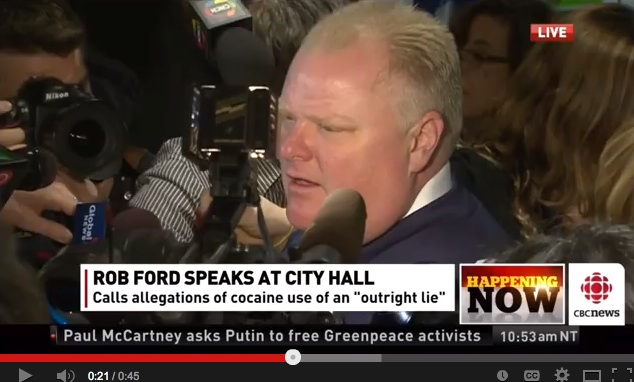
Toronto Mayor Rob Ford has done it. So has Lululemon founder Chip Wilson. So have presidential candidates like Herman Cain and Sarah Palin. Each is guilty of saying dumb things in media interviews.

Why do powerful people say dumb things in media interviews?

Here are 3 reasons…

First, powerful people fail to dedicate the appropriate amount of time to preparing for and training for their interviews. Most people who run for office or lead corporations are usually sent to a media training coach so they can learn to effectively communicate with the media. The media trainer should never be a spin doctor who teaches people to avoid answering questions, but rather a thoughtful coach who teaches the spokesperson to craft thoughtful, well worded answers that provide the appropriate amount of context, quotes, and supporting facts. The essence of the best answers requires having a good writer who can write articulate, quotable phrases in the voice of the spokesperson. The spokesperson is then responsible for internalizing these phrases for use in the interview.

One media training class is never enough. Media interviews require practice before each interview, just as an athlete would practice before each game.

Training, practicing and internalizing key phrases requires dedicated time, and many powerful people fail to allocate time, thinking they can do fine without additional practice.

That leads us to reason number two, which is arrogance and overconfidence by the powerful person.

Powerful people have often had some success in the past with spontaneously saying the right thing in the right moment. Politicians have often been told early in their careers that they were good public speakers. However, the stakes get higher each day as a person’s public profile rises. Often, reporters begin to dig a little deeper and question the congruency between what a person has said in the past and their actions in the present.

The increased scrutiny generates harder questions, which requires even more practice and more time spent internalizing powerful, quotable phrases. Yet the arrogant and over confident spokesperson fails to recognize that what got them to this level will not get them to the next level. In other words, a good public speaker needs to become a great professional speaker. Many are never motivated to become as great as they should be.

This brings us to reason number three, which is the spokesperson’s failure to correlate the monetary and reputational impact of what they say and the massive damage that happens when they say dumb things. One of the worst examples I’ve ever seen is a spokesperson who said the wrong thing and derailed a $700-million industrial project.

Toronto Media Training BraudJust look at the spokespeople we sited above. Rob Ford’s dumb statements have lead his city council to begin stripping him of his power. It is unknown whether his reputational damage will cause him to lose his job come election time. Chip Wilson has seen an outcry on social media as former customers abandon Lululemon yoga wear, all because of a careless adlib on Bloomberg TV.  Herman Cain tried to run for president, knowing sexual harassment allegations were part of his past, yet failed to be prepared with a well-written response. Instead, when he was asked if he had ever been accused of sexual harassment, he responded, “Have you ever been accused of sexual harassment?” His campaign contributions dried up and his bid for President ended. Sarah Palin may be able to bring a crowd to their feet in a public rally of supporters, but in media interviews my opinion is she is consistently one of the worst spokespeople I have ever seen. Her failed interview with Katie Couric during her bid for Vice President derailed the presidential campaign of Senator John McCain. Many would say her verbal blunders have kept her from advancing her political career. Her statements may be acceptable to a certain loyal audience, but constant blunders erode her loyal support and empower her detractors.

Chip Wilson BloombergPowerful people become powerful because they have certain skills or characteristics that propel them forward. The most powerful people are those who can recognize their own weaknesses and either hire people to do those jobs for them, or they hire coaches who will honestly critique their weakness and develop a process to improve in those areas.

Talking to the media is hard. It requires you to think like a reporter and organize your thoughts like a journalist is taught to write a news report. It requires you to know how to punch home a headline, how to begin and end with a great synopsis sentence, how to pepper the interview with well planned quotes, and how to give a few supporting facts without over loading the interview with irrelevant details. A journalist spends four years in college learning this system and practices it daily with each report they write.

No spokesperson should be foolish, arrogant or over confident enough to try to match their amateur status with that of a professional, anymore than they should think that one trip to the putt-putt course makes them ready to play golf in the PGA.


Media Training Advice to Toronto Mayor Rob Ford

By Gerard Braud

Toronto Media Training BraudWhen media training a candidate, politician, or elected official, one of the hardest things to teach them is when to shut up.

In every media training class I impart this expert advice to the trainee: “When you are digging a hole for yourself, put down the shovel.”

Media Training BackhoeToronto May Rob Ford has likely never heard this from his media trainer. One must ask, has Rob Ford ever had media training? Instead of putting down the shovel he has brought in a backhoe.

As repulsive as you may find Rob Ford’s latest quote, I’m going to give it to you here just to show what an amazing failure this guy is every time he is questioned by reporters. You can watch the video for yourself.

“Oliver Gondek says that I want to eat her pussy and Oliver Gondek, I’ve never said that in my life to her. I would never do that. I’m happily married. I’ve got more than enough to eat at home,” said Toronto Mayor Rob Ford.

From Vancouver to Toronto, Canadians have dominated the news for the past two weeks for saying things to the media that they should not say. Each time, they make the situation worse with a poorly executed apology. We saw that last week with Lululemon Founder Chip Wilson and now with Toronto Mayor Rob Ford.

Each case, the spokesman created their own crisis by what they said. Dare I say the United States media has not covered this much news from Canada in my lifetime?

Admittedly it is difficult to media train certain people with certain personality types. Certain rich or powerful people are arrogant enough, or over confident enough, that their inflated egos preclude them from seeking expert advice and expert coaching in order to improve their skills in many areas, including talking to the media.

Oh! Canada!

Media Training Jon StewartIf after this you need to have a good laugh, watch John Stewart’s coverage of this story on The Daily Show.