Posts

The Great Crisis Communication Lie: A Plan Can’t Anticipate Everything

Crisis Communication movie gerard braud

Click image to watch video

By Gerard Braud

It’s been said that the person who says something can’t be done is always right.

Does this adage apply to crisis communication and crisis communications plans?

The Malaysia Airlines crisis and communication challenges with the media and families have many in public relations saying, “This is unprecedented. You can’t prepare for this.”

Pardon me, but that’s bull$h*t.

As a defiant, non-conformist, contrarian, nothing inspires me to do something more than doing something they said couldn’t be done.

If you want to prepare and you are willing to put forth the effort, you can write a crisis communications plan and a library of pre-written news releases that will serve you in any crisis. Public relations people without the expertise, who are unwilling to put forth the effort, take the easy way out by saying, “It can’t be done.”

Here is the backstory of how defiance turned into a process that allowed public relations teams to put an effective crisis communications plan in place in as few as two days

In 1996, I begin doing extensive research on crisis  communications plans and found each plan repeated the same flaws as the ones before it. All conformed to public relations standards of then and today. Being a contrarian, I researched the common communications mistakes made in each crisis. I poured over case studies from when I was a member of the media. I analyzed why spokespeople said dumb things to me in most crises when I was a television reporter. I analyzed why corporations were slow to communicate about each crisis.

Malaysia-BlogThe pain, problems, and predicaments of the communicator and the corporation were scrutinized. Once this was done, I began to work backwards, with the end in mind. Multiple end points were identified, which consisted of the intervals at which a statement would need to be made by a company to the media, a company’s employees, and the stakeholders most affected by the crisis.

From 1996 – 2004, I wrote crisis communications plans for a wide variety of businesses, government agencies, and non-profit organizations. The process often took a year of collaboration, which for me was too long. Dealing with the slow pace of corporate collaboration didn’t fit my personality, despite the large sums of money companies would pay for a year’s worth of work.

In 2004, while spending six months recovering from a near-death-illness, I began looking for the fastest way to deliver a crisis communications plan. I had so many plans written that I was able to condense the crisis communications plan writing process down to two intense days of a group writing retreat. I provided the expertise and base documents, while the public relations team provided a workforce to modify the documents.

Malaysia blog 2

Ten years later, the plan still works in every crisis. Granted, the base crisis communications plan is a living document that undergoes constant modification to incorporate the ever-growing list communications outlets, such as social media.

The reality is, you don’t know how every crisis will unfold. The secret is to understand the intervals at which you must communicate to key audiences. You must make sure your crisis communications plan has a system in place to gather information, confirm information, then release that information.

The biggest breakthrough for me was unlocking the secret to creating a library of pre-written news releases that lives in the addendum of each plan. Starting with the end in mind, I was able to analyze the questions that get asked in every news conference by the media. Based on those questions and a clear understanding of how journalists will

write their news reports, I was able to create a series of statements that include multiple-choice and fill-in-the-blank options.

Some of my pre-written news releases have as few as five paragraphs while others have more than 30 paragraphs. Some pre-written news releases are for an event that can be handled with a single press release. Others are three-part releases that can be used to issue advisories before, during, and after an event, such as for an electric company dealing with a winter storm. Still others must exceed three parts, such as an ongoing crisis similar to Malaysia Airlines. These pre-written news releases can usually be edited and released in as few as ten minutes. This is in stark contrast to the typical problem of a public relations person sitting before a blank computer screen and writing from scratch, then facing hours of revisions and hours of delayed communications.

What are the constant realities for the company you work for? The reality for every airline is that they may experience a crash. Virtually every set of scenarios can be broken down into fill-in-the-blank and multiple-choice options.

A crisis communications plan can be structured to identify your key audiences, the various ways you must communicate to those audiences, and the frequency of your communications.

Is writing this type of crisis communications plan easy? My original plan took about 1,000 hours to develop – that’s six months. Since then, it has evolved with many more hours.

Today, it is ready to launch and implement in as few as two days. If you would like to know more, call me.

Analyses of case studies in your industry will show you the communications flaws of those who came before you so you can modify your crisis communications plan in such a way that those flaws are eliminated.

If you think it can’t be done, you are correct for yourself. You are not, however, correct for everyone.

Those who are willing to prepare can be prepared and they will communicate effectively when “it” hits the fan. Others, however, will make the same mistakes so many before have made, who have thrown up their hands and said it can’t be done.

Crisis Communication Case Study: Malaysia Airlines

Malaysia-BlogBy Gerard Braud

Ask any expert in global crisis communications how Malaysia Airlines should be communicating during their crisis and you will get varied opinions. Having worked in Malaysia many times writing crisis communications plans and teaching media training, I would like to offer five things worth considering, should you face a prolonged crisis that draws global media attention.

Culture – Problem #1

Malaysian’s culture and religion are different from traditional western culture and religion. Their language also includes a mix of Malay, Mandarin Chinese and English. Prior to my trips, I’ve taken classes to help learn and respect their culture. I’ve even learned to speak some Malay.

Sadly, western media wants to play by western rules, often with little regard for the culture of another country. Media are not known to stop what they are doing to take cultural sensitivity classes. U.S. media can be especially pushy and overbearing. Chances are western media will not adjust to or fully respect Malaysia’s culture. Hence, if you work for the airline, you must be prepared to adjust to all of the many global media outlets and their ways. This is no easy task.

Accomplishing this means that long before you ever have a global crisis, you need to write a crisis communications plan that takes this into account. Next, you need to practice it at least once a year in a crisis communications drill until you are an expert communicator and public relations professional. The drill will also help your leaders better understand what they will face during a crisis, provided your drill includes intense mock media and mock news conferences.

Joint Information Centers (JICs) – Problem #2

In the U.S., when your corporation has to share the stage, microphone and crisis with government agencies, often all parties agree to set up a Joint Information Center (JIC). Often, the government agencies want to take the lead and usually corporations are too willing to let the investigating agencies bear the burden of the media interviews. This usually happens because the corporation has failed to write a good crisis communications plan, they have failed to train their spokespeople, and they have failed to hold annual crisis communications drills. Due to their failures – all of which could have been avoided – they capitulate to government agencies, praying the government agencies have good spokespeople.

I despise when this is done. I especially despise when a corporation depends entirely on government spokespeople to communicate.

Consider that government agencies cannot and will not communicate empathy to the affected parties. Their communications is only about the issues related to their investigation and fact gathering. Government agencies have a different communications motive than the affected company. Only the offending party – in this case the airline – can adequately communicate empathy to the family members of passengers.

You have an obligation to media train your spokespeople to the highest level so they can hold their own in a news conference.

Separate Media From Grieving Families – Problem #3

Malaysia blog 2Never house family members in a building or hotel where the media has easy access to them. Crying family members amid the media makes for a great story for the media and a horrible story for your company.

When I was a reporter, I hated talking to family members in situations like this. I recall covering the derailment of an Amtrak passenger train with a high fatality count. The train plunged off of a bridge late one night and the passengers were trapped in the rail cars deep in a river. Family members were holding out hope that there were air pockets with people alive in the cars, just as Malaysian Airline families are holding out hope that their family members are alive somewhere on a remote island.

In the story I was covering, the trauma went on for days, with Amtrak housing the families in the lobby of a hotel with us – the media. The families never got a break from the cameras and the microphones and our producers kept asking for more interviews. Amtrak looked bad every time someone fell to pieces emotionally in the hotel lobby.

If your company might face this type of crisis with a high fatality count, your crisis communications team must work with your risk management team to identify, in advance, facilities where families can be housed without the media being anywhere around.

Brute Force Never Plays Well In Front of the Media – Problem #4

When Malaysian authorities hauled away a grieving family member earlier this week, it made a bad situation look worse. Authorities lost their cool. This happens all over the world. When they lose their cool, authorities seldom ask, “How will this play on TV?” This is one more reason to follow the advice above to keep the families separate from the media.

My experience in Malaysia assures me there are many gated resorts that the airline could take over as their base for families. These resorts have sleeping accommodations, restaurants and beaches. Malaysia Airlines should be using one of these resorts. The risk management team should be prepared to buy out the entire resort, keeping families content behind gates, keeping the media on the other side.

Manage Speculation With More Spokespeople – Problem #5

In an ongoing crisis like this, the media lack facts, so they turn to third party experts and ask speculative questions to get speculative answers. If your company is the offending company, you need to have highly trained spokespeople speaking on behalf of your company in every country where your customers have a presence. Those trained spokespeople need to:

A.) state the obvious facts in well worded quotes

B.) constantly communicate empathy and what is being done for the families

C.) constantly discourage speculation

If we look at the Malaysian Airlines case study, speculation has been generated by:

A.) an oil slick near Vietnam

B.) debris at sea near China

C.) possible debris spotted by Australia

D.) rumors that the plane landed safely on some remote airstrip

E.) rumors about the pilots and their routes.

When you fail to provide good information in a crisis, the media fill the void with speculation.

Conclusion

Never believe that any crisis is too big or too complicated to prepare for. You can prepare a crisis communications plan that will address every scenario you may face. Your crisis communications plan can have an addendum of pre-written news releases and media advisories for even an extended crisis like Malaysian Airlines. You can test your crisis communication team, your crisis management team and your spokespeople with a crisis communications drill annually. You can conduct media training annually for everyone who may have to serve as a spokesperson.

This isn’t rocket science, but it does require a commitment from the public relations team and from the leadership team.

So, will you prepare and perform flawlessly or will you leave everything to chance?

Newton to Media: Please Stay Away on Sandy Hook Anniversary

By Gerard Braud

Sandy Hook 2It is a bold move; perhaps unprecedented. Certainly in my career in crisis communications and my prior career as a reporter, I cannot recall a community that has suffered a crisis, asking the media to stay away. However, officials in Newtown, Connecticut are asking the media to stay away on December 14th, the one-year anniversary of the tragic shooting that killed 27 people.

From a media relations perspective, I support this bold move.

As for the lessons for communicators and public relations professionals, Newtown offers many crisis communications lessons. Free information and a free webinar from one year ago are still online. Sadly, a bold post-Newton prediction I made in a blog post on CommPro.biz has come true.

I predicted that, “The Sandy Hook shooting will likely not raise any discussions about effective crisis communications, although it should.” With CommPro.biz, I presented a free webinar outlining what all schools should do in order to be properly prepared for effective crisis communications should they experience a shooting or some other type of crisis.

An effective crisis communication plan can save lives and move people out of harms way. With all my heart I believe it and advocate for crisis communications preparedness each day.

Sandy HookThe blog and webinar are still online for your review.

Sadly, I can report my prediction has come true, at least among the schools that contacted me immediately after the webinar and during the year. Of those who had more questions about writing a crisis communications plan, to date, not a single person who has contacted me has been able to get their school officials to endorse or believe in the premise that if you plan on a sunny day, all will go much more smoothly on your darkest day. So many organizations see communications about a crisis as a reactive response to media after a crisis rather than a pro-active event of planning that should be done long before a crisis ever strikes. Not a single person who contacted me was able to get their schools to allocate even a modest amount of time or money to begin the effort.

It would be a great day for children, parents and educations if my prediction were wrong.

The lessons from one year ago are all still online, offered to you free of charge.

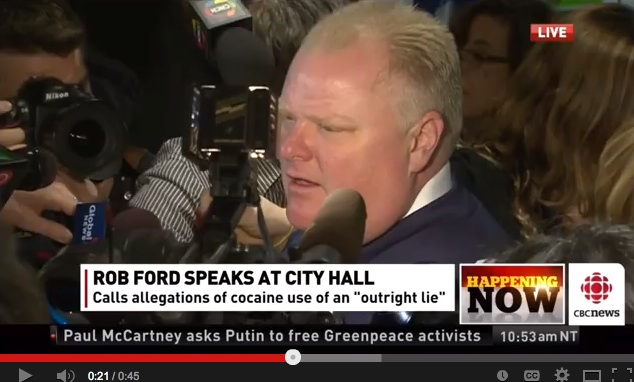
Media Training Advice to Toronto Mayor Rob Ford

By Gerard Braud

Toronto Media Training BraudWhen media training a candidate, politician, or elected official, one of the hardest things to teach them is when to shut up.

In every media training class I impart this expert advice to the trainee: “When you are digging a hole for yourself, put down the shovel.”

Media Training BackhoeToronto May Rob Ford has likely never heard this from his media trainer. One must ask, has Rob Ford ever had media training? Instead of putting down the shovel he has brought in a backhoe.

As repulsive as you may find Rob Ford’s latest quote, I’m going to give it to you here just to show what an amazing failure this guy is every time he is questioned by reporters. You can watch the video for yourself.

“Oliver Gondek says that I want to eat her pussy and Oliver Gondek, I’ve never said that in my life to her. I would never do that. I’m happily married. I’ve got more than enough to eat at home,” said Toronto Mayor Rob Ford.

From Vancouver to Toronto, Canadians have dominated the news for the past two weeks for saying things to the media that they should not say. Each time, they make the situation worse with a poorly executed apology. We saw that last week with Lululemon Founder Chip Wilson and now with Toronto Mayor Rob Ford.

Each case, the spokesman created their own crisis by what they said. Dare I say the United States media has not covered this much news from Canada in my lifetime?

Admittedly it is difficult to media train certain people with certain personality types. Certain rich or powerful people are arrogant enough, or over confident enough, that their inflated egos preclude them from seeking expert advice and expert coaching in order to improve their skills in many areas, including talking to the media.

Oh! Canada!

Media Training Jon StewartIf after this you need to have a good laugh, watch John Stewart’s coverage of this story on The Daily Show.


Navigate the Waters of Reputational Repair: 5 Steps to Effective Crisis Communications Planning

By Gerard Braud Navigating the waters of a crisis requires a good crisis communication plan before the waters ever begin to rise. Clear sunny day planning, long before your darkest day, is the secretBy Gerard Braud

DSC_0076Navigating the waters of a crisis requires a good crisis communication plan before the waters ever begin to rise. Clear sunny day planning, long before your darkest day, is the secret. In today’s social media filled world, this has never been more true.

Sadly, in our social media world some public relations people expect to Tweet their way out of a crisis or repair damage using Facebook. Neither is true. While “shiny and new” social media can be part of an effect communications strategy, you must first have the foundation of tried and true media relations, crisis communications, employee communications and stakeholder communications.

(Hear from Gerard in person during this special free webinar on November 20, 2013 1:00 p.m. EST)
Want to know the secret ingredients? Read on…

Here is a sure fire 5 step approach that must be your foundation.

Step 1: Vulnerability assessment

Before “it” hits the fan, you have to identify everything that could go wrong, including potential sudden crises and smoldering crises. Hire a facilitator to take your organization through the process of a deep examination of the things that could go wrong that would damage the reputation and revenues of the company.

Step 2: Write your pre-written news releases, web posts, and e-mails

Perhaps you’ve heard the expression, “when you are up to your ass in alligators it is hard to think about draining the swamp.” This applies to crisis communications. One of the biggest mistakes public relations people make is that as the crisis is unfolding, they open a blank document on their computer and start writing a news release, which then goes through hours of unnecessary re-writes before it is release. Consider this: on a clear sunny day you should write as many of these potential news releases as possible, leaving blanks that you’ll fill in when you know the details of the actual event. These documents can be pre-approved by leaders, speeding up your ability to release them to the public. I’ve facilitated many crisis communication writing retreats that produced more than 150 pre-written news releases in one day. That kind of productivity rocks!

Step 3: Write your crisis communications plan

Very few documents that public relations people refer to as a crisis communication plan would pass my test for what a plan should be. Most are worthless 6 to 12 page documents that state standard operating procedure and serve absolutely no purpose on the day of your crisis. Yet to be fair, this is what most PR people were taught in school or at some PR seminar. Frustrated by what I kept finding, I invented something new.

My approach is to write a document that is intended to be read and followed during the crisis. It dictates specific, sequential tasks in a very fast moving time frame. It captures all of the perfect behaviors of the most senior communicator, yet is so easy to follow than any one who can read can execute the plan flawlessly. I’ve invested about 2,500 hours of development in my base plan, which is about 50 pages long, which I am now able to customize for my clients during a single afternoon workshop.

Step 4: Annual media training for a crisis

Despite all of the buzz about social media, holding a live news conference within both the first and second hour of a crisis is vital if the media are standing at your door. Many organizations damage their revenues and reputations when untrained spokespeople say dumb things during a crisis.

It is important for every potential spokesperson to recognize that media training is not a bucket list item that you do once in life. Talking to the media is a skill that requires regular practice. I recommend media training for all spokespeople at least once a year, with an expert coach. Then, before every media interview, in-house staff should do a fast refresher course.

Think of it this way – the best athletes achieve great success because they practice often and partner with a great coach. Great spokespeople practice often and partner with a great coach, protecting their reputation and revenues through what they say, and just importantly, what they don’t say.

Step 5: An annual crisis communications drill

Realistic crisis communications drills are the best way to test your communications team and the decision making process of your leaders. A drill once a year allows colleagues to establish trust and good working relationships. A crisis drill allows ample time for leaders to pause and discuss decisions they must make during a real crisis. This helps them avoid decision paralysis during a crisis.

Your crisis communications drill should include at least two mock news conferences during the drill. Hire mock media and never use real media. Your facilitator must write a complicated, yet realistic scenario. It must include a likely crisis, plus all of the social media, employee and media buzz that would surround a real crisis. The facilitator should also hire a team of people to flood your phone lines with constant calls, replicating the calls you would receive from media, customers, and concerned citizens in a real crisis.

Conclusion

All of this takes time. None of it is easy or fast. But, it is much easier to prepare on a clear sunny day than to struggle and fail on your darkest day. Your reputation and revenues depend upon it.

About the author: Gerard Braud (Jared Bro) has helped leaders and organizations on 5 continents write their crisis communications plans, using his one-of-a-kind writing retreat that completes one years worth of work in 2 days. He is regarded as an expert in media training and crisis communications plans and is the author of Don’t Talk to the Media Until… 29 Secrets You Need to Know Before You Open Your Mouth to a Reporter. Contact him at www.braudcommunications.com or gerard@braudcommunications.com


Lesson 9: How to Keep Your Crisis Communications Drill Realistic?

By Gerard Braud

Entergy Drill Gerard braudWhat a nice complement I received today after a crisis communications drill with a nuclear power plant and four government agencies. The Governor’s Office of Homeland Security and Emergency Preparedness thanked our mock media team for the intense questioning and realism of our news mock conferences.

“I participated in a crisis drill last week and the news conferences were kind of a joke,” he said. “They had a bunch of students asking questions and it just got silly. Today felt like the real thing.”

Wow #CrazyFlattered #KeepingItReal

The last thing you want in your crisis communication drill is for people to be silly and treat it as though it is a game. My drills are so serious that I’ve successfully made spokespeople emotionally break down and cry at the podium and on two occasions. People involved have been fired because the drill exposed their complete incompetence in their jobs.

The purpose of a crisis communications drill is to test your skills and abilities so that if necessary, they can be modified after the drill in order to improve performance during a real crisis.

DSC_0011Here are five tips to keep it real:

1) Build your crisis scenario around something that is highly likely, especially if people within your organization are in denial about how likely the scenario is to happen. Such a scenario will immediately send a feeling of dread over many drill participants. It is helpful if the facilitator can immediately and repeatedly bring the roll players to the point at which they mutter, “Oh sh*t.” This emotional trigger is just one of many emotional triggers that you want to employ. In a real crisis, emotions of dread, fear, panic and anxiety are all brought to the surface. It is the job of your facilitator to bring those emotions to the forefront of a drill.

2) Make the drill scenario big enough that a real crisis of this nature would bring out the media, which in the case of the drill, forces you to have several mock news conferences to test your spokespeople. The folks who role play as mock media need to be smart and mature, and capable of asking realistic questions that realistically challenge your spokespeople.

3) Judge your crisis communications team on how well they followed their crisis communications plans. The plans I write are usually about 50 pages long and are designed to be read and executed in sequential order so that nothing is forgotten in the way of communications. Too many flawed plans are just six to ten pages long, they only state standard operating procedures and for the most part, they are useless during your crisis. The 50 page plan I customize for my clients can get you flawlessly through the first two hours of your crisis, with directions for subsequent communications beyond two hours if needed.

4) Social media is a part of the real world and it needs to be a part of your drill. The facilitator and/or mock media role players should inject rumors, photos, videos and posts that might appear on social media if the event were real.

5) Realistically bother the heck out of as many people as possible with phone calls. In a real crisis the media and worried members of the community would be calling employees wanting information. I like to have a phone bank with at least five people who each play five personalities. I provide them with a list of phone numbers of people they should be calling periodically during the drill.

The bottom line is your crisis communications drill is designed to be your preparation for a real event. Make your drill every bit as realistic as an actual crisis event.


Lesson 7: Who Should Know Details Before Your Crisis Communications Drill?

By Gerard Braud

Braud Crisis Plans_6113No one knows the hour or the day when a real crisis will strike, nor do they know how or when various events will cascade during the crisis. Your crisis communications drill needs to simulate as much of this as possible.

In a crisis communications drill, chances are you need to let everyone involved know at least the date of the drill. The date is the only piece of information that I ever share with people involved in the crisis drills I facilitate.

I may take the easy path and run a drill for three hours from 9 a.m. until noon, or I may let the crisis begin to unfold as people are in the middle of their commute to work. Sometimes I launch the drill as parents are juggling the morning rituals of getting their kids up and off to school.

Since real crisis events seldom happen at a convenient time, your crisis communications drill should duplicate and simulate real life challenges.

In addition to keeping the starting time a secret, I never share details about the drill scenario with anyone other than other drill facilitators.

Secrecy is important because you don’t want anyone taking extra precautions in the days or weeks before the drill. The drill is designed to measure everyone’s preparedness and response at a specific moment in time. In other words, if a crisis happened now, how prepared would everyone be?

After the drill you should be prepared to modify your crisis communications plan. 

Lesson 6: Who Should Participate in Your Crisis Communications Drill?

By Gerard Braud

Trainwreck CEOVarious teams within your organization can organize crisis drills. If no one else within your company, government agency or non-profit is organizing an annual crisis drill, then individuals within the communications department can take the lead to organize a drill.

Ideally, to get a well rounded drill you want to test your public relations team and their ability to craft and disseminate effective communications in a timely manner. Additionally, Emergency Managers and Incident Commanders may be called upon to participate in any type of drill designed to test emergency response to a rapidly evolving crisis such as a workplace shooting or fire. If the crisis drill scenario involves the disruption of production or disruption to the supply chain or any upset at a facility, the risk management team should also be part of the planning and execution of the crisis drill.

Together, these three teams must work to each perform their assigned task in a prescribed amount of time.  They must work to support one another with shared information and shared decision-making, all under the supervision of the Crisis Management Team.

A drill is designed to replicate an actual event. Held on a clear sunny day, a crisis drill prepares you and your organization for your darkest day. If you discover on a sunny day that members of the various teams are not functioning well together, you have time to correct the bad behavior or bad decision making before a real crisis happens.

9thWard-KatrinaVersary-Media_0406There are exceptions to this rule. Sometimes it is possible to test just the crisis communications team and the leadership team during a drill that simulates a smoldering crisis, rather than a sudden crisis. For example, instead of simulating a workplace shooting, build a scenario centered around a smoldering issue like executive behavior or discrimination. Such a drill will test the ethical decision making of your leaders. It will test their commitment to communicate pro-actively about such an event, and it will test the communications team for their ability to word-smith a perfect communiqué for what is often the most difficult of all crises.

Keep in mind that a smoldering crisis does not trigger the incident command plan or the risk management plan. This also proves once again that a crisis communications plan is always an important tool and document to have because it must guide your communications activity with other teams and also independent of other teams and their plans.


Lesson 4: Test Your Crisis Communication Speed

By Gerard Braud

Braud Crisis Drill_5723*How quickly can you get approval for and issue a statement to the media, your employees and other key stakeholders during a crisis? Your crisis communication plan should clearly spell out what is acceptable and what is not acceptable.

It greatly disturbs me to see that some companies and government agencies think five hours from the onset of a crisis is an acceptable time frame to respond within. It disturbs me even more to know that some organizations think tomorrow or the day after is soon enough. Just this week, while speaking to a group of public relations professionals in Washington, D.C. several of the attendees said it often takes their organizations one to two days to approve a news release.

Wow! It is 2013 and we live in a world where social media gives details about a crisis the second it happens. Speed is important.

In every crisis communication plan I write, it states that the first communications should happen in one hour or less. Admittedly, this is about 59 minutes too long, but is likely a realistic amount of time in a corporate setting where statements must be written by the public relations team and approved by executives before being released.

My key to speed is the use of a First Critical Statement. It is a pre-written, fill-in-the-blank document that allows an organization to release a few basic facts until more is known. The goal is to control the flow of accurate information rather than allowing rumors to spread on social media and speculation to run rampant among the media.

(Download a free copy with this link. Enter this coupon code to get it as a free gift: CRISISCOMPLAN )

If your crisis communications plan has this template in it, you should be using it in your crisis communications drill.

Katrina Media_0318Your crisis communications drill, while allowing you to test your crisis communications plan, allows you to test your public relations department and their ability to gather facts quickly. The team must fill out the First Critical Statement, get it approved by executives, then release it to the world. It also allows you to test your executives, who must be taught that time is critical and that major rewrites can slow the communications process.

Yesterday’s article referred to feeding little bits of information to the media, just as you would serve a buffet. Following that analogy, the First Critical Statement is the salad.

As the crisis communications drill continues to unfold, your crisis communications plan should dictate that by the start of the second hour of your crisis, a more detailed statement should be released to the media, your employees, and other key audiences.

Katrina Media_0327The plans I write for my clients may have over 100 of these pre-written statements in the addendum of the plan. These are also fill-in-the-blank and multiple choice documents written on a clear sunny day that can be quickly modified and released to the key audiences. They can also be pre-approved by executives on a clear sunny day. Such pre-approval eliminates approval delays on the day of your crisis.

Your crisis communications drill allows you to again test the speed at which the documents are modified and the speed at which they are approved.

Speed is critical when you need to communicate in a crisis. Your crisis communications drill helps you to perfect that.


Washington Navy Yard Shooting: How the Daily Show Portrayed the Media’s Coverage

By Gerard Braud

Daily Show Jon Stewart Gerard BraudWithin the office here, I ranted at the media relentlessly about the horrible live coverage of the tragic events unfolding at the Washington Navy Yard. Only my assistant Shannon had to hear my rants.

Fortunately, comedian Jon Stewart has the resource and video tape evidence to call out the media for the idiotic way they covered this event. Here is the  link to the show, and believe me it is worth watching every minute of it.

On a daily basis I beg corporations and government agencies to write a proper crisis communications plan, which has features that allow spokespeople to give small amounts of information at regular intervals. It starts with the First Critical Statement, which I’ll give you below. This is a psychological feature of the plans I write because it wards off the stupidity, rumors, speculation and unprofessionalism displayed on Monday, especially by CNN, but by many local stations as well.

Your assignments for the day:

1) Watch this daily show clip.

2) Call me for a free chat about your crisis communications plan and whether it is perfect or if it could use some improvement. My number is 985-624-9976.

3) Download copy of my First Critical Statement with this link.

To download it for free, enter the coupon code CRISISCOMPLAN

An e-mail will be sent instantly. Make sure it doesn’t go to your spam filter by authorizing my e-mail address gerard@braudcommunications.com.