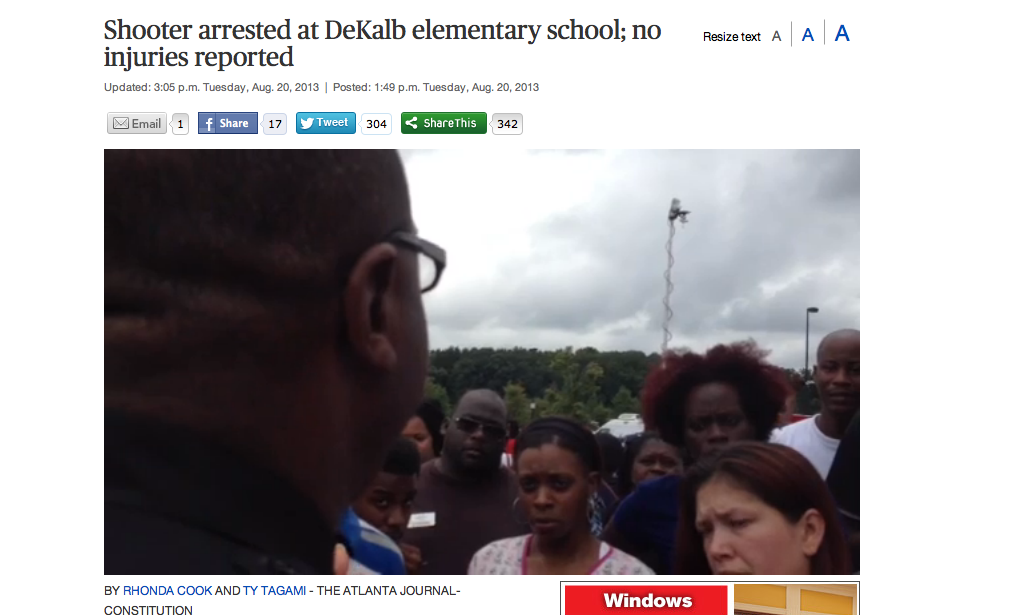
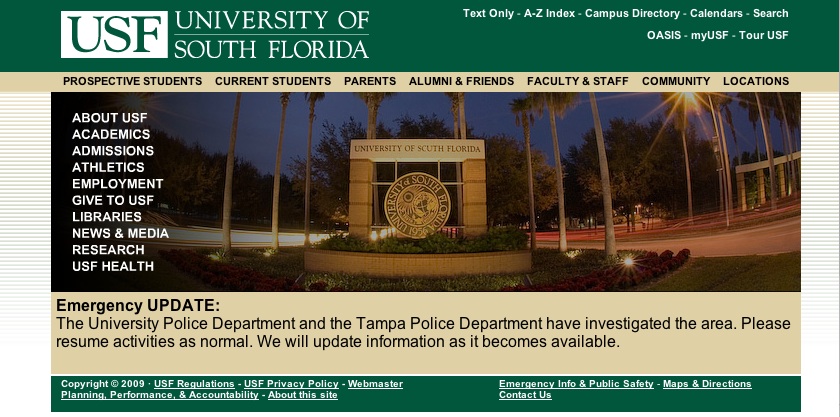
We interrupt this blog with Breaking News. A school shooting at McNair Elementary School in DeKalb County, Georgia is sadly duplicating the same crisis communication failures that we began to outline in this morning’s article and the serious written and awaiting posts in the coming days.
Our goal is not to belittle this school or the DeKalb County schools. Our goal is to have all schools and school districts wake up and adopt crisis communications plans and modern communications techniques. News about a school shooting must come from the school with great effort. Schools must not relegate information to the media, who will speculate about what they don’t know. Schools must not let social media go wild with panic and speculation.
Here is a breakdown of how information is and is not flowing about this shooting, just as it has in many other school shootings:
The DeKalb County School website has NO information about the shooting. Within one hour or less of the onset of the crisis, the county should be posting truthful, honest information about this crisis.
Eyewitnesses post iPhone video.
Online news organizations repost the iPhone video.
The DeKalb Facebook page only gloats about happy news, ignoring this as a viable way to send timely and accurate information to the public. Ideally, they should have a short post with a link back to their official website.
Parents are being interviewed by the media, expressing their fears and frustrations. Police are trying to manage frustrated parents at a time when school officials should be managing this task.
So far… now in our third hour, we’ve seen no sign of a news conference from the DeKalb County School system. We do know the superintendent has spoken to parents at an area where children are being taken.
The bottom line is, it is time for educators and the education establishment to get educated about crisis communications. If you were being graded on this today, you would receive and F in communication, like so many other schools before you.
https://braudcommunications.com/wp-content/uploads/2020/12/Logo-white-01-300x138.png00gbraudhttps://braudcommunications.com/wp-content/uploads/2020/12/Logo-white-01-300x138.pnggbraud2013-08-20 14:34:172021-05-21 00:42:01Breaking News: McNair Elementary School Shooting in DeKalb County, Georgia: Lessons in Crisis Communication
Information drives the world. It drives opinion, it causes misconceptions, and it causes confusion. Information — good and bad — is at our fingertips 24/7 though mobile devices and the Internet. Yet in crisis after crisis, official communications is slow. Slow communications often leads to additional deaths and injuries.
In any sudden crisis, a crisis communications team, with authorization from the crisis management team, should be able to do three things:
1) Hold a news conference
2) Post information to the internet.
3) Use a variety of communications channels to issue detailed information within one hour or less of the onset of the crisis.
As soon as a school shooting takes place, several things happen. First, there is the onslaught of media who will begin interviewing misinformed, hysterical parents and students. At the same time there is a clear absence of an official spokesperson from the school, who could be providing reliable information. Secondly, social media is buzzing with rumors, innuendos, and filled with constant inappropriate and insensitive opinions and comments.
The consistent problem is that in a crisis, actionable information from reliable, knowledgeable, and official sources is lacking. The functions commonly known as public relations, media relations, employee communications and customer (parent/student) communications are often an after thought, relegated to those who have many other responsibilities for other aspects of the crisis. This must change and change quickly.
The future requires that rapid communications of relevant, accurate and actionable information must be made a priority by way of the development and implementation of crisis communications plans in all schools. It requires that key individuals in each school be assigned new communication responsibilities and that they receive training on crisis communications. While certain key individuals manage the crisis, others must manage the communications.
Many documents that purport to be a “Crisis Communications Plan” are not worth the paper they are written on. Most are superficial duplicates of a misguided attempt by schools to list a set of standard operating policies and public relations basics. These fall far short of equipping school leadership and their staff with the necessary tools to communicate rapidly and effectively in a crisis. A properly written crisis communications plan goes far beyond standard operating policy. It gives specific directives, assigned to specific individuals, on an assigned timetable. This ensures that truthful information reaches the media and the masses before misguided rumors spread by word of mouth and social media.
Historically, most organizations “wing it” on the day of their crisis, treating communications as an afterthought amid frustrations of the onslaught of media coverage. Done correctly, on a clear sunny day, an organization must strategize about their vulnerabilities and potential crises, then begin to write a crisis communications plan with clear directives on how and when to respond when any crisis reaches a flash point. This process is often tedious and time consuming because there are very few true expects in this body of knowledge. Implemented correctly on a clear sunny day and used correctly during a crisis, the crisis communications plan will ensure that any school can communicate detailed information to the media and the masses within one hour or less of the onset of a crisis. Achieving this level of speed requires effort beyond just writing the crisis communications plan. It requires that on a clear sunny day, an entire library of pre-written news releases with fill-in-the-blank and multiple choice options is also written, so there is a full library of one hundred or more templates that address most, if not all, of the potential crises identified during the vulnerability assessment.
Your assignment for this article is to plan a day to begin discussing all the things that might go wrong at your school. List them as part of a vulnerability assessment. If the list looks frightening, then good. Will it frighten you enough to take the next step and begin writing a crisis communications plan and your pre-written templates? For most schools the answer is something like, “we would love to have that, but we don’t have time,” or “that’s not in the budget.” If you miss the opportunity to do the right thing on a clear sunny day, you will pay the price on your darkest day.
In our next article we will examine why so many schools (and corporations) are doomed from the beginning because of a major design flaw.
https://braudcommunications.com/wp-content/uploads/2020/12/Logo-white-01-300x138.png00gbraudhttps://braudcommunications.com/wp-content/uploads/2020/12/Logo-white-01-300x138.pnggbraud2013-08-20 14:00:532021-05-21 00:43:37Crisis Communication for Schools: Part 3 Pain, Problem and Predicament
For the purpose of our discussion in these articles, we will define a crisis this way:
A crisis is any incident that may seriously affect the safety, function, operation, reputation and/or revenue of any organization, public or private.
We will not debate or parse words as to whether what is called a crisis in this article might otherwise be called a situation, incident, event or any other synonym. Furthermore, we will divide our crises into two types: sudden crises and smoldering crises. A sudden crisis has a sudden flash point, such as a school shooting, tornado, fire, or explosion. A smoldering crisis might involve a labor dispute, issues of discrimination, and incidents of executive misbehavior such as embezzlement or sexual misconduct. In a smoldering crisis, details are known to internal decision makers, but not yet known to the public.
In our last article, we introduced you to the concept of the text messaging notification system and the crisis communications plan. While a text message notification system is intended for use in only a sudden crisis, the crisis communications plan can be used to communicate vital information for both a smoldering and a sudden crisis.
Confusion in “Crisis Plans” – Defining a Crisis Communications Plan
A great flaw in schools, in corporations, and in the world of emergency response is the generic use of the term “crisis plan” and crisis team. A crisis plan is not the same as a crisis communications plan. Each school and school system must operate with a collection of three unique plans that are executed by three unique teams, with each team being composed of individuals with specific skills and areas of expertise. Although the plans each serve a unique purpose, they are also designed to be executed in unison without any plan overriding or contradicting the directives of another.
The three types of plans needed are:
1) An Incident Command Plan, which is sometimes called the Emergency Response Plan, Coordinates police, fire and rescue. It is executed by the Incident Command Team.
2) A Risk Management Plan, which is sometimes called a Business Continuity Plan, ensures the components of the business operations are restored following a crisis, including identifying alternate facilities and supply chains. The Risk Management Plan is executed by the Risk Manager.
3) A Crisis Communications Plan, dictates prescribed measures for communicating accurate and timely information to key audiences, including parents, students, employees, the media and other stakeholders. It includes the components of public relations,media relations and stakeholder relations, and is executed by the Crisis Communications Team.
All plans and all actions during a crisis should be managed by the Crisis Management Team.
Further confusion takes place in this area when the incident command plan makes reference to crisis communications. Usually this refers to details about radio systems and other technology used for interactive communications among emergency responders. This confusion must be avoided. We must emphasize that in this document, crisis communications is a function of public relations, media relations, employee relations, and social media management.
A sudden crisis, such as a school shooting or tornado would trigger all three plans. But a smoldering crisis such as an accusation of sexual harassment, would trigger the use of only the crisis communications plan, without causing a need to use the incident command plan or the risk management plan.
Your assignment for this article is to have a discussion with the leaders in your organization to identify the types of plans you have. If you think you have a crisis communications plan, I will be giving you come criteria in future articles by which you can determine if your plan is written properly.
You can also email a copy of your plan to me at gerard@braudcommunications.com and I will be happy to give you 15 minutes of free feedback.
https://braudcommunications.com/wp-content/uploads/2020/12/Logo-white-01-300x138.png00gbraudhttps://braudcommunications.com/wp-content/uploads/2020/12/Logo-white-01-300x138.pnggbraud2013-08-20 12:42:162021-05-21 00:44:35Crisis Communications for Schools Part 2: Defining a Crisis and a Crisis Plan
If you have school age kids, you’ve likely gotten a text message or phone message about some type of emergency or non-emergency at school. While useful for emergency notification, these systems are not a substitute for having and using a Crisis Communications Plan.
Out next few articles will answer the questions:
What is a Crisis?
What is a Crisis Communications Plan?
How to Write a Crisis Communications Plan?
Do I Need a Crisis Communications Plan?
Our goal is to give you practical information that applies if you work for a school, things you should be asking if you are a parent, and we’ll draw some parallels between crisis communication for schools and crisis communication for corporations.
Like building blocks, if your school or business has a text messages alert system, it is time for you to add the next layer of protection. This will help you build a holistic system surrounding all of the aspects of communicating during a crisis.
You need a crisis communications plan. This plan must be a system that addresses all of the modern communications challenges created by mobile technology, social media and traditional media.
What Is a Crisis Communications Plan? A crisis communications plan is a manual that will guide school administrators (or corporate officials) through the process of rapidly and effectively send credible, actionable information to key stakeholder audiences. These will include the media, employees, parents, students and the community. (In the case of a business, it includes getting information to your customers, just as a school sends information to parents and students.)
For all of the benefits of text message alert systems in schools, there are unintended consequences that must be and can be addressed.
1) The lifesaving use of text messages triggers an onslaught of media arriving at the school to report on the unfolding event.
2) The text and voice message systems brings an onslaught of parents in panic arriving at the school to rescue or comfort their children, and thereby creating traffic jams that delay life saving emergency vehicles and emergency responders.
3) The speed of the notification system hastens and triggers an instantaneous disbursement of panic, misinformation, rumors and inappropriate comments on social media.
All three of these unintended consequences can be mitigated and managed to the safety and betterment of parents, students and educators. It requires the use of a comprehensive Crisis Communications Plan.
Rapid or Mass Notification Systems versus a Crisis Communications Plan
Some schools and school systems mistakenly believe that their policy to send out rapid communications via text messages or phone messages is their crisis communications plan. This is incorrect. A system that sends out mass notification by way of text messages or telephones requires us to make a fine distinction between notification and communication. Notification screams panic! Communication uses words and information to calm fears by sharing actionable, honest and accurate information about the severity of an event. For example, a 140 character text message cannot convey the details of a web posting, email blast or news conference.
A mass notification system can quickly send messages such as, “gunman on campus,” “shelter in place,” etc. These are only short bursts of actionable information, which create the unintended negative consequences of panic that we mentioned previously. In contrast, a crisis communications plan must be used in addition to the mass notification system, but often it is used when the mass notification system is not even required, as we will explain in upcoming articles. The crisis communications plan provides the actionable and informative words and details that will be used in news conferences, on websites, in emails, in meetings with parents, student, and employee, as well as on social media sites.
As you will learn in this series of articles, a crisis communications plan can be vital before, during and after a crisis.
https://braudcommunications.com/wp-content/uploads/2020/12/Logo-white-01-300x138.png00gbraudhttps://braudcommunications.com/wp-content/uploads/2020/12/Logo-white-01-300x138.pnggbraud2013-08-20 04:00:432021-05-21 00:45:46Crisis Communication for Schools: Part 1
In a major crisis, you should be talking with the media within one hour or less of the onset of the crisis. The CEO featured in the link below might be considered a “train wreck.” He has waited 5 days before making a statement after a horrible train derailment that resulted in a fireball and explosion that has destroyed a significant part of downtown Lac-Magantic, Quebec. To date, 15 people are dead, while 35 people are still missing.
Edward Burkhardt, CEO of Montreal, Maine & Atlantic Railways waited 5 days before visiting the crash site and making a statement to the media. His statement lacks a significant, quotable apology to those affected, while focusing too much on the technical aspects of dealing with insurance, finances and monetary issues. He even begins his statement by defending whether he is a compassionate person.
True, I believe a CEO should spend more time managing the crisis and running the company than trying to be a spokesperson, but a crisis this big demands at least a few hours to talk with the media and the families who have lost loved ones. News reports indicate that at the time of the news briefing, the CEO had not reached out to families.
1) The CEO does not to be the first person to speak in the first hour, but in an event this horrific, the CEO should speak by the end of the first business day of the tragedy. A public relations person can speak in the first hour, while a subject matter expert should speak within the second hour of the crisis.
2) Personality affects a person’s performance. Those with a technical background can be horrible in adlib situations. This CEO appears to have a technical mind like an engineer or accountant. Your media trainer must understand the difficulties of training technical people and must help them become good spokespeople.
3) Rambling adlibs never work. Start with a written statement containing powerful quotes and powerful compassion for the dead and their families.
7) Every company must have a properly written crisis communications plan, constructed on a clear sunny day, in order to be able to weather your darkest day.
8) Pre-written news releases must make up a significant part of your crisis communication plan.
9) Success during your crisis is higher when you have at least one crisis communication drill every year.
https://braudcommunications.com/wp-content/uploads/2020/12/Logo-white-01-300x138.png00gbraudhttps://braudcommunications.com/wp-content/uploads/2020/12/Logo-white-01-300x138.pnggbraud2013-07-12 07:00:312021-05-21 01:00:15This CEO is a Train Wreck: 9 Crisis Communication Lessons You Can Learn
Hats off to my colleague Barbara Paynter at Hennes Paynter Communications for the way her team used YouTube with regard to the three Cleveland women who underwent years as kidnapping victims. They include Amanda Berry, Gina DeJesus and Michelle Knight.
This technique gives the PR team and the spokespeople complete control over the content of what they say. This, thereby, controls what the media can use.
YouTube keeps reporters from asking uncomfortable questions of these three women, who are likely still in a fragile emotional state.
YouTube allows the women to take their message unfiltered and unedited to the world, via social media.
Given the choice, the only additional thing I may have done is to also upload this same video to CNN as an iReport.
Paula Deen’s interview with the NBC Today Show and Matt Lauer is a living example of three common mistakes made by powerful people who fail to adequately prepare for a media interview.
Lesson One: Plan Your Quotes
Granted, the racial slur in question is the event everyone focuses on. But in the June 26, 2013 interview with Matt Lauer, it wasn’t her use of a slur, but her failure to plan great quotes and her propensity to ad lib statements that could be taken out of context, that created the greater problem.
“I is what I is, and I’m not going to change,” Deen said, as my wife and I shared a cup of coffee in the kitchen, watching Today.
As soon as she said it, I told my wife, there’s the sound bite of the day. Sure enough, that was the sound bite that showed up moments later on CNN and every other network. Outside of the context of the full interview, this is a damning sound bite. If you are a person who believed before the interview that Deen was a racist, and then you saw just that quote on the news, she essentially said to you, “I am a racist and I’m not changing.”
Wow? Every day spokespeople continue to say dumb things in interviews and it appears there is no end in site. I would really like to know what, if any preparation she did before this interview. I would love to know if Paula Deen had a media trainer, or if, like many high powered people, she decided to just “wing it.” Did she mistakenly believe that because she is on television so often that no preparation was needed for an interview worth tens of millions of dollars?
In media training, I tell every potential spokesperson, “When you wing it, you crash and burn.”
It is amazing that companies will spend countless hours negotiating multi-million dollar contracts, yet spend little or no time training a spokesperson for an interview that could potentially cause them to lose millions of dollars in revenue with a single misplaced word or sentence.
Lesson Two: Apologize, Yet Understand the Rule of Thirds
Deen does get high marks from me for agreeing to do an interview. If you are in trouble, you need to apologize and make the apology good. She tried, but failed to get full credit for her effort because of her ad lib, oh shucks, I’m from the south persona.
My rule of 3rds applies to Deen’s case. I believe that for any public figure, 1/3rd of the people love you, 1/3rd of the people hate you, and 1/3rd swing like a pendulum, siding with the popular 1/3rd. To that extent, Deen will never lose her loyal following. Media stories showed supporters, black and white, outside of her restaurant verbalizing their love for the southern cooking icon. The monetary loss of sponsors begins when the 1/3rd in the middle decide not to buy your products any more, with, in my opinion, the nail in the coffin being a bad ad lib.
Lesson Three: If You Could Attach a Dollar to Every Word You Say, Would You Make Money or Lose Money?
Ultimately, “I is what I is, and I’m not changing,” caused Deen to likely lose tens of millions of dollars. It became the trigger that caused more sponsors and retailers to drop her.
So let me ask you, before an interview, are you willing to ask an interview expert to help you prepare, or would you rather just “wing it?”
https://braudcommunications.com/wp-content/uploads/2020/12/Logo-white-01-300x138.png00gbraudhttps://braudcommunications.com/wp-content/uploads/2020/12/Logo-white-01-300x138.pnggbraud2013-06-27 12:39:142021-05-21 01:03:08Three Media Lessons from Paula Deen
Few organizations in the world face the communications challenges of America’s Rural Electric Cooperatives.
On any given day customers could be protesting over electric rates. Workers could be under attack for disconnecting service. Board members could be scrutinized for per diems, travel or expenses. Add to that the growing influence of negative social media comments and big city media covering more co-op controversies, and you have a storm brewing. That storm demands effective communications from all executives, board members, and co-op public relations teams.
Here are three steps every cooperative should take:
There is no excuse, in this modern age of media, for any executive, board member or public relations person to mess up when talking to the media. But it still happens.
Many rural people tend to be friendly, honest and sometimes too chatty. Unfortunately many executives, board members and public relations people mistake the gift of gab for the ability to be an effective communicator with the media. Many board members mistakenly believe the respect they get from their status in their communities will transfer to respect from the media. That isn’t true. The fact is many of the habits you have in everyday conversation have to be avoided when talking with a reporter.
Don’t worry, there is hope. The secret is to set aside one day every year to sit down in front of a television camera with a media training coach to practice realistic interview scenarios.
Since most reporters really do not fully understand the history and inner workings of cooperatives, your media training must adopt the newest innovations in training. Never settle for training that provides only bullet points as talking points. This outdated method leads to bad ad-libs and ugly quotes.
Modern training requires a library of pre-written quotes, learned and internalized by each executive, board member and spokesperson. When written properly, internalized, and practiced, these verbatim sentences provide context, information and strong quotes. These are all elements reporters need in their story. Also, when written in a conversational sentence structure, these sentences are easy to work into everyday conversations by leaders and employees alike.
Consider that many executives who are interviewed complain that they are taken out of context and misquoted. A well-worded, pre-planned opening sentence delivered by the spokesperson can serve as a pre-amble statement that provides context to your cooperative’s goals and purpose. This forever eliminates the issue of being taken out of context.
With annual media training you will be a good spokesperson for good news, as well as when you have to speak to the media during a crisis.
The worst time to deal with a crisis is during the crisis. The best time is on a clear sunny day.
During good times, your cooperative must conduct a vulnerability assessment to identify all potential crises.
You must write a crisis communications plan that chronologically tells you every step you must take to effectively communicate during the crisis.
You must write a preliminary fill-in-the-blank statement to use in the first hour of your crisis when facts are still being determined.
You must create a more detailed news release style statement for each potential crisis that you identified in your vulnerability assessment.
If you identify 100 potential crises, then you need to write 100 potential news releases, using evergreen facts, fill in the blanks and multiple-choice options. This is best done through a facilitated writing retreat with your communications team.
A classic mistake cooperatives make is to prepare communications only for natural disasters, power outages and worker injury. A modern crisis communications plan must also cover smoldering crises such as executive misbehavior, discrimination, financial mismanagement, per diems, and even crises involving social media.
When pre-written on a clear sunny day, these documents are ready for quick release to the media, employees, customers, the Internet and other key audiences. This process is not easy and is time consuming, but it pays huge dividends during your crisis. Many organizations experience a crisis, then in the midst of it, look at a blank word document and try to spontaneously draft a statement. The statement then goes through unprecedented scrutiny and rewrites, resulting in massive delays. In the modern age of fast communications, this is lunacy. You should never put off until tomorrow what you can write today.
Writing your Crisis Communications Plan is the perfect way to get all employees, executives, and board members on the same page. On a clear sunny day you can all agree on the policies and procedures that need to be followed for effective crisis communications. Make sure your plan goes beyond standard operating procedures. Also, make sure it doesn’t rely on only the expertise of your public relations team. The plan must be so thorough that nothing in the process is forgotten, yet easy enough to understand and follow that it can be executed by anyone who can read.
Too many cooperatives make the mistake of thinking their executives can wing it in a crisis. They think a gift of gab equates to being a great spokesperson. They also think that knowledge of the business equips them to manage a crisis and the communications for that crisis.
The secret to getting it right on your darkest day is to set aside time on a clear sunny day to hold a crisis drill. During your drill your emergency managers can run a table-top exercise. Your communications team and executives act out a real-time exercise, complete with news conferences, using role players to portray the media.
When done correctly, a drill exposes bad decision-making, bad behavior and outright incompetence among responders, spokespeople and those in leadership roles. Conversely, annual drills teach your team members how to effectively work together during a crisis. Team members are taught to achieve effective communications while also working to end the crisis.
As more cities sprawl into rural areas, they bring more homes and electric customers into your cooperative territory. The sprawl also brings more media attention and more scrutiny of your operations.
The best way to prepare for the increased attention you will get, is to plan on a clear sunny day and never to wait for the dark clouds to roll in.
About the author: Gerard Braud, CSP, Fellow IEC has helped organizations on 5 continents communicate more effectively with the media, employees and customers in good times and bad. He facilitates writing retreats and workshops to help cooperatives write and complete their crisis communications plans in just 2 days. He also trains cooperative board members and leaders on how to become effective spokespeople.
https://braudcommunications.com/wp-content/uploads/2020/12/Logo-white-01-300x138.png00gbraudhttps://braudcommunications.com/wp-content/uploads/2020/12/Logo-white-01-300x138.pnggbraud2013-05-15 09:54:052021-05-21 01:19:30Dark Day Crisis Planning Must Begin on a Sunny Day
{Editor’s note: In 2013, CNN selected me as one of their top iReporters, out of more than 11,000 iReporters. This is part of a series of articles about how you can be a good iReporter and how to make CNN iReports a vital part of your crisis communication and media relations strategy.}
As you watch television news, especially live cable news and live breaking news in a crisis, observe the questions from the news reporters, news anchors and members of the media. They want to know how much worse will the event get?
If you recognize this, you can make this a part of your planned storytelling, whether you are filing a CNN iReport, communicating as a public relations spokesperson, or communicating as a Public Information Officer (PIO) for a federal or state agency, or for state, county or local government.
During Hurricane Isaac, my goal was to manage the expectations of the national audience and the national media so they would know just how bad things would get. For the most part, it was all predictable for me, because I had been through and reported on so many hurricanes during my career as a television reporter. As a resident of Mandeville, Louisiana and as someone born in New Orleans, I had a pretty good idea of what was to come. (Although the 4 10-food alligators, the 50 dead nutria and the thousands of snakes were a surprise.)
Electric utility companies are a perfect example of the kind of company that should build their media training and crisis communications strategy around managing the expectations of their audience. Some people in New Orleans were very mad at Entergy of New Orleans when the electric company didn’t have electricity restored to all of their customers on the day following the hurricane. The angry citizens called the media and complained non-stop on social media. Although all were without electricity after Hurricane Katrina, they expected faster restoration after Isaac, which was a Category 1 hurricane. Restoration to 99% of the customers may be great, but the 1% without power can still cause a public relations problem for a company.
To their credit, Entergy was holding news briefings and using social media where possible. But here is what I would like to see every investor owned utility and every Rural Electric Cooperative (Co-op) say to their customers before any big, predictable weather event:
“This storm will disrupt electrical service. You may lose electricity early as trees fall on power lines or as winds blow power lines down. Your home may survive the storm, but in the days immediately after the storm, you may be very miserable. You won’t be able to turn on any lights. You won’t be able to cook on electric stoves. If you have an electric hot water heater, you may not have hot water. Your air conditioning (or heating) may not work. While our electric crews and those from other communities will begin restoring power quickly, we cannot say when everyone will have their lights back on. Furthermore, if the electric meter to your home is damaged or if the electrical wiring in your home gets wet or damaged, it may be weeks or months before your power can be restored. For that reason, we suggest you follow the advice of your local government and evacuate to an area outside of the predicted disaster zone, then return home when you can once again have modern conveniences.”
That type of statement
1.) Tells it to the audience straight without any public relations B.S.
2.) It manages their expectation for how bad things may get
3.) It gives them a clear reason as to why they should evacuate — because many people are in denial about whether or not the wind or flooding will harm them, but they don’t want to be miserable and without creature comforts.
State, county and city governments can also benefit from this approach. The government will often call for an evacuation for public safety. Many people don’t want to evacuate because a previous hurricane did not significantly impact them. Government should emphasize that no two storms are alike. A zone that survived one hurricane might be destroyed by the path of another storm. Government public information officers and spokespeople should also emphasize the loss of creature comforts associated with the loss of electricity, water, operating toilets, and the inability to cook or buy supplies.
To continue to manage the expectations of the audience before, during and after an event, any corporation or government agency, can do exactly what I did as a citizen — they can create a CNN iReport account and file multiple iReport videos just as I did. We will look at that in our next article.
https://braudcommunications.com/wp-content/uploads/2020/12/Logo-white-01-300x138.png00gbraudhttps://braudcommunications.com/wp-content/uploads/2020/12/Logo-white-01-300x138.pnggbraud2013-04-16 09:44:542021-05-21 01:37:39Manage the Expectations of Your Audience: Story Telling Secrets of the Media and a CNN iReporter