Navigate the Waters of Reputational Repair: 5 Steps to Effective Crisis Communications Planning

By Gerard Braud Navigating the waters of a crisis requires a good crisis communication plan before the waters ever begin to rise. Clear sunny day planning, long before your darkest day, is the secretBy Gerard Braud

DSC_0076Navigating the waters of a crisis requires a good crisis communication plan before the waters ever begin to rise. Clear sunny day planning, long before your darkest day, is the secret. In today’s social media filled world, this has never been more true.

Sadly, in our social media world some public relations people expect to Tweet their way out of a crisis or repair damage using Facebook. Neither is true. While “shiny and new” social media can be part of an effect communications strategy, you must first have the foundation of tried and true media relations, crisis communications, employee communications and stakeholder communications.

(Hear from Gerard in person during this special free webinar on November 20, 2013 1:00 p.m. EST)
Want to know the secret ingredients? Read on…

Here is a sure fire 5 step approach that must be your foundation.

Step 1: Vulnerability assessment

Before “it” hits the fan, you have to identify everything that could go wrong, including potential sudden crises and smoldering crises. Hire a facilitator to take your organization through the process of a deep examination of the things that could go wrong that would damage the reputation and revenues of the company.

Step 2: Write your pre-written news releases, web posts, and e-mails

Perhaps you’ve heard the expression, “when you are up to your ass in alligators it is hard to think about draining the swamp.” This applies to crisis communications. One of the biggest mistakes public relations people make is that as the crisis is unfolding, they open a blank document on their computer and start writing a news release, which then goes through hours of unnecessary re-writes before it is release. Consider this: on a clear sunny day you should write as many of these potential news releases as possible, leaving blanks that you’ll fill in when you know the details of the actual event. These documents can be pre-approved by leaders, speeding up your ability to release them to the public. I’ve facilitated many crisis communication writing retreats that produced more than 150 pre-written news releases in one day. That kind of productivity rocks!

Step 3: Write your crisis communications plan

Very few documents that public relations people refer to as a crisis communication plan would pass my test for what a plan should be. Most are worthless 6 to 12 page documents that state standard operating procedure and serve absolutely no purpose on the day of your crisis. Yet to be fair, this is what most PR people were taught in school or at some PR seminar. Frustrated by what I kept finding, I invented something new.

My approach is to write a document that is intended to be read and followed during the crisis. It dictates specific, sequential tasks in a very fast moving time frame. It captures all of the perfect behaviors of the most senior communicator, yet is so easy to follow than any one who can read can execute the plan flawlessly. I’ve invested about 2,500 hours of development in my base plan, which is about 50 pages long, which I am now able to customize for my clients during a single afternoon workshop.

Step 4: Annual media training for a crisis

Despite all of the buzz about social media, holding a live news conference within both the first and second hour of a crisis is vital if the media are standing at your door. Many organizations damage their revenues and reputations when untrained spokespeople say dumb things during a crisis.

It is important for every potential spokesperson to recognize that media training is not a bucket list item that you do once in life. Talking to the media is a skill that requires regular practice. I recommend media training for all spokespeople at least once a year, with an expert coach. Then, before every media interview, in-house staff should do a fast refresher course.

Think of it this way – the best athletes achieve great success because they practice often and partner with a great coach. Great spokespeople practice often and partner with a great coach, protecting their reputation and revenues through what they say, and just importantly, what they don’t say.

Step 5: An annual crisis communications drill

Realistic crisis communications drills are the best way to test your communications team and the decision making process of your leaders. A drill once a year allows colleagues to establish trust and good working relationships. A crisis drill allows ample time for leaders to pause and discuss decisions they must make during a real crisis. This helps them avoid decision paralysis during a crisis.

Your crisis communications drill should include at least two mock news conferences during the drill. Hire mock media and never use real media. Your facilitator must write a complicated, yet realistic scenario. It must include a likely crisis, plus all of the social media, employee and media buzz that would surround a real crisis. The facilitator should also hire a team of people to flood your phone lines with constant calls, replicating the calls you would receive from media, customers, and concerned citizens in a real crisis.

Conclusion

All of this takes time. None of it is easy or fast. But, it is much easier to prepare on a clear sunny day than to struggle and fail on your darkest day. Your reputation and revenues depend upon it.

About the author: Gerard Braud (Jared Bro) has helped leaders and organizations on 5 continents write their crisis communications plans, using his one-of-a-kind writing retreat that completes one years worth of work in 2 days. He is regarded as an expert in media training and crisis communications plans and is the author of Don’t Talk to the Media Until… 29 Secrets You Need to Know Before You Open Your Mouth to a Reporter. Contact him at www.braudcommunications.com or gerard@braudcommunications.com


The Death of PR Perseverance (F-bombs included)

By Gerard Braud

bar-congress-drinksFive public relations veterans, pontificating and dropping F-bombs over cocktails recently at the PRSA conference, concluded the biggest problem in PR today is the lack of perseverance by those in the media relations, public relations and the communication professions.

Is this true or not true for you? Read on…

I’ll describe the group as “old salty dogs” who speak their mind and say hello to the truth and to hell with political correctness. Sitting there are a combined 150 plus years of PR experiences, including myself, three gals and another guy. The waiter has just brought the first round of drinks, so these comments have not been impaired by alcohol.

One gal said she was successful because every November, she went back to her boss and asked for budget money she had been denied earlier in the year, knowing there is always extra money in the pot. She says often she got what she asked for and sometimes more because she was “Smart enough to ask, when the rest of the dumb a**es sat with their fingers up their a**es and never asked. It was like robbing a fu*#ing bank and I walked out with all the money.”

“And if they didn’t have the money, I didn’t walk out of the office until I got a definitive answer that I’d get the money after the first of the fu*#ing year. I always finished the year strong and I hit the ground running hard on January 2nd,” she said.

“Most people today are afraid they’ll get fired if they push too hard,” I responded.

“They should be fu*#ing fired for not asking,” the other guy said. “That’s the fu*#ing problem with PR people; they’re afraid to get fu*#ing fired or quit their fu*#ing jobs. Your fu*#ing career never starts until you’re willing to quit or get fired.”

Do you ask for extra money in November? Read on…

Another veteran complained that PR people go into hibernation mode and near paralysis from Halloween to the first of March. “It’s like they surrender to the holidays until after New Years and then have difficulty regaining momentum after the first of the year. This isn’t a job that you start and stop,” she barked. “I call bull sh*t on this ‘seat at the table’ crap. You don’t deserve a fu*#ing seat if you don’t do your job 12 months out of the year.”

That lit up the discussion like throwing a match on gasoline. One gal blamed it on moms in PR not being able to comprehend that work is work and home is home. The guy said he thinks it is “the damn Gen X-Gen Ys” who aren’t as committed to their jobs and “go into lala land from Halloween to New Years.” One gal ranted about how hard she worked to establish herself in a male dominated workplace 34 years ago and how “PR people today are pissing on the trails that were blazed to make PR a credible part of corporate culture. You can’t just fu*#ing mentally shut down every winter.”

In his book Good to Great, author Jim Collins made a great point that we each have to “keep the fly-wheel turning” if we want to succeed in our careers. In other words, we have to persevere to succeed.

What do you think? Is perseverance dead in PR? Do you persevere or hibernate in the winter?

Experts in Crisis Communication Agree: Home Depot Tweet Gone Wrong: 5 Things Your Public Relations Team Should Do Right Now

HD TweetBy Gerard Braud

Experts in crisis communication know social media in corporate communications is highly likely to lead to a crisis. I would say more brands are likely to be harmed than helped by a social media brand page.

Home Depot leaders acted swiftly to fire an outside agency and an employee who posted a picture on Twitter that depicted two black drummers and a third drummer with a monkey mask, with the tweet, “Which drummer is not like the others?”

Good job Home Depot for acting swiftly. Good job Home Depot for terminating the agency and personnel who clearly don’t understand the need to think before Tweeting.

Immediately there were cries of racism. The drummers were beating on Home Depot plastic buckets and sitting in front of a promotional banner for Home Depot’s sponsorship of College Game Day.

To their credit, Home Depot used the same offending brand Twitter page to post an apology that said, “We have zero tolerance for anything so stupid and offensive. Deeply sorry. We terminated agency and individual who posted it.”

HD Appology tweetI love that in a world where lawyers don’t let public relations employees say “sorry,” that Home Depot uses the word “sorry.” I love that they use the word “stupid.” The tweet apology is well written and conveys the anger the company feels toward the offending agency and employee.

HD FacebookHome Depot uses a Facebook and YouTube brand page, but nothing is posted there relating to the Tweet. The Home Depot home page and Media Center also have no news releases or apologies.

From a crisis communication perspective, in this case I think I agree with the Home Depot public relations and crisis communication strategy to confine the crisis to only the offending branch of social media and not bring it over to Facebook or YouTube. However, now that the story is making headlines in newspapers and morning television, I think an apology in the corporate Media Center newsroom on their primary website would be in order. In fact, I would have put up a news release apology in the corporate site newsroom within minutes of issuing the apology tweet. By the way, in the crisis communication plan system that I suggest you have, such an apology would be pre-written and pre-approved on a clear sunny day… written months ago and waiting in the addendum of your crisis communication plan.

HD Homepage 2In a crisis, it is important to tell the story from your perspective and to own the search engine optimization (SEO) for your brand and your story. Posting in your corporate newsroom helps with this. Failure to do so sends anyone searching for information to other pontifications, reports and blogs… like this one.

What should you do in your brand?

1)  Review your social media policy and make it tough. The social media policies that we write at Braud Communications on behalf of our clients are brutally tough.


2)  Terminate those who post recklessly.


HD snarky tweets3) Pre-determine whether a social media crisis requires response on all social media channels or only the offending channel.


4) Pre-determine if your home page newsroom will be used for an apology. I think it should be used.


5) Consider establishing a rule that two to three internal eyes need to review every social media post before anyone hits send. Make sure those 2 to 3 people represent the cultural and age diversity of your audience. In the case of Home Depot, it was clear that the age or cultural background of the person who posted this tweet was such that it likely never crossed their mind that this tweet might be considered racist.

As crisis communication case studies go, I’ll say Home Depot is handling this one well.


LAX Airport Shooting – Crisis Communication Case Study Real Time

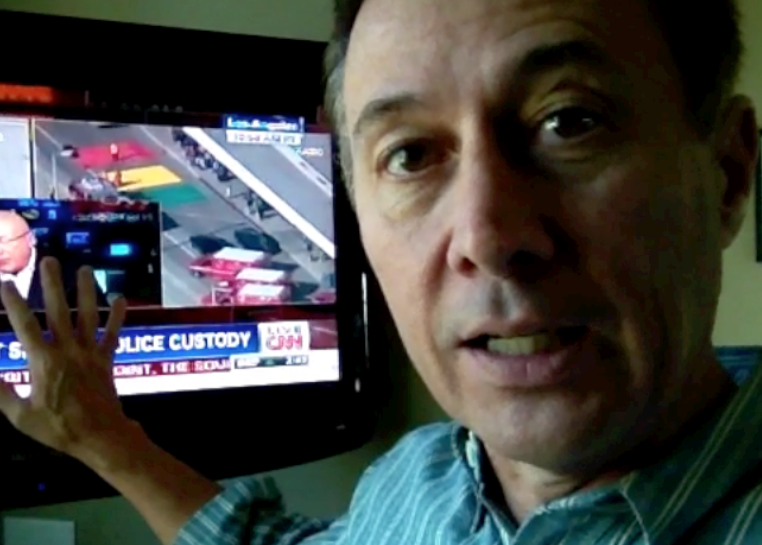
A shooting at the LAX Airport has the media scrambling to tell the story. The media are speculating with little or no official information. More than 90 minutes into the event I’ve not seen a spokesperson on CNN from the LAPD or from the LAX Airport.

From a crisis communication standpoint in the world of public relations, media relations and crisis communications we are watching bad PR unfold in real time. I encourage you to follow along with me.

Monitor CNN, LAX Facebook, LAX Twitter, the official LAX website, the LAPD website and the TSA website. As I monitor this story, a joint news conference has just started two hours and thirty minutes into this crisis. In 2013, that is too long of a time.

Watch my quick video and image that if you were a PR person in a crisis, you could shoot a post a short video with a first critical statement added as you will see at the end of this video.

Braud LAX Shooting


The LAX Twitter page is the only source of official information.

Twitter LAX


The LAX website has no news.

LAX website


The LAX Facebook page has a pumpkin from Halloween yesterday.

LAX Facebook


The LAPD website has no news.

LAX PD


The TSA website has no news.

TSA LAX


In a crisis, every organization must have a well written crisis communication plan that would sort out all of this on a clear sunny day so that communications can happen in one hour or less of the onset of a crisis. This is Public Relations failure in action.

Here it is in the nation’s second largest media market and the media are left to speculate and do phone calls with eyewitnesses.

Likely, right now, in a room somewhere, executives are managing the crisis and are too busy to approve a news release. The PR team is likely working from scratch to get the news release written and executives are trying to rewrite it. Meanwhile, a pre-written news release for this event should have been written years ago and put in a pre-written news release file.

Somedays I wonder when the PR profession will “get it.” This is one more example that they don’t.

The Tricks & Treats of Facebook in a Crisis

By Gerard Braud

TricksandTreatsvideoGerardBraud

Click image to watch video

Is Facebook your friend or foe in a crisis? The frightening truth is it really depends on a lot of factors.

(Don’t be afraid to look at Facebook in an all new light when you join us for this special Halloween webinar.)

Let us start with a discussion about your brand page. Do you have one? There are three schools of thought when it comes organizational brand pages.

First, many organizations don’t have one because the leaders within the organization are afraid too many people will say nasty things on the page. Secondly, some organizations have brand pages set up by excitable communicators or marketers who think Facebook is the best invention since sliced bread (or pumpkin pie).  The reality is your organization may not be the kind of place the average person wants to “Like” and read about in their Facebook newsfeed. I personally have no desire to follow my bank, hospital or electric company. Thirdly, there are organizations — especially in the realm of fun consumer brands — that people “Like” to have in their newsfeed and love to engage with.

Regardless of which of the three categories applies to you, when a crisis happens, Facebook sometimes becomes one of your best communications outlet for getting actionable information to key audiences. But here is the scary part — It can also be a place where the world gangs up on you because of how you are communicating during the crisis.

Let us look at three types of crises and how they played out on Facebook, and what you should do to be prepared in a similar situation.

The most frightening thing I’ve observed this year was the use of Facebook by individuals who quickly set up a Facebook page and publish more information about your crisis than your organization is publishing on all of your communications channels.

WilliamsOlefinsOn the morning of June 13, 2013 there was a tragic explosion and fire at the Williams Olefins Chemical plant in Geismar, LA, about 50 miles from my home, which killed 2 workers and injured 114 more. Before the company had a single news release issued, or before they provided any images or videos posted to the web, either community members or employees published a Facebook page with more details than the company ever gave.

GeismarThe owner of this “Fan” page has not responded to my requests for an interview. A friend who works for Williams had told me long ago that the company does not allow the communications department to use any of the advanced crisis communications procedures that I recommend. Instead, their corporate bosses subscribe to FEMA’s National Incident Management System (NIMS) which relegates the task of communicating details about the crisis to the Louisiana State Police.

I personally hate NIMS. A state trooper can only communicate response details. The trooper isn’t able to communicate empathy to the community, nor is there anything about NIMS that meets the needs of employees who know people who have been personally affected. Furthermore, NIMS provides no social media presence.

For the record, my crisis communications plans dictate that the company in crisis must communicate with the outside world within one hour or less of the onset of the crisis. My priorities in such an event would be as follows:

1) Use a modified, pre-written news release template from my crisis communications plan, as my script for a live news conference with all media who have gathered at the scene of the explosion.

2) Post the identical pre-written news release to the corporate website.

3) Send an e-mail to all employees, media and stakeholders, with the identical information in text and with a link to the company website.

4) Create a short YouTube video with the identical information.

5) Post a link on Facebook with a link to the website and the video.

6) Post a link to Twitter with a link to the website and the video.

7) Add photos and videos to the corporate website and to Facebook as the event continues to unfold.

Throughout your crisis, your official website is the most secure location for official information. Social media can be used, but must be monitored and facilitated to handle comments. Using social media requires you to have ample staff.

In this case study of the Williams Company, eye witnesses did a better job of providing information than the company and the state police.

Don’t let a similar situation be your demise.

Next, consider scary weather and Facebook. In many weather events, the electricity goes out and people are displaced from their homes. When the lights are on and people are at home, they tend to migrate to Google on their computer for information about a crisis. But when the lights are out and people may not be home, they generally turn to their mobile phone and Facebook becomes a big player.

Likewise, if you are trying to function in an official capacity without electricity and you have difficulty accessing your corporate website, Facebook becomes a great communications option for you, because you can access and update it via your smart phone.

Weather events also become a time when a brand page is really needed and all the more reason to set one up on a clear sunny day, even though you might not usually attract many “Likes” during normal times. Trust me, your “Likes” will go up exponentially during the crisis.

This year we’ve had serious forest fires, floods, deadly tornadoes and pre-season snow storms. In every case, organizations have seen their Facebook followers spike. A quick way to see proof is to visit a Facebook page of an electric company in a region affected by a natural disaster. On the “about” link you can access the analytics that allow you to view the spike in “Likes” during the crisis.

Furthermore, in a weather event, your organization may be a small part of a big story, fighting with bigger players for media attention. Facebook circumvents the media and allows you to take details straight to your primary audience.

Finally, consider that some scary events can quickly turn your Facebook page into a bitching page, especially if the synical audience on social media thinks some aspect of your crisis has been handled poorly.  A good example is a shooting at Middle Tennessee State University on February 14, 2011.

MTSUshootingWhen a gunman was reported, the University used their text message system to alert students of the potential danger. But prior to the crisis, the University apparently did not do a good enough job of managing the expectations of the student body to make them aware that mass texting systems often take 20 – 30 minutes before everyone gets their alert message. This is the kind of thing that must be managed on a clear sunny day with proper information and a test text, rather than creating a crisis within a crisis on the day of your crisis.

During the Middle Tennessee crisis, the University’s Facebook page lit up, with more comments about slow text alerts than there were comments about the event.

So upon further consideration, is Facebook your friend or foe in a crisis?

There are some scary things happening on Facebook during crises and you can’t afford to get tricked by them. Take steps today to be prepared.

Learn more by signing up today for this special Halloween Webinar.


Lesson 11: Test Your Security Team During Your Crisis Communications Drill

By Gerard Braud

CrisisDrillGerardBraudWhile working with crisis communications clients, I provide a “first critical statement” template.  This template is intended to be read to the media, emailed to employees, and posted to the web in the first hour of a crisis when little is known about the emerging crisis. Some companies that operate facilities that have no spokespeople on site, but that have a security guard at the front gate. I’ve suggested that the template is simple enough that a security guard could go through low-level media training and be taught to deliver the message if media showed up at the front gate.

Amazingly and predictably, executives, in a semi-confidential and ultra condescending way, will say, “Have you met those people? They can’t be trusted with that!”

My response is, “Well, you gave ’em a gun.”

While some security companies employ highly trained security professionals, others employ people with skills equal to a day laborer. Some are taught to simply check badges and passes at a guard gate. Many have little education, poor verbal skills, and they come to work with a power attitude they developed when a badge was bestowed upon them.

Regardless of their skill level, three things are true:

1) If a crisis happens, chances are they will encounter the media and may be the first person the media approaches with cameras and questions.

2) If there is a chance for a real life media encounter, then they need to be an active part of your crisis communications drill.

3) They can be media trained to deliver the first critical statement. I’ve done it successfully many times.

As you plan your crisis communications drill scenario, let your mock media team know that testing the security team is an important part of the drill. Your mock media team should be reasonably assertive without being aggressive with the security personnel.

crisisdrillgerardbraud2The goal is to record on video tape what the guards do and say. Guards generally all do the same thing. Some instinctively say, “No comment.” Others verbally and forcefully tell the mock media that they cannot be on the site or that they will be arrested, even when the mock media are standing safely and legally on the public right of way. Many security guards feel a need to put their hands on the camera lens to block the view of the camera. Some try to physically push and escort mock reporters away.

It is somewhat comical from my standpoint because they do all the things they’ve ever seen other guards do in any bad television situation.

Security guards often are the proverbial worst first impression. What they say can and will be used against them in the court of public opinion.

Such behavior sends a message to the public that the company has done something wrong and that they have something to hide.

Remember, if a drill is your opportunity to mess up in private, so behaviors can be addressed and corrected, challenging the security team in your drill is important.

Furthermore, a low-level media training class needs to be created to teach these guards how they appear to the public when they act inappropriately with the media. They must be taught to politely instruct the media where to park. Next guards must be taught how to ask the media for credentials and a business card so the appropriate media contact in the company can be called. The guards also need to be taught a verbal script. This may be, “How can I help you?” “If you’ll provide me with your media credentials and a business card I’ll be glad to call someone who can speak with you.”

Entergy drill Gerard Braud 1When the guards are asked casual questions by either real or mock reporters, they need to respond, “My responsibilities are confined to maintaining security at this entrance, but I’m sure someone from the company will be able to answer all of your questions shortly, so if you will, please bare with me while I tend to may assigned duties, you should be hearing from someone soon.”

It wouldn’t hurt to have a printed statement at the entrance for the guard to hand out.

You only get one chance to make a good first impression. Make sure your security guards make a good first impression and that they are included in every crisis communications drill.


Lesson 10: Mock Media in Your Face at Your Crisis Communication Drill: Six Great Tips

By Gerard Braud

DSC_0159A real crisis is a pressure cooker and your crisis communications drill should replicate that. The pressure causes the media to be intense and often abrupt. The media may appear hostile. You will see similarities between media and sharks that sense blood in the water. Your crisis communications drill must duplicate that.

Here are six ways to do that.

1) Television cameras are intimidating, so make sure your mock media team has real television cameras to record each mock news conference. When your spokesperson or team of spokespeople enter the room for their mock news conference, have at least one camera person in their face with the camera as they enter. Get realistically and uncomfortably close. Make it real

2) Still photographers are also a part of real crises, so have a few of them in the room making noise with their shutters, setting off distracting flashes with each photo. Have them move about the room capturing the spokespeople from various angles.

3) During a real crisis, chances are your cell phone and desk phone would be ringing constantly as reporters try to get the inside scoop before their competition gets it. Therefore in a crisis communication drill, set up a phone bank of at least five people, with at least five fake personalities and fake names for each.

Personality #1 – A member of the local media

Personality #2 – A member of the national media

Personality #3 – A local mayor, councilperson or county official

Personality #4 – A state regulatory agency or state legislator

Personality #5 – A citizen with a host of fears and concerns

IMG_2621I give each personality a script containing likely questions they would ask and we schedule realistic calls at realistic intervals in a realistic sequence.

The challenge here is to force your communicators to stay on task to issue news releases in one hour or less of the onset of the crisis, while letting most calls roll to voice mail or passing their phone off to an assistant who can log the calls without answering any questions.

4) Media are not polite to one another during a real crisis, so they should not be polite to one another in your crisis communications drill. During your mock news conferences, let your mock reporters ask realistic questions simultaneously. Let them try to out shout one another. Force your spokesperson to take control of the news conference and the reporters by calling on specific reporters and recognizing questions at their discretion. This type of practice is invaluable.

5) Do your homework before the drill to know what previous crises are like skeletons in the closet of the organization being drilled. Nothing makes a spokesperson look like a deer in the headlights like asking a question based on serious facts. Just this week in a drill I did this to a spokesperson, when I quoted the company’s past news releases and past news articles about recent layoffs, losses in stock value, and the $511 Million spent for repairs at their facility featured in the drill. The kicker is a nugget I found in a news article about the company replacing a part which actually failed during the scenario of the drill. Having Google at your finger tips on an iPad or iPhone is amazing. Real reporters would do it to you, so in your crisis communications drill, your mock reporters must duplicate this behavior.

6) Fake live shots are now faster and easier than ever, because of iPads and iPhones (or the smart phone of your choice.) In a real crisis, a serious news conference might be carried live on television, followed by a live report from the reporter covering the story. To duplicate this, after every mock news conference I use the video feature on my iPad to record me doing a fake live report. I then hand the iPad to the crisis communication media monitoring team and let them see within seconds what I would have said if I were real media and this were a real event.

Braud Crisis Plans_6113Many executives admit that managing the crisis is the easy part, but managing the media is the tough part of a crisis. The truth is, most organizations spend more time, more money, and dedicate more people to emergency response then they do to crisis communications. Hence, if you dedicate more time, money and people to practicing and preparing for your crisis communications, you will have less difficulty with the media.

Each organization should conduct media training at least once a year for all spokespeople and again prior to every news conference. Spokespeople should include public relations professionals, subject mater experts, and top executives.

The great flaw is that most organizations treat media training as though it is a bucket list item that can be checked off and forgotten about. The key is maintaining and improving training based on modern communications.

Lesson 9: How to Keep Your Crisis Communications Drill Realistic?

By Gerard Braud

Entergy Drill Gerard braudWhat a nice complement I received today after a crisis communications drill with a nuclear power plant and four government agencies. The Governor’s Office of Homeland Security and Emergency Preparedness thanked our mock media team for the intense questioning and realism of our news mock conferences.

“I participated in a crisis drill last week and the news conferences were kind of a joke,” he said. “They had a bunch of students asking questions and it just got silly. Today felt like the real thing.”

Wow #CrazyFlattered #KeepingItReal

The last thing you want in your crisis communication drill is for people to be silly and treat it as though it is a game. My drills are so serious that I’ve successfully made spokespeople emotionally break down and cry at the podium and on two occasions. People involved have been fired because the drill exposed their complete incompetence in their jobs.

The purpose of a crisis communications drill is to test your skills and abilities so that if necessary, they can be modified after the drill in order to improve performance during a real crisis.

DSC_0011Here are five tips to keep it real:

1) Build your crisis scenario around something that is highly likely, especially if people within your organization are in denial about how likely the scenario is to happen. Such a scenario will immediately send a feeling of dread over many drill participants. It is helpful if the facilitator can immediately and repeatedly bring the roll players to the point at which they mutter, “Oh sh*t.” This emotional trigger is just one of many emotional triggers that you want to employ. In a real crisis, emotions of dread, fear, panic and anxiety are all brought to the surface. It is the job of your facilitator to bring those emotions to the forefront of a drill.

2) Make the drill scenario big enough that a real crisis of this nature would bring out the media, which in the case of the drill, forces you to have several mock news conferences to test your spokespeople. The folks who role play as mock media need to be smart and mature, and capable of asking realistic questions that realistically challenge your spokespeople.

3) Judge your crisis communications team on how well they followed their crisis communications plans. The plans I write are usually about 50 pages long and are designed to be read and executed in sequential order so that nothing is forgotten in the way of communications. Too many flawed plans are just six to ten pages long, they only state standard operating procedures and for the most part, they are useless during your crisis. The 50 page plan I customize for my clients can get you flawlessly through the first two hours of your crisis, with directions for subsequent communications beyond two hours if needed.

4) Social media is a part of the real world and it needs to be a part of your drill. The facilitator and/or mock media role players should inject rumors, photos, videos and posts that might appear on social media if the event were real.

5) Realistically bother the heck out of as many people as possible with phone calls. In a real crisis the media and worried members of the community would be calling employees wanting information. I like to have a phone bank with at least five people who each play five personalities. I provide them with a list of phone numbers of people they should be calling periodically during the drill.

The bottom line is your crisis communications drill is designed to be your preparation for a real event. Make your drill every bit as realistic as an actual crisis event.


Lesson 8: Which Team is in Charge During Your Crisis Drill?

By Gerard Braud

Gerard Braud * 15I worked in drills in which I facilitate everything on behalf of the crisis communications team, while also developing the scenario for the drill. I’ve also worked in drills in which the emergency manager selects the drill scenario and acts as lead facilitator. Simultaneously, I facilitate only the cascading events dealing with internal and external communications, as well as managing the mock media.

The fact is, I don’t care which team is in charge, as long as every team gets to experience the realistic anxiety and decision making necessary for everyone to learn.

A crisis communications drill is an opportunity for all teams to execute their respective plans to test their readyness, while also making sure that each team can coexist with the others, both in a drill and in a real crisis.

The bottom line is just make sure someone sets the course to have at least one drill a year. Remember, a drill allows you to mess up in private so you never mess up during a real crisis.

Lesson 7: Who Should Know Details Before Your Crisis Communications Drill?

By Gerard Braud

Braud Crisis Plans_6113No one knows the hour or the day when a real crisis will strike, nor do they know how or when various events will cascade during the crisis. Your crisis communications drill needs to simulate as much of this as possible.

In a crisis communications drill, chances are you need to let everyone involved know at least the date of the drill. The date is the only piece of information that I ever share with people involved in the crisis drills I facilitate.

I may take the easy path and run a drill for three hours from 9 a.m. until noon, or I may let the crisis begin to unfold as people are in the middle of their commute to work. Sometimes I launch the drill as parents are juggling the morning rituals of getting their kids up and off to school.

Since real crisis events seldom happen at a convenient time, your crisis communications drill should duplicate and simulate real life challenges.

In addition to keeping the starting time a secret, I never share details about the drill scenario with anyone other than other drill facilitators.

Secrecy is important because you don’t want anyone taking extra precautions in the days or weeks before the drill. The drill is designed to measure everyone’s preparedness and response at a specific moment in time. In other words, if a crisis happened now, how prepared would everyone be?

After the drill you should be prepared to modify your crisis communications plan.