Posts

Social Media for Crisis Communications: The Social Media Listening Post in Crisis Communication

By Gerard Braud

youtube

Let’s look at several case studies to understand the impact of social media when “it” hits the fan.

Social media allows us to communicate in a crisis; social media fails on us during a crisis; social media can cause a crisis.

Where do we start? Think of social media first as a place to Listen and not to talk. Look in the mirror. You will notice the good Lord gave you 2 ears and one mouth. You should use them in that proportion.

Now let us look at social media case studies of crises that involved natural disasters. In the case of Haiti, immediately following the January 2010 earthquake, Twitter was providing a platform for discussions. Facebook was providing a social media channel for discussions that are more in depth. But the conversations were incomplete because many of the people closest to the situation could not talk with us or receive our messages because they were without electricity. Their cell phone batteries were dead and the cell phones that had power were competing for limited band width and likely unable to get a signal. This should be a big red flag that social media and electronic communications have their limitations in many crises.

The Fukushima disaster and Japanese tsunami in March 2011 was another event that unfolded on social media. Some people claimed they learned about the actual earthquake on Twitter, before the shock waves even reached them. Whether this is true or another internet myth, the reality is it could have happened and could happen for other events in the future.

One social media trap is that verifying information is often difficult. It is not wise to repeat unverified sources, even though people on social media do it all the time. This means our listening requires extra attention. In the case of Twitter, we can sort our listening by hash tags by simply following a trending word with the # sign in front of it. Among the great dangers on Twitter is when wrong information is re-tweeted. On Twitter you will often see the letters “RT” before a message, signifying it has been re-tweeted by followers of the original message.

And while social media allows you to listen, often technology fails you, preventing you from both listening and talking.

Twitter, again, is constantly vulnerable to overload. Have you ever tried to use Twitter, Twitter over capacityonly to get a screen that displays a giant whale being lifted by tiny birds? The message says Twitter has exceeded its capacity.

Think about it? In a crisis, internet and telephone use goes up exponentially. At the time you need it most, it may fail you, impeding your ability to listen as well as talk. This is a warning sign that says your Crisis Communications Plan should not be built with a heavy foundation of social media. Your plan should be more heavily rooted in more traditional communications means, with a component of social media as a lower priority option, based on where technology stands today in 2013. This may change in the future, and you must be vigilant to stay abreast of trends and technology so you can rethink this as needed in the future.

To prove the point of technology’s weakness and failure, examine how often it fails not in a crisis, but in a simple, regional moment of joy. When my hometown New Orleans Saints football team won the NFC Championship on January 24, 2010, all cell phone and land based phone lines in New Orleans and our region were jammed and calls could not be made. Even text messages could not go through. This lasted for nearly one hour after the end of the game. For that reason, you should never put all of your eggs in one basket. This is a clear example that if you live by technology you will die by technology. In the world of crisis communications you may have many tools at your disposal, but you must have a Plan B and a Plan C. If one set of tools fail, what can you use next?

You, as a professional communicator, representing a company, government agency or not-for-profit organization, must consider carefully how much trust you want to put into social media as a part of your crisis communications tool box.

You must also be aware that your potential opponents may be out maneuvering and out communicating you, using these same tools, in certain types or crisis events.

Egypt WaelGhonim2In 2009 we saw a different type of crisis and crisis communication as the Arab Spring
unfolded. The initial government opposition in Egypt started on Facebook. As outrage
spread on Facebook, it eventually spilled into the streets as protests. Eventually in Egypt and other countries, social media played a major role as protesters in the Middle East were using Twitter to communicate where police attacks were taking place and twitter WaelGhonimwhere protesters could find safe houses during street riots. For the most part, the government leaders were not savvy enough to understand the power of social media. Private Facebook postings to
friends and direct tweets to colleagues gave protestors a clear communications advantage as this crisis unfolded. Eventually, some of the open chatter of protesters on Twitter allowed their opponents, the
government, to listen in on the conversation to eavesdrop.

And while the protesters were technically using Twitter as a communications tool, their needs are likely very different than the communications needs of your company.

As we stop for today, add to your to-do list the need to set aside 10 minutes to evaluate how you might use social media to listen during certain types of crises. Also, evaluate to what degree you might use it as an outbound communications tool to talk during a crisis.


Social Media for Crisis Communications: Are You a Social Media Hypocrite?

By, Gerard Braud

GeismarAs we talk about social media for crisis communication, we have to consider whether your audience uses social media and how they use it. But before we talk about them, we should talk about you and your personal social media habits.

Some companies have no Facebook page, no Twitter, and no YouTube channel. Some companies have no social media. Some companies have set up social media pages, but use them sparingly or not at all. Some companies aggressively post to one or more social media channels.

Let’s cut to the chase, especially for companies aggressively posting to social media. On a clear sunny day, when there is no crisis at hand, are you a social media hypocrite? Do you — or someone on your communications team — sit in your office each day updating your corporate social media sites expecting your audiences to follow you, when in fact you don’t personally follow any other companies?

At home, on your personal Facebook, Twitter or YouTube sites, do you personally follow your bank on social media? Do you follow your hospital? Do you follow your oil company?

While teaching my Social Media When “It” Hits the Fan workshop recently to a state-wide medical association, the audience was initially appalled that asked if they were social media hypocrites. They then realized they were. Each has spent countless hours developing Facebook, Twitter, and YouTube for their hospitals. Some had branched out into Pinterest and Instagram. Yet on reflection, they realized that they spend a lot of time posting information for their corporate social media accounts, with the belief their audiences and customers would read it, when in fact they didn’t follow their bank, doctor, oil company, etc. They quickly realized that they were social media hypocrites. Many realized that they were social media and public relations sheep, setting up social media accounts because some so-called social media expert said that every company needs to be on social media or you will be left behind.

InstagramNext, we should talk about the age and social media habits of your audience to determine if social media is the right fit for your organization on a clear sunny day when there is no crisis, because this will affect whether you can reach them during a crisis.

It has been my experience that there is a large generational divide between those who use it and those who don’t, which we will address in greater detail later. The age and social media habits of your audience will help you decide when and if social media needs to be part of your crisis communication strategy. People in their mid-20’s pioneered social media behavior and made Facebook popular. Now, as some grandparents join Facebook to keep track of their grandkids, younger participants are leaving because Facebook isn’t as cool anymore.

We can say, with a degree of safety, that people under 35 are more active than those who are older. So as you decide if social media is right for you, keep this in mind. The best research on social media behavior comes from the experts at PEW Research.

As of December 2012:

  • 15% of online adults say they use Pinterest
  • 13% of online adults say they use Instagram
  • 6% of online adults say they use Tumblr
  • 67% of online adults say they use Facebook
  • 16% of online adults say they use Twitter

• 20% of online adults say they use LinkedIn as of August 2012.

Before further exploring the age and habits of your audiences, we all need to agree on a few things about crisis communications and crisis communication plans.

When “it” hits the fan, you have to consider, what does your audience need to know and how do you want them to behave? What is it that you want them to do? Perhaps you need to evacuate a community before a hurricane or issue advisories to your customers and employees before a bad weather event. Sometimes you need to communicate safety information in the throes of a crisis. Many times you may be communicating with your audiences because of an ugly rumor or the exposure of a scandal.

Your assignment now is to stop here for the day and to make a list. First revisit yesterday’s list to identify your potential audiences by age and their likelihood of using social media. Second on the list is to identify the types of crises that your company or organization may face. Third on the list is to assess how you want your audiences to behave in various crises. Based on what you place on this list, we can better determine what communications channels are the right fit in each type of situation. Allow yourself 15-30 minutes to evaluate these questions.

Tomorrow, we’ll examine what a great Crisis Communication Plan should be, so that we can determine the best way to incorporate social media into your strategy for effective communications.


Crisis Team Truths

DSC_0004By Gerard Braud

Many public relations people call their Crisis Communications Team a Crisis Team. The problem is, many other people in the same organization also claim to have a Crisis Team.

We have word confusion. Every company should have these teams:

1. Crisis Management Team

2. Crisis Communications Team

3. Incident Command Team or Emergency Response Team

4. Risk Management Team or Business Continuity Team

A proper crisis response structure would work as follows:

The Crisis Management Team would be lead by the CEO or his/her designee. This team includes members of the Crisis Communications Team, the Incident Command Team or Emergency Response Team, and the Risk Management Team or Business Continuity Team. One or two other key people would be on this team. The overall job of this team is to manage and end the crisis.

9thWard-KatrinaVersary-Media_0379The Crisis Communications Team is responsible for spreading the world that a crisis has occurred and what is being done to resolve the situation and return to normal. This team communicates with the media, employees, customers and other key stakeholder groups.

The Incident Command Team or Emergency Response Team responds to the crisis. Their job is to end the emergency and return things to normal.

The Risk Management Team or Business Continuity Team keeps the company running, keeps the supply chains open, and keeps the company profitable.

In the world of public relations, something may be a crisis which will trigger the Crisis Communications Plan and Crisis Communications Team. In this case, the Emergency Response is not needed and Business Continuity is not needed. A sexual harassment case would be an example. By my definition, a crisis is anything that affects reputation and/or revenue. Sometimes it is a sudden crisis, such as a fire and explosion. Other times it is a smoldering crisis that is not an emergency, but could harm reputation and/or revenue.

To avoid confusion, call the teams by their proper terms and never call them a Crisis Team.

Are your teams named correctly?


Crisis Plan Truths

crisis truth blogBy Gerard Braud

Many public relations people who need a Crisis Communications Plan search for the words “crisis plan.” This leads to problems.

Sometimes, as soon as you type the word “crisis,” your browser will auto fill with these options:

Crisis Plan Template

Crisis Plan Free Template

Crisis Management Plan

Crisis Communications Plan (with an “s”)

Crisis Communication Plan (with no “s”)Crisis comm

Crisis Expert

Crisis Communications Expert (with an “s”)

Crisis Communication Expert (with no “s”)

School Crisis Plan

Crisis Intervention Plan

The list goes on. Try it.

In public relations we face a problem with terminology. Did you know that people in the business continuity world, the emergency response world, and the public relations world all generically use the term Crisis Plan, yet each document is very different?

Likewise, there are many bad examples on the web of documents that serve no real purpose. This one has been at the top of the list for years.

I guess this is what most people think a Crisis Communications Plan is because they find it on the web and it is free. I think of this as only a list of standard operating procedures, yet it is far short of what I prescribe as a Crisis Communications Plan.

For a short time my website was #2, behind this site. However, I slipped in the SEO after a website server glitch.

Bottom line – if you are in PR, please call your document a Crisis Communications Plan. If you are in business continuity, please call your plan a “risk management plan” or a “business continuity plan.” If you are in emergency response, please call your plan either an “emergency operations plan, emergency management plan or an incident command plan.”

Every organization should have all three plans.

Do you have all three plans where you work?


Postpone Your Crisis: Crisis Communication Wisdom with a Twist

By Gerard Braud Consider this: scheduling your crisis may be the wave of the future. Rather than being ambushed and surprised by a sudden crisis, which forces you into crisis communication, considerK2 copyBy Gerard Braud

Consider this: scheduling your crisis may be the wave of the future. Rather than being ambushed and surprised by a sudden crisis, which forces you into crisis communication, consider the model used by many of your leaders who ignore my plea to plan for the worst.

Here is how it works. Many public relations people have e-mailed me to say that they cannot conduct media training or crisis communication training with their executives because the executives do not have time. Often these public relations people are asking for only a single day for media training. Sometimes they are asking for two days to write a crisis communications plan. Regardless of which communication training you ask for, there are always too many other projects more important than preparing to effectively communicate in a crisis. Hence, if an executive does not have time to schedule the training for the skills that would be mandatory in order to protect the profits and reputation of their company during a crisis, it only makes sense to declare that no crises should take place unless it is scheduled.

So next time you want to schedule media training or crisis communication training and you are told there is no time on the schedule because we have too many higher priority projects, just ask your executives when they would like to schedule their crisis?

Sure, it has been said that, “If you fail to plan, than plan to fail.” But under this new crisis communication model, we could simply say, “Plan to fail.”

If you’ve ever been told there is no time on the schedule for communication training, please share this article with the person who told you that, then send their reaction to me.

The Great Crisis Communication Lie: A Plan Can’t Anticipate Everything

Crisis Communication movie gerard braud

Click image to watch video

By Gerard Braud

It’s been said that the person who says something can’t be done is always right.

Does this adage apply to crisis communication and crisis communications plans?

The Malaysia Airlines crisis and communication challenges with the media and families have many in public relations saying, “This is unprecedented. You can’t prepare for this.”

Pardon me, but that’s bull$h*t.

As a defiant, non-conformist, contrarian, nothing inspires me to do something more than doing something they said couldn’t be done.

If you want to prepare and you are willing to put forth the effort, you can write a crisis communications plan and a library of pre-written news releases that will serve you in any crisis. Public relations people without the expertise, who are unwilling to put forth the effort, take the easy way out by saying, “It can’t be done.”

Here is the backstory of how defiance turned into a process that allowed public relations teams to put an effective crisis communications plan in place in as few as two days

In 1996, I begin doing extensive research on crisis  communications plans and found each plan repeated the same flaws as the ones before it. All conformed to public relations standards of then and today. Being a contrarian, I researched the common communications mistakes made in each crisis. I poured over case studies from when I was a member of the media. I analyzed why spokespeople said dumb things to me in most crises when I was a television reporter. I analyzed why corporations were slow to communicate about each crisis.

Malaysia-BlogThe pain, problems, and predicaments of the communicator and the corporation were scrutinized. Once this was done, I began to work backwards, with the end in mind. Multiple end points were identified, which consisted of the intervals at which a statement would need to be made by a company to the media, a company’s employees, and the stakeholders most affected by the crisis.

From 1996 – 2004, I wrote crisis communications plans for a wide variety of businesses, government agencies, and non-profit organizations. The process often took a year of collaboration, which for me was too long. Dealing with the slow pace of corporate collaboration didn’t fit my personality, despite the large sums of money companies would pay for a year’s worth of work.

In 2004, while spending six months recovering from a near-death-illness, I began looking for the fastest way to deliver a crisis communications plan. I had so many plans written that I was able to condense the crisis communications plan writing process down to two intense days of a group writing retreat. I provided the expertise and base documents, while the public relations team provided a workforce to modify the documents.

Malaysia blog 2

Ten years later, the plan still works in every crisis. Granted, the base crisis communications plan is a living document that undergoes constant modification to incorporate the ever-growing list communications outlets, such as social media.

The reality is, you don’t know how every crisis will unfold. The secret is to understand the intervals at which you must communicate to key audiences. You must make sure your crisis communications plan has a system in place to gather information, confirm information, then release that information.

The biggest breakthrough for me was unlocking the secret to creating a library of pre-written news releases that lives in the addendum of each plan. Starting with the end in mind, I was able to analyze the questions that get asked in every news conference by the media. Based on those questions and a clear understanding of how journalists will

write their news reports, I was able to create a series of statements that include multiple-choice and fill-in-the-blank options.

Some of my pre-written news releases have as few as five paragraphs while others have more than 30 paragraphs. Some pre-written news releases are for an event that can be handled with a single press release. Others are three-part releases that can be used to issue advisories before, during, and after an event, such as for an electric company dealing with a winter storm. Still others must exceed three parts, such as an ongoing crisis similar to Malaysia Airlines. These pre-written news releases can usually be edited and released in as few as ten minutes. This is in stark contrast to the typical problem of a public relations person sitting before a blank computer screen and writing from scratch, then facing hours of revisions and hours of delayed communications.

What are the constant realities for the company you work for? The reality for every airline is that they may experience a crash. Virtually every set of scenarios can be broken down into fill-in-the-blank and multiple-choice options.

A crisis communications plan can be structured to identify your key audiences, the various ways you must communicate to those audiences, and the frequency of your communications.

Is writing this type of crisis communications plan easy? My original plan took about 1,000 hours to develop – that’s six months. Since then, it has evolved with many more hours.

Today, it is ready to launch and implement in as few as two days. If you would like to know more, call me.

Analyses of case studies in your industry will show you the communications flaws of those who came before you so you can modify your crisis communications plan in such a way that those flaws are eliminated.

If you think it can’t be done, you are correct for yourself. You are not, however, correct for everyone.

Those who are willing to prepare can be prepared and they will communicate effectively when “it” hits the fan. Others, however, will make the same mistakes so many before have made, who have thrown up their hands and said it can’t be done.

Crisis Communication Case Study: Malaysia Airlines

Malaysia-BlogBy Gerard Braud

Ask any expert in global crisis communications how Malaysia Airlines should be communicating during their crisis and you will get varied opinions. Having worked in Malaysia many times writing crisis communications plans and teaching media training, I would like to offer five things worth considering, should you face a prolonged crisis that draws global media attention.

Culture – Problem #1

Malaysian’s culture and religion are different from traditional western culture and religion. Their language also includes a mix of Malay, Mandarin Chinese and English. Prior to my trips, I’ve taken classes to help learn and respect their culture. I’ve even learned to speak some Malay.

Sadly, western media wants to play by western rules, often with little regard for the culture of another country. Media are not known to stop what they are doing to take cultural sensitivity classes. U.S. media can be especially pushy and overbearing. Chances are western media will not adjust to or fully respect Malaysia’s culture. Hence, if you work for the airline, you must be prepared to adjust to all of the many global media outlets and their ways. This is no easy task.

Accomplishing this means that long before you ever have a global crisis, you need to write a crisis communications plan that takes this into account. Next, you need to practice it at least once a year in a crisis communications drill until you are an expert communicator and public relations professional. The drill will also help your leaders better understand what they will face during a crisis, provided your drill includes intense mock media and mock news conferences.

Joint Information Centers (JICs) – Problem #2

In the U.S., when your corporation has to share the stage, microphone and crisis with government agencies, often all parties agree to set up a Joint Information Center (JIC). Often, the government agencies want to take the lead and usually corporations are too willing to let the investigating agencies bear the burden of the media interviews. This usually happens because the corporation has failed to write a good crisis communications plan, they have failed to train their spokespeople, and they have failed to hold annual crisis communications drills. Due to their failures – all of which could have been avoided – they capitulate to government agencies, praying the government agencies have good spokespeople.

I despise when this is done. I especially despise when a corporation depends entirely on government spokespeople to communicate.

Consider that government agencies cannot and will not communicate empathy to the affected parties. Their communications is only about the issues related to their investigation and fact gathering. Government agencies have a different communications motive than the affected company. Only the offending party – in this case the airline – can adequately communicate empathy to the family members of passengers.

You have an obligation to media train your spokespeople to the highest level so they can hold their own in a news conference.

Separate Media From Grieving Families – Problem #3

Malaysia blog 2Never house family members in a building or hotel where the media has easy access to them. Crying family members amid the media makes for a great story for the media and a horrible story for your company.

When I was a reporter, I hated talking to family members in situations like this. I recall covering the derailment of an Amtrak passenger train with a high fatality count. The train plunged off of a bridge late one night and the passengers were trapped in the rail cars deep in a river. Family members were holding out hope that there were air pockets with people alive in the cars, just as Malaysian Airline families are holding out hope that their family members are alive somewhere on a remote island.

In the story I was covering, the trauma went on for days, with Amtrak housing the families in the lobby of a hotel with us – the media. The families never got a break from the cameras and the microphones and our producers kept asking for more interviews. Amtrak looked bad every time someone fell to pieces emotionally in the hotel lobby.

If your company might face this type of crisis with a high fatality count, your crisis communications team must work with your risk management team to identify, in advance, facilities where families can be housed without the media being anywhere around.

Brute Force Never Plays Well In Front of the Media – Problem #4

When Malaysian authorities hauled away a grieving family member earlier this week, it made a bad situation look worse. Authorities lost their cool. This happens all over the world. When they lose their cool, authorities seldom ask, “How will this play on TV?” This is one more reason to follow the advice above to keep the families separate from the media.

My experience in Malaysia assures me there are many gated resorts that the airline could take over as their base for families. These resorts have sleeping accommodations, restaurants and beaches. Malaysia Airlines should be using one of these resorts. The risk management team should be prepared to buy out the entire resort, keeping families content behind gates, keeping the media on the other side.

Manage Speculation With More Spokespeople – Problem #5

In an ongoing crisis like this, the media lack facts, so they turn to third party experts and ask speculative questions to get speculative answers. If your company is the offending company, you need to have highly trained spokespeople speaking on behalf of your company in every country where your customers have a presence. Those trained spokespeople need to:

A.) state the obvious facts in well worded quotes

B.) constantly communicate empathy and what is being done for the families

C.) constantly discourage speculation

If we look at the Malaysian Airlines case study, speculation has been generated by:

A.) an oil slick near Vietnam

B.) debris at sea near China

C.) possible debris spotted by Australia

D.) rumors that the plane landed safely on some remote airstrip

E.) rumors about the pilots and their routes.

When you fail to provide good information in a crisis, the media fill the void with speculation.

Conclusion

Never believe that any crisis is too big or too complicated to prepare for. You can prepare a crisis communications plan that will address every scenario you may face. Your crisis communications plan can have an addendum of pre-written news releases and media advisories for even an extended crisis like Malaysian Airlines. You can test your crisis communication team, your crisis management team and your spokespeople with a crisis communications drill annually. You can conduct media training annually for everyone who may have to serve as a spokesperson.

This isn’t rocket science, but it does require a commitment from the public relations team and from the leadership team.

So, will you prepare and perform flawlessly or will you leave everything to chance?

Managing Expectations: 12 Crisis Communication Action Items for Winter Storms

By Gerard Braud

winter storm cleonCrisis Communications, a working Crisis Communication Plan as well as good media training skills will be critical in the next few days as bad weather moves across the United States.

Before the weather gets to you, now is the time to begin managing the expectations of your customers and employees. Many of you will experience power outages that may last up to two weeks. Let your customers and employees know this through effective communications today.

In your communications to them, be very clear about the pain, problems and predicaments they will face.

#1 Do Not Sugar Coat the News

Tell people exactly how bad things may get. Make sure your messaging is direct and simple. Deliver the headline, give a good synopsis, and then give the details. Write your communications the same way a reporter would write a news story. Don’t overload your communications with corporate jargon, acronyms and politically correct phrases that may confuse your audience.

#2 Do Not Hedge Your Bets With Optimism

You are better off to tell audiences what the worst will be and then be happy if the worst does not come to pass. It is easier to celebrate good news than to apologize for a situation that drags on and gets worse.

Click here to watch Gerard’s video on winter storms

Gerard Braud Winter Storm

Click image to watch video

#3 Be Ready to Use Every Means of Communications Available to You

Traditional media will be overwhelmed with many stories. If you want to get their attention and get coverage as a way to reach your audiences, do these things now:

  • Be ready to post updates to your primary website starting now.
  • Use iPad and iPhone video to record each update and post it to YouTube.
  • Send e-mails to employees with links to your website and video.
  • Post that same video to CNN iReports.
  • Add links to Facebook and Twitter that send your audiences to your website and your video.

#4 Media Training for Spokespeople

Anyone who records a video or does an interview with the media should have gone through extensive media training prior to this crisis. Additionally, do role-playing and practice with them before each interview in the coming days.

Cleon#5 Be Skype Ready

In a winter storm type crisis, media may ask you to do live interviews via Skype. Download Skype to your mobile devices now and practice using Skype. Additionally, all spokespeople on a Skype interview must be properly media trained in a Skype interview setting. Use my online tutorials to help you prepare spokespersons.

#6 Expect a Spike in Social Media Communications

Keep in mind that organizations that often have very little following on social media will see a spike in social media during power outages. As audiences have no computer access they will turn to their mobile devices. Your team needs to be prepared to monitor social media and reply to posts only when it is absolutely necessary. Too many replies to negative comments only lead to more negative comments and those comments keep re-posting more frequently in everyone’s news feed.

#7 Direct Tweets to Reporters

Increasingly, reporters respond quickly to Tweets. I find that in a weather crisis you can get a reporter’s attention faster with a Tweet than with an e-mail, phone call or text message.

#8 Be a Resource

Don’t confine your social media posts to only information about your organization. Post resource information that your audience needs, such as locations to shelters, information about emergency supplies, and any other creature comforts they need.

#9 Don’t Be Left in the Dark

Now is the time to review your list of emergency supplies and gather all of the devices you need to power your mobile devices. Devices like Mophies can charge your phones and tablets. Make sure you have batteries and flashlights. If you can, get a generator and ample supplies of gasoline. Gather extra food, water and blankets. Make sure you can heat your work environment.

#10 Rest When You Can

Rest and sleep well before the crisis. Work strategically in shifts during the crisis. Everyone doesn’t have to be awake all of the time. Naps are allowed in the middle of the day.

#11 Victory from Preparedness

Don’t judge your public relations skills by how well you were able to wing it during and after the crisis. Victory is measured by how much you did on a clear sunny day to prepare for your darkest day.

#12 Update Your Crisis Communication Plan

When this crisis is over, evaluate whether your crisis communication plan worked. It should be so thorough that nothing slips through the cracks, yet easy enough to read and follow during your crisis so that it tells you everything to do with a precise timetable for achieving each task. If it doesn’t meet these criteria, evaluate it during and after your crisis, then prepare for a substantial re-write or re-design as soon as this crisis is over.

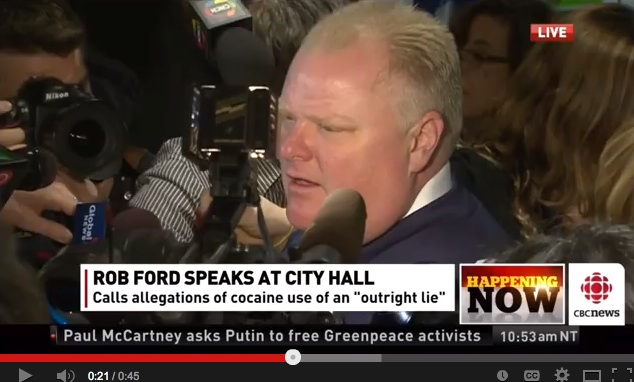
Media Training Advice to Toronto Mayor Rob Ford

By Gerard Braud

Toronto Media Training BraudWhen media training a candidate, politician, or elected official, one of the hardest things to teach them is when to shut up.

In every media training class I impart this expert advice to the trainee: “When you are digging a hole for yourself, put down the shovel.”

Media Training BackhoeToronto May Rob Ford has likely never heard this from his media trainer. One must ask, has Rob Ford ever had media training? Instead of putting down the shovel he has brought in a backhoe.

As repulsive as you may find Rob Ford’s latest quote, I’m going to give it to you here just to show what an amazing failure this guy is every time he is questioned by reporters. You can watch the video for yourself.

“Oliver Gondek says that I want to eat her pussy and Oliver Gondek, I’ve never said that in my life to her. I would never do that. I’m happily married. I’ve got more than enough to eat at home,” said Toronto Mayor Rob Ford.

From Vancouver to Toronto, Canadians have dominated the news for the past two weeks for saying things to the media that they should not say. Each time, they make the situation worse with a poorly executed apology. We saw that last week with Lululemon Founder Chip Wilson and now with Toronto Mayor Rob Ford.

Each case, the spokesman created their own crisis by what they said. Dare I say the United States media has not covered this much news from Canada in my lifetime?

Admittedly it is difficult to media train certain people with certain personality types. Certain rich or powerful people are arrogant enough, or over confident enough, that their inflated egos preclude them from seeking expert advice and expert coaching in order to improve their skills in many areas, including talking to the media.

Oh! Canada!

Media Training Jon StewartIf after this you need to have a good laugh, watch John Stewart’s coverage of this story on The Daily Show.


Navigate the Waters of Reputational Repair: 5 Steps to Effective Crisis Communications Planning

By Gerard Braud Navigating the waters of a crisis requires a good crisis communication plan before the waters ever begin to rise. Clear sunny day planning, long before your darkest day, is the secretBy Gerard Braud

DSC_0076Navigating the waters of a crisis requires a good crisis communication plan before the waters ever begin to rise. Clear sunny day planning, long before your darkest day, is the secret. In today’s social media filled world, this has never been more true.

Sadly, in our social media world some public relations people expect to Tweet their way out of a crisis or repair damage using Facebook. Neither is true. While “shiny and new” social media can be part of an effect communications strategy, you must first have the foundation of tried and true media relations, crisis communications, employee communications and stakeholder communications.

(Hear from Gerard in person during this special free webinar on November 20, 2013 1:00 p.m. EST)
Want to know the secret ingredients? Read on…

Here is a sure fire 5 step approach that must be your foundation.

Step 1: Vulnerability assessment

Before “it” hits the fan, you have to identify everything that could go wrong, including potential sudden crises and smoldering crises. Hire a facilitator to take your organization through the process of a deep examination of the things that could go wrong that would damage the reputation and revenues of the company.

Step 2: Write your pre-written news releases, web posts, and e-mails

Perhaps you’ve heard the expression, “when you are up to your ass in alligators it is hard to think about draining the swamp.” This applies to crisis communications. One of the biggest mistakes public relations people make is that as the crisis is unfolding, they open a blank document on their computer and start writing a news release, which then goes through hours of unnecessary re-writes before it is release. Consider this: on a clear sunny day you should write as many of these potential news releases as possible, leaving blanks that you’ll fill in when you know the details of the actual event. These documents can be pre-approved by leaders, speeding up your ability to release them to the public. I’ve facilitated many crisis communication writing retreats that produced more than 150 pre-written news releases in one day. That kind of productivity rocks!

Step 3: Write your crisis communications plan

Very few documents that public relations people refer to as a crisis communication plan would pass my test for what a plan should be. Most are worthless 6 to 12 page documents that state standard operating procedure and serve absolutely no purpose on the day of your crisis. Yet to be fair, this is what most PR people were taught in school or at some PR seminar. Frustrated by what I kept finding, I invented something new.

My approach is to write a document that is intended to be read and followed during the crisis. It dictates specific, sequential tasks in a very fast moving time frame. It captures all of the perfect behaviors of the most senior communicator, yet is so easy to follow than any one who can read can execute the plan flawlessly. I’ve invested about 2,500 hours of development in my base plan, which is about 50 pages long, which I am now able to customize for my clients during a single afternoon workshop.

Step 4: Annual media training for a crisis

Despite all of the buzz about social media, holding a live news conference within both the first and second hour of a crisis is vital if the media are standing at your door. Many organizations damage their revenues and reputations when untrained spokespeople say dumb things during a crisis.

It is important for every potential spokesperson to recognize that media training is not a bucket list item that you do once in life. Talking to the media is a skill that requires regular practice. I recommend media training for all spokespeople at least once a year, with an expert coach. Then, before every media interview, in-house staff should do a fast refresher course.

Think of it this way – the best athletes achieve great success because they practice often and partner with a great coach. Great spokespeople practice often and partner with a great coach, protecting their reputation and revenues through what they say, and just importantly, what they don’t say.

Step 5: An annual crisis communications drill

Realistic crisis communications drills are the best way to test your communications team and the decision making process of your leaders. A drill once a year allows colleagues to establish trust and good working relationships. A crisis drill allows ample time for leaders to pause and discuss decisions they must make during a real crisis. This helps them avoid decision paralysis during a crisis.

Your crisis communications drill should include at least two mock news conferences during the drill. Hire mock media and never use real media. Your facilitator must write a complicated, yet realistic scenario. It must include a likely crisis, plus all of the social media, employee and media buzz that would surround a real crisis. The facilitator should also hire a team of people to flood your phone lines with constant calls, replicating the calls you would receive from media, customers, and concerned citizens in a real crisis.

Conclusion

All of this takes time. None of it is easy or fast. But, it is much easier to prepare on a clear sunny day than to struggle and fail on your darkest day. Your reputation and revenues depend upon it.

About the author: Gerard Braud (Jared Bro) has helped leaders and organizations on 5 continents write their crisis communications plans, using his one-of-a-kind writing retreat that completes one years worth of work in 2 days. He is regarded as an expert in media training and crisis communications plans and is the author of Don’t Talk to the Media Until… 29 Secrets You Need to Know Before You Open Your Mouth to a Reporter. Contact him at www.braudcommunications.com or gerard@braudcommunications.com